






Definition & Meaning of the PHS 398 Training Budget Form
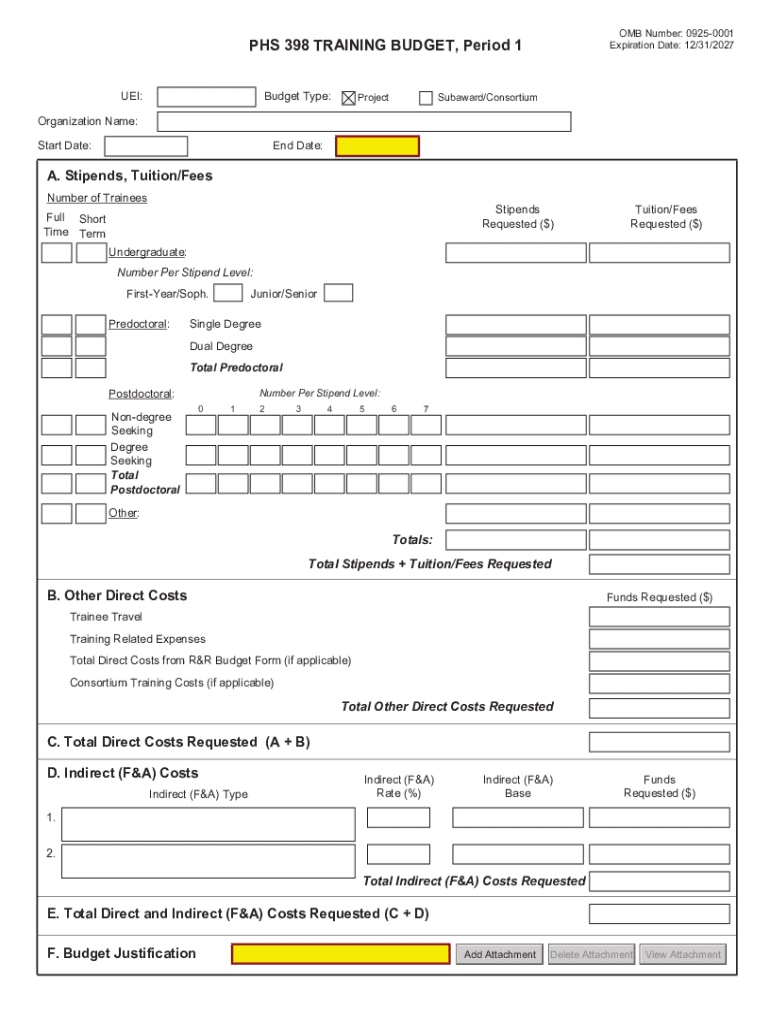
The PHS 398 Training Budget Form is a financial documentation tool used predominantly within U.S. academic and research institutions. It is pivotal for detailing the budgets associated with training grants funded by the Public Health Service (PHS). The form captures extensive budgetary information covering various categories such as stipends, tuition fees, travel expenses, and other related costs. Understanding this form is essential for institutions applying for PHS training grants to ensure compliance and accurate financial reporting.
Key Elements of the PHS 398 Training Budget Form
The PHS 398 Training Budget Form is divided into several sections that capture all necessary financial details:
- Stipends: Includes budget estimates for stipends allocated to trainees. The calculation should factor in the level of education or experience and the number of trainees.
- Tuition and Fees: Reflects the total tuition and fee expenses for each trainee. This includes any differential costs for in-state versus out-of-state tuition.
- Trainee Travel Expenses: Covers anticipated travel costs for trainees to attend requisite conferences or workshops.
- Training-Related Expenses: Additional costs essential for the training program, such as materials, supplies, or specialized equipment.
- Total Direct and Indirect Costs: Summarizes direct costs and includes indirect costs (F&A), offering transparency on how funds are utilized.
How to Use the PHS 398 Training Budget Form
To effectively use the PHS 398 Training Budget Form, follow these steps:
- Gather Required Financial Information: Collect data on all prospective expenses, including salary stipends, tuition fees, travel, and training-related expenses.
- Consult Relevant Guidelines: Review the National Institutes of Health (NIH) guidelines for the correct preparation of the form.
- Complete Each Section: Fill out each relevant section meticulously. Ensure all cost estimations are as accurate as possible to reflect reality.
- Review and Double-check Entries: Before submission, review all entries for accuracy, consistency, and alignment with stated guidelines.
- Submit: Once completed, submit the form through the appropriate submission portal or method required by the NIH or relevant grant-giving body.
Steps to Complete the PHS 398 Training Budget Form
Completing the PHS 398 Training Budget Form involves several methodical steps to ensure precision and compliance:
- Input Basic Information: Begin by inputting basic information such as the grantee institution's name and federal-wide assurance number.
- Detail Stipends and Tuition Fees: Allocate and record the appropriate stipend levels and tuition fees, ensuring they match those authorized by funding agencies.
- Estimate Travel and Other Costs: Provide estimates for travel and any other associated costs, accurately reflecting anticipated expenditures.
- Compile Justifications: Clearly outline justifications for each significant expense to provide context and rationale for budget allocations.
- Verification and Submission: Double-check all entries for errors or inconsistencies and submit the completed form via the specified submission methods.
Important Terms Related to the PHS 398 Training Budget Form
Understanding key terminology is crucial when dealing with the PHS 398 Training Budget Form:
- Direct Costs: Expenses directly attributable to the training program, such as salaries and supplies.
- Indirect Costs: Also known as Facilities and Administrative (F&A) costs, these are incurred for common objectives, such as infrastructure and administrative support.
- FTE: Full-Time Equivalent, a unit that indicates the workload of an employed trainee.
Eligibility Criteria
Eligibility to use the PHS 398 Training Budget Form is typically restricted to institutions that meet certain criteria:
- Institutional Eligibility: Universities, nonprofits, and research institutions with accredited programs.
- Programmatic Eligibility: The institution must demonstrate a robust training program meeting federal requirements.
- Budget Adherence: Abide by NIH stipulations regarding budgetary constraints and allocations.


Legal Use of the PHS 398 Training Budget Form
The PHS 398 Training Budget Form must be used within a legal framework:
- Compliance with Federal Guidelines: All entries must adhere to federal regulations governing training grants.
- Transparency and Accuracy: Ensure all reported figures are transparent and accurately depict intended use.
- Legal Attestation: Institution officials must verify and approve the form, indicating all data is truthful and verifiable.
Form Submission Methods
While different methods may be available for submitting the PHS 398 Training Budget Form, the preferred approach is usually online:
- Electronic Submission: Use the NIH eRA Commons interface for electronic submissions, ensuring real-time processing and submission acknowledgment.
- Mail Submission: Some instances may still allow physical submissions. Ensure timely delivery and include all necessary attachments.
- In-Person Submission: Rarely used, but confirm with NIH if necessary to comply with emergencies or exceptional circumstances.
These guidelines ensure the comprehensive and compliant completion of the PHS 398 Training Budget Form, enabling institutions to secure necessary funding for training programs.