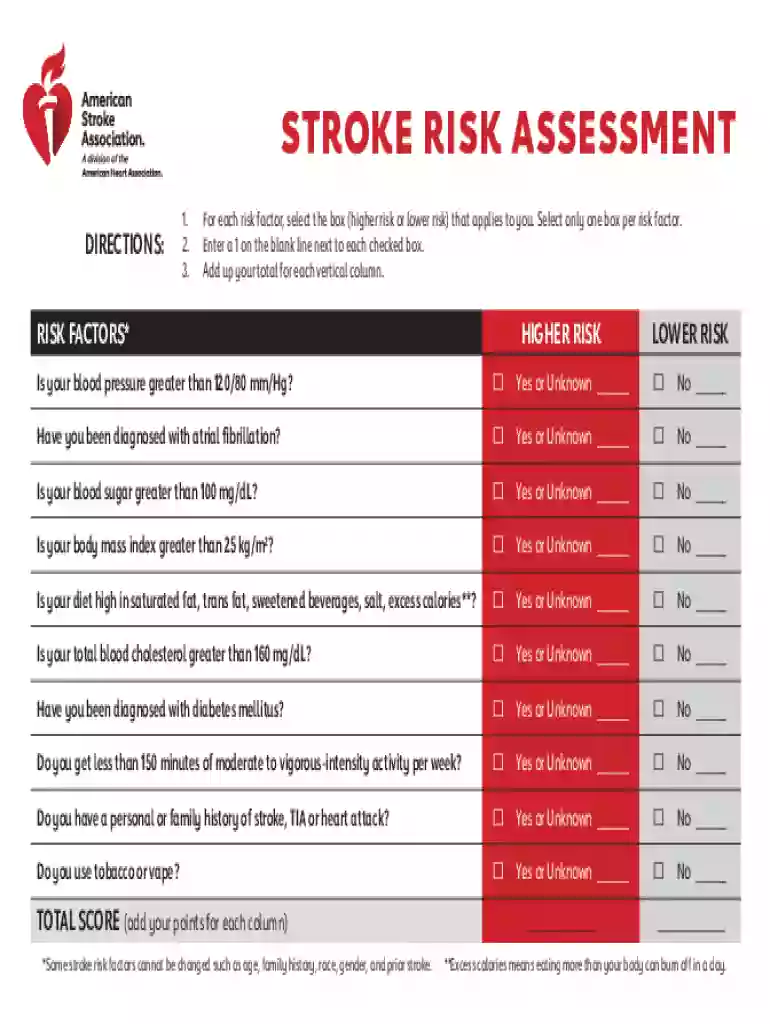
Stroke Risk Assessment 2026

Get Form
stroke risk assessment Preview on Page 1

Here's how it works

01. Edit your stroke risk assessment online
Type text, add images, blackout confidential details, add comments, highlights and more.

02. Sign it in a few clicks
Draw your signature, type it, upload its image, or use your mobile device as a signature pad.

03. Share your form with others
Send stroke risk assessment online via email, link, or fax. You can also download it, export it or print it out.

How to use or fill out Stroke Risk Assessment with our platform

Form edit decoration
9.5
Ease of Setup
DocHub User Ratings on G2
9.0
Ease of Use
DocHub User Ratings on G2
  1. Click ‘Get Form’ to open the Stroke Risk Assessment in the editor.
  2. Review each risk factor listed. For each one, select either the 'Higher Risk' or 'Lower Risk' box that applies to you. Remember, only select one box per risk factor.
  3. Next to each checked box, enter a '1' on the blank line provided. This will help you keep track of your risk factors.
  4. After completing all sections, add up your total for each vertical column to assess your overall stroke risk.
  5. Once completed, review your results. If you scored higher in the 'higher risk' column or are unsure about your risk, consider discussing it with a healthcare professional.

Start using our platform today for free and take control of your health with the Stroke Risk Assessment!

See more Stroke Risk Assessment versions

We've got more versions of the Stroke Risk Assessment form. Select the right Stroke Risk Assessment version from the list and start editing it straight away!
Versions Form popularity Fillable & printable
2022 4.7 Satisfied (26 Votes)
2003 4.8 Satisfied (49 Votes)
be ready to get more

Complete this form in 5 minutes or less

Get form

Got questions?

We have answers to the most popular questions from our customers. If you can't find an answer to your question, please contact us.
Contact us
The number 1 risk factor for stroke that you can affect is high blood pressure. High blood pressure often has no signs or symptoms, so its important to get your blood pressure checked by a doctor or nurse regularly.
A blockage of a blood vessel in the brain or neck, called an ischemic stroke, is the most frequent cause of stroke and is responsible for about 80 percent of strokes.
While there are no screening guidelines for stroke, an ASCVD risk score can help assess your 10-year risk of stroke and heart disease by looking at various factors. Additionally, a carotid ultrasound may help find the buildup of plaque in the carotid arteries, which can increase the risk of stroke.
The four common risk assessment tools are: risk matrix, decision tree, failure modes and effects analysis (FMEA), and bowtie model. Other risk assessment techniques include the what-if analysis, failure tree analysis, Layer of Protection Analysis (LOPA) and Hazard and Operability (HAZOP) analysis.
The ABCD2 Score is a risk assessment tool designed to improve the prediction of short-term stroke risk after a transient ischemic attack (TIA). The score is optimized to predict the risk of stroke within 2 days after a TIA, but also predicts stroke risk within 90 days.

Security and compliance

At DocHub, your data security is our priority. We follow HIPAA, SOC2, GDPR, and other standards, so you can work on your documents with confidence.

Learn more
ccpa2
pci-dss
gdpr-compliance
hipaa
soc-compliance