




01. Edit your form online
Type text, add images, blackout confidential details, add comments, highlights and more.

Type text, add images, blackout confidential details, add comments, highlights and more.

Draw your signature, type it, upload its image, or use your mobile device as a signature pad.

Send it via email, link, or fax. You can also download it, export it or print it out.
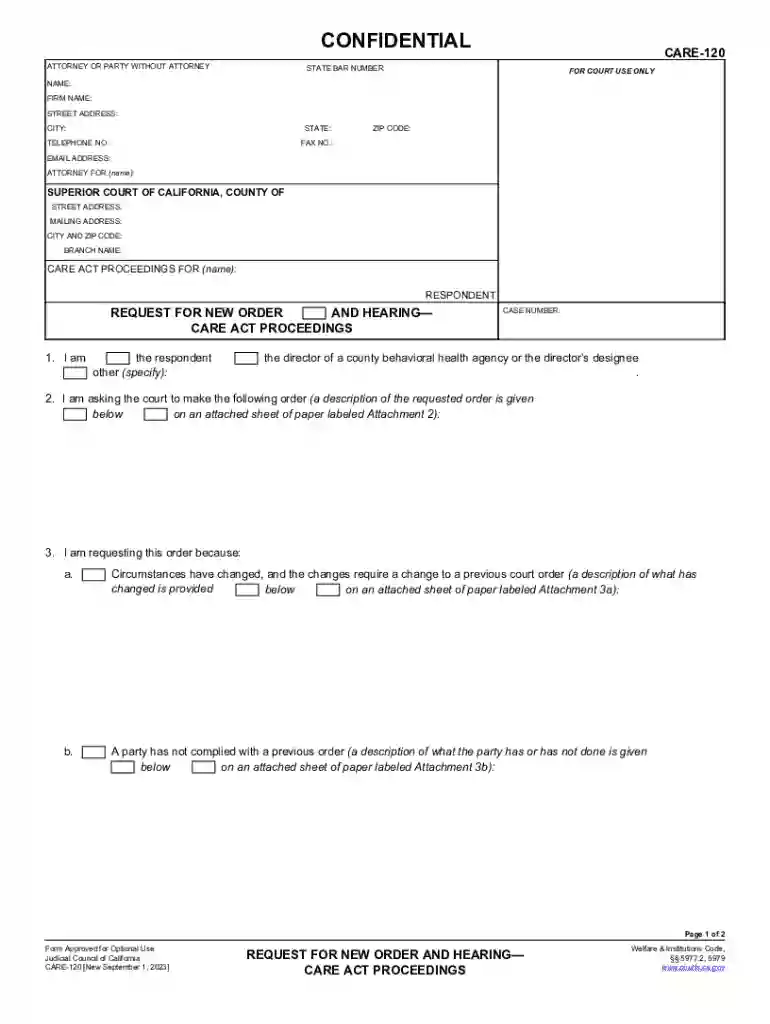
The "CARE-120 Request for New Order and HearingCARE Act Proceedings Judicial Council forms" is a legal form used in the Superior Court of California. The primary purpose of this document is to facilitate a request for a new court order within CARE Act proceedings due to changed circumstances or non-compliance with an existing order. This form is integral in allowing individuals or representatives, such as a county behavioral health agency director, to initiate changes within the judicial system to address and rectify issues effectively.
Using the CARE-120 form requires attention to detail and adherence to specific legal standards and guidelines. Below is a structured approach on how to effectively utilize this form.
Completing the CARE-120 form calls for detailed attention to each section and ensuring all prerequisites are met.
The CARE-120 form is employed by various individuals and entities involved in California court proceedings.


Understanding how the CARE-120 form fits within the legal context of California’s CARE Act proceedings is crucial for proper utilization and compliance.
While the CARE-120 form is used within California, its usage might vary due to different local court rules.
Exploring practical examples helps contextualize the use of the CARE-120 form.
Submitting the CARE-120 form can be done through several avenues, each offering different benefits.
Overall, using the CARE-120 Request for New Order and HearingCAR Act Proceedings form demands thorough preparation with consideration to the outlined processes, accurately reflecting the need for judicial intervention in the concerned matters.
At DocHub, your data security is our priority. We follow HIPAA, SOC2, GDPR, and other standards, so you can work on your documents with confidence.

Introduction. 5. Your hearing aid. 6. How to get your hearing aid readyfor use. 9. How to place the hearing aids in your ears. 13. How to remove the hearing
Audiologists offer services to identify individuals with hearing difficulties; determine the cause of hearing loss; assess hearing needs; treat needs using
I am requesting this order because: a. Circumstances have changed, and the changes require a change to a previous court order (a description of what has.


