






Key Elements of the Two Parties Legal Contract Template
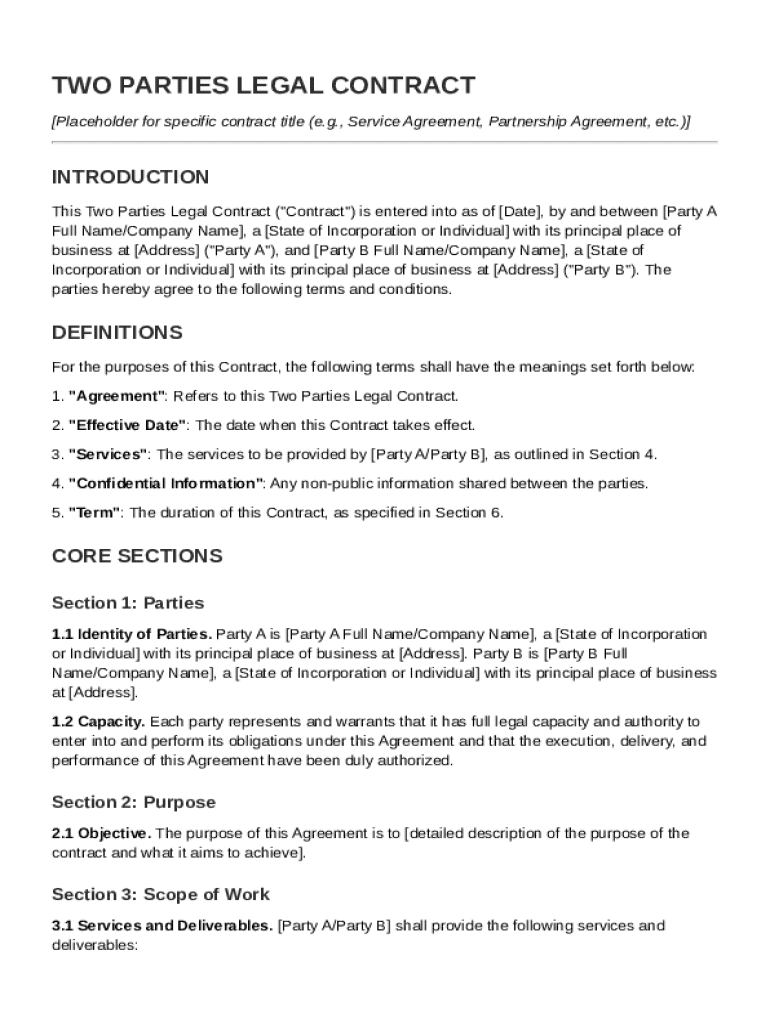
A Two Parties Legal Contract Template is essential for formalizing agreements between two entities. This document covers several critical elements necessary for clarity and enforceability:
-
Identities of the Parties: Clearly identifies Party A and Party B, detailing their full legal names and any relevant identifiers. This is crucial for precisely outlining the roles and responsibilities of each party.
-
Scope of Work: Defines the purpose and scope of the agreement. It outlines what each party is expected to perform or deliver, ensuring both parties have aligned expectations.
-
Payment Terms: Specifies the financial obligations, including payment amounts, schedules, and methods. This section is vital for avoiding disputes over payment timelines or amounts.
-
Confidentiality Obligations: Establishes protocols for handling sensitive information. This can include non-disclosure agreements (NDAs) to protect proprietary information shared during the contract's duration.
-
Duration and Termination Conditions: Details the contract's validity period and any conditions under which it can be terminated. This section ensures both parties understand the contract's timeline and the process for ending the agreement if necessary.
-
Liability Limits: Sets the parameters for liability, specifying what actions or damages each party is responsible for, and the extent of that responsibility. Defining these limits helps mitigate potential legal risks.
-
Governing Law and Dispute Resolution: Identifies which jurisdiction's laws will govern the contract and the procedure for resolving disputes. This section is crucial for preemptively managing potential conflicts.
-
Miscellaneous Provisions: Covers any additional clauses needed for the specific arrangement, such as intellectual property rights or force majeure.
How to Use the Two Parties Legal Contract Template
Utilizing a Two Parties Legal Contract Template involves understanding and customizing it to fit specific agreements:
-
Download the Template: Obtain a downloadable template from a trusted legal template provider such as DocHub.
-
Review the Sections: Examine each section to ensure it accurately reflects the intended agreement. Consider any additional clauses that might be required for the specific context.
-
Customizing Party Information: Input the correct legal names and detailed contact information for both parties. This step is essential to ensure all parties are identifiable and accountable.
-
Define the Specifics: Customize the scope, payment terms, confidentiality clauses, and other sections to reflect the exact terms agreed upon by both parties.
-
Consult Legal Advice: Although templates are a good starting point, seek professional legal advice to ensure the contract meets all legal requirements and fully protects both parties' interests.
-
Finalize: Once both parties agree on the terms, finalize the contract. When using platforms like DocHub, secure electronic signatures can be applied to authenticate the document.
Legal Use of the Two Parties Legal Contract Template
Employing this contract template under legal frameworks ensures it is legally binding:
-
Validity: For a contract to be legally binding, it must include mutual consent, a lawful purpose, and consideration. Ensure these elements are clearly stated within the document.
-
Compliance: Check that the contract complies with relevant federal and state laws applicable to the agreement. Non-compliance can render a contract void.
-
Enforceability: The template should facilitate enforceability in the event of a breach. Clarity in clauses about remedies and resolution paths is vital for upholding the contract.
Steps to Complete the Two Parties Legal Contract Template
Completing the template requires a methodical approach to ensure accuracy and comprehensiveness:
-
Identify Parties and Assign Roles: Clearly state the identities of both parties involved, including roles and responsibilities.
-
Describe the Agreement Scope: Outline the activities included under the agreement, ensuring both parties have a mutual understanding.
-
Outline Payment Structures: Define payment terms meticulously, including amounts, due dates, and methods of transaction.
-
Draft Additional Provisions: Include any relevant clauses such as confidentiality, liability limits, etc., to fit the contractual needs.
-
Verification: Review the complete document to ensure all sections are filled accurately and completely.
-
Execute the Agreement: Obtain signatures from both parties. Using DocHub, signatures can be seamlessly added via digital means.
State-Specific Rules for the Two Parties Legal Contract Template
Contracts can vary significantly by state due to different local laws and regulations:
-
Jurisdiction Variances: Certain states may have specific requirements for contracts, like needing them to be notarized or witnessed.
-
Enforceability: Some state laws prioritize specific aspects, like how liabilities are limited or how disputes are resolved.
-
Adaptations: When operating in multiple states, it may be necessary to adapt contracts to reflect each jurisdiction’s laws while maintaining the core agreement structure.
Examples of Using the Two Parties Legal Contract Template
Practical applications of the Two Parties Legal Contract Template:
-
Vendor Agreements: Used when contracting third-party suppliers to deliver products or services, specifying the deliverables and timelines.
-
Freelance Contracts: Engages independent contractors for projects, clearly outlining the expectations, deadlines, and payment structures.
-
Consulting Services: Establishes clear terms with consulting firms, including detailed scope and objectives to meet agreed-upon results.
Who Typically Uses the Two Parties Legal Contract Template
Various entities find this template beneficial:
-
Businesses and Corporations: For formalizing relationships with partners, vendors, or service providers.
-
Freelancers and Consultants: Protects their work agreements and ensures clear terms and payment procedures.
-
Non-Profit Entities: Utilizes the template to manage partnerships with donors, service providers, or event hosts.
-
Legal Professionals: Leverage these templates to streamline the drafting process for clients needing simple yet effective contracts.


Why You Should Use the Two Parties Legal Contract Template
Using a structured contract template provides several advantages:
-
Clarity and Security: Clearly outlined terms protect both parties from misunderstandings or disputes.
-
Efficiency: Time-saving by providing a ready-to-use framework that just requires customization.
-
Risk Management: By covering fundamentals like liability and confidentiality, parties can mitigate future legal risks.
-
Legally Binding: When correctly completed and executed, it provides enforceability in disputes, safeguarding involved parties.
Engaging this template provides a foundation for constructing secure and effective agreements, applicable across various sectors while catering to both simple and complex contractual needs.