
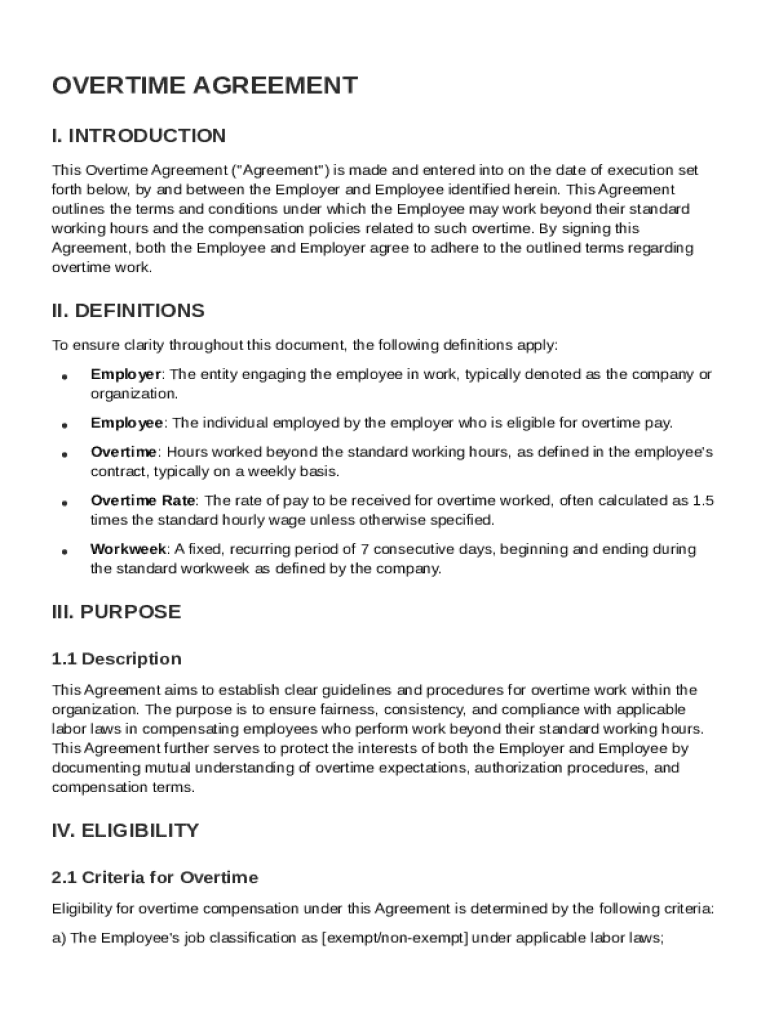







Definition & Meaning
An Overtime Agreement Template is a structured document that outlines the terms and conditions under which employees may work beyond their standard hours. This agreement serves multiple purposes, including defining key terms such as "overtime" and "standard hours", establishing eligibility criteria for different employee categories, and detailing the processes for approval and documentation of overtime work. It's essential for promoting transparency and understanding between employers and employees to prevent disputes and ensure fair compensation practices.
In addition, the template serves as a foundation for ensuring compliance with federal and state labor laws, thereby protecting the interests of both parties. By clearly stating the compensation rates and limitations on overtime hours, it mitigates potential legal issues and ensures that overtime work is conducted ethically and legally.
Key Elements of the Overtime Agreement Template
The Overtime Agreement Template includes several critical elements that provide a comprehensive framework for managing overtime work. The primary components are:
-
Eligibility Criteria: This section specifies which categories of employees are eligible for overtime compensation, often considering factors such as employment status (full-time, part-time, or temporary) and job classification.
-
Approval Processes: Detailed processes for obtaining approval for overtime are outlined, which can include requirements for requesting permission from supervisors and documenting the necessity for extra hours.
-
Compensation Rates: Clear definitions of the rates at which overtime will be compensated. This often includes time-and-a-half or double-time rates and any variations that may apply on weekends or public holidays.
-
Limitations on Overtime Hours: To prevent employee burnout and ensure adherence to labor regulations, the template outlines maximum allowable overtime hours within a specific period, such as a week or month.
-
Legal Compliance Provisions: Includes provisions to ensure the agreement aligns with relevant federal and state labor laws to protect both the employer and employee from legal repercussions.
How to Use the Overtime Agreement Template
Utilizing the Overtime Agreement Template effectively requires a systematic approach:
-
Customization: Adapt the template to fit the specific needs of your organization and comply with relevant labor laws. This may involve tailoring sections like eligibility criteria or compensation rates based on your industry standards.
-
Review and Approval: Have the template reviewed by HR or legal professionals to ensure that it is comprehensive and compliant with current laws and regulations.
-
Employee Briefing: Conduct informational sessions or provide detailed written explanations to employees to familiarize them with the terms of the agreement and ensure they understand their rights and responsibilities.
-
Implementation: Integrate the agreement into your organizational policies. Regularly update it to reflect any changes in legislation or company policy.
-
Documentation: Maintain thorough records of all executed agreements and any overtime approvals for future reference and compliance audits.
Legal Use of the Overtime Agreement Template
The legal use of the Overtime Agreement Template involves ensuring that it fully complies with the Fair Labor Standards Act (FLSA) and any applicable state labor laws. Important legal considerations include:
-
Adherence to State Regulations: Since labor laws can vary significantly from state to state, it's crucial to modify the template to comply with specific state requirements regarding overtime pay and employee eligibility.
-
Legally Binding Terms: Ensure that the agreement's terms are clearly defined and understood by both parties to make it legally enforceable. Language in the agreement should be unambiguous and consistent with legal standards.
-
Employee Consent: The template must include sections where employees can acknowledge their understanding and consent to the terms explicitly, usually by means of a signature.
State-Specific Rules for the Overtime Agreement Template
State-specific laws can significantly affect the implementation of overtime agreements. Key considerations include:
-
Overtime Calculation: Some states have laws that require overtime pay to be calculated differently than the federal standard, particularly concerning multiple hourly rates.
-
Exemptions and Exceptions: Various states have exemptions for certain job roles or industries, so it's important to identify any employees who may fall under these categories.
-
Maximum Hour Limitations: State laws may also impose stricter limitations on the number of overtime hours employees can work without additional clearance or compensation incentives.
Steps to Complete the Overtime Agreement Template
Completing the Overtime Agreement Template involves several steps:
-
Gathering Necessary Information: Collect information related to standard work hours, current pay rates, and previous overtime data for benchmarking.
-
Template Customization: Tailor the document to reflect your company’s policies, state laws, and any industry-specific requirements.
-
Employee Input: Involve employee representatives in the drafting stage to ensure that the agreement is fair and considers the workforce's perspectives.
-
Thorough Review: Have HR and legal teams review the document to ensure accuracy and compliance.
-
Signing by All Parties: Ensure that both employee and employer sign and date the document to formalize the agreement.
-
Distribution and Storage: Distribute copies to all relevant parties and store original documents securely for future reference.
Important Terms Related to Overtime Agreement Template
Understanding certain key terms is crucial to contextualizing the Overtime Agreement Template:
-
Standard Work Hours: The regular working hours an employee is scheduled to work without eligibility for overtime compensation.
-
Overtime Pay Rate: The rate at which overtime hours are compensated, often 1.5 or 2 times the employee's standard pay rate.
-
Exempt/Non-Exempt Employees: Classifications under the FLSA that determine eligibility for overtime pay, with exempt employees typically ineligible due to the nature of their job duties.
-
FLSA: The Fair Labor Standards Act, which sets federal standards for minimum wage, overtime pay, recordkeeping, and youth employment.
-
Compensatory Time: A practice some employers use in lieu of paying overtime, where employees accrue time off for hours worked beyond their standard schedule.
Who Typically Uses the Overtime Agreement Template
The Overtime Agreement Template is used by a variety of stakeholders across different levels of an organization:
-
Human Resources Departments: Use the template to ensure compliant processing of employee overtime while safeguarding the organization against potential disputes and violations.
-
Managers and Supervisors: Apply the terms laid out in the template to manage department workloads and approve overtime work as needed.
-
Employees: Reference the agreement to understand their entitlements and responsibilities when working overtime, ensuring they receive appropriate compensation.
-
Legal Advisors: Assist in drafting and reviewing the template to ensure it aligns with labor laws and is legally robust.


Examples of Using the Overtime Agreement Template
Real-world scenarios illustrate the application of the Overtime Agreement Template:
-
Manufacturing Industry: A factory implements the template to manage seasonal overtime effectively, ensuring all workers understand the pay rates and limits on additional hours.
-
Corporate Environment: An IT firm uses the agreement to structure flexible working hours while preventing employee burnout by clearly defining the terms of compensatory time.
-
Healthcare Sector: A hospital adapts the template to manage unpredictable overtime due to patient care demands, making sure staff are adequately compensated for additional shifts.




