




01. Edit your form online
Type text, add images, blackout confidential details, add comments, highlights and more.

Type text, add images, blackout confidential details, add comments, highlights and more.

Draw your signature, type it, upload its image, or use your mobile device as a signature pad.

Send it via email, link, or fax. You can also download it, export it or print it out.
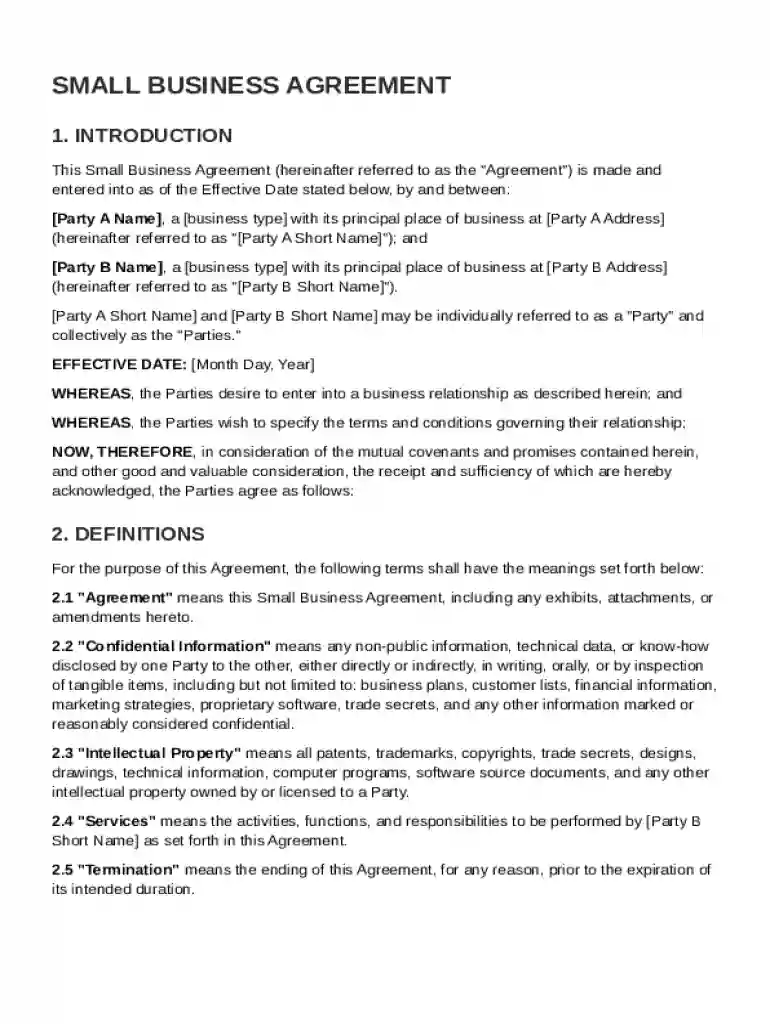
The Small Business Agreement Template is a legally binding document that outlines the terms and conditions of a business relationship between two parties. This agreement is crucial for small businesses as it acts as a safeguard for both parties, detailing roles, responsibilities, and expectations. It covers essential aspects such as the definition of services provided, compensation structures, confidentiality clauses, intellectual property rights, warranties, and liability limitations. The document also outlines dispute resolution procedures in the event of disagreements, ensuring a clear framework for service delivery, payment terms, and obligations upon termination.
Utilizing the Small Business Agreement Template involves a few straightforward steps. Primarily, both parties should review the template to ensure it comprehensively covers all aspects of their business relationship. Users can edit sections to suit specific agreements, such as adjusting the scope of services or modifying compensation terms. The template's flexibility allows for detailed customization, ensuring that unique business needs are met. Once completed, the agreement should be thoroughly reviewed by both parties, possibly with the assistance of legal counsel to ensure compliance with local regulations. Finally, both parties should sign the document to formalize the agreement, ensuring all modifications are equally agreed upon.
The template comprises several critical components designed to protect both parties' interests. These include:
Completing the template requires meticulous attention to detail to ensure all sections are appropriately filled:
Understanding the terminology used within the template is crucial:
The template is primarily used by small business owners, freelancers, and consultants who require a formal contract to establish a legal framework for their business dealings. It is especially beneficial for individuals entering into new business partnerships or offering professional services where clearly defined terms are necessary. This template is versatile and applicable across various industries, including technology, marketing, and consulting, providing a standardized way to document and protect business relationships.


The Small Business Agreement Template serves critical legal functions by ensuring any business relationship is bound by enforceable terms. This legal documentation minimizes the risk of disputes and provides a reference point should misunderstandings arise. By addressing key legal components such as dispute resolution processes and intellectual property rights, the agreement helps protect businesses from potential legal pitfalls. Moreover, it ensures compliance with laws governing business agreements in the United States, making it a valuable tool for maintaining legal integrity within a business transaction.
While the template provides a comprehensive starting point, users must consider state-specific variations in business law that can impact the agreement. Regulations concerning confidentiality clauses, intellectual property rights, and liability may differ from one state to another. It's essential for parties to understand the specific legal requirements in their state to ensure that the agreement is enforceable. Consulting with legal professionals familiar with state legislation can help tailor the template to meet local requirements and provide additional safeguards.
Real-world applications of the template highlight its practicality. For instance, a freelance web designer and a small business might use the agreement to outline deliverables, payment terms, and confidentiality obligations. In another scenario, a marketing consultant could use it to formalize an arrangement with a client, specifying metrics for performance and the length of the service. These examples illustrate the template’s adaptability to various contexts, facilitating seamless and legally sound business interactions.
At DocHub, your data security is our priority. We follow HIPAA, SOC2, GDPR, and other standards, so you can work on your documents with confidence.



A new plan must be obtained and approved 30 days prior to the expiration of the current plan. The contractor must provide a copy of the approved plan to each
Contract Templates. Services Agreements Interagency Cooperation Contracts Interlocal Cooperation Contracts Hotel Agreement Speaker Agreements
Nov 17, 2020 Source Company information as of Mar-20. Notes. 1. One combined agreement covering the TSA and LTA applicable for Greece.


