




01. Edit your form 7004 online
Type text, add images, blackout confidential details, add comments, highlights and more.

Type text, add images, blackout confidential details, add comments, highlights and more.

Draw your signature, type it, upload its image, or use your mobile device as a signature pad.

Send it via email, link, or fax. You can also download it, export it or print it out.
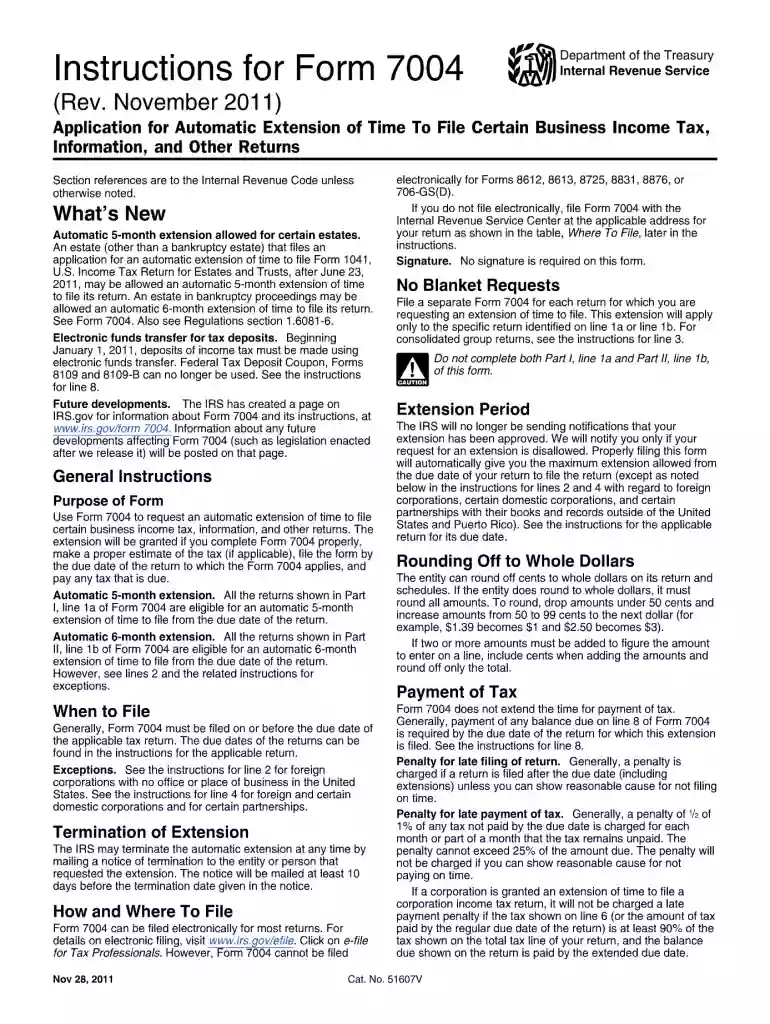
Form 7004 is utilized to request an automatic extension of time to file certain business income tax, information, and other returns. Primarily used by businesses, the form allows entities to seek either a five-month or six-month extension, depending on the type of return required. This form does not provide an extension of the time to pay any taxes due; it strictly pertains to the extension for filing. The form is typically filled by C corporations, S corporations, partnerships, and certain trusts.
Using Form 7004 involves several steps to ensure completeness and correctness. Businesses must first determine their eligibility for filing this form based on their entity type and the specific tax returns requiring an extension. The next step is to complete the form with all necessary details, including the entity's identifying information, the type of return requiring an extension, and the estimated total tax liability for the year. Detailed sections on the form guide the user to specify the return type and calculate any balance due. It's crucial that the form is submitted by the original due date of the tax return to ensure that the extension request is timely and valid.
Gather Necessary Information: Collect tax information from accounting records, including the taxpayer identification number, the entity type, and estimated tax liabilities.
Determine Extension Duration: Check if your entity qualifies for a five-month or six-month extension based on its type and the return filed.
Fill in Entity Information: Include the name, address, and taxpayer identification number of the business at the top of the form.
Indicate Tax Return Type: Select which form you're requesting an extension for by marking the appropriate box on Form 7004.
Calculate Estimated Tax Liability: Enter calculations for estimated tax liabilities to understand what payment, if any, needs to accompany the form.
Submit the Form: Ensure submission by the deadline of the original return, either by mailing it to the appropriate IRS address or filing electronically, if available.
The filing deadline for Form 7004 depends on the original due date of the tax return being extended. Typically, it aligns with the due date of the returns, such as March 15 for calendar-year partnerships and S corporations or April 15 for C corporations and some other entities. It is crucial for taxpayers to submit Form 7004 on or before this payroll tax filing deadline to secure the requested extension. Missing the deadline may lead to penalties and interest on any unpaid tax liability.
Identifying Information: This section includes the business name, address, and taxpayer identification number.
Return Type Indicator: Here, you select for which return you are requesting a filing extension by checking the relevant box.
Estimated Tax Payments: Calculate the estimated tax liability and deduct any payments made to date to determine the balance due.
Signature Section: Although often overlooked, a signature may be required based on the filing method and form instructions.
Failing to file Form 7004 or submit it by the appropriate deadline can lead to penalties for late filing. Interest on any unpaid taxes also accrues from the original due date until the tax is paid in full. Notably, filing an extension does not extend the time to pay any owed taxes, so the taxpayer should consider full or partial payments accompanying the form to minimize penalties. Furthermore, inaccuracies in estimating the tax liability might also lead to potential repercussions or additional scrutiny from the IRS.
Small Business Corporation: A C corporation with a fiscal year ending on December 31 wishes to extend its annual return due on April 15. The corporation estimates its tax liability and files Form 7004 by the due date to extend filing until October 15.
Partnership: A partnership needing more time to gather and review financial documentation files Form 7004, securing a five-month extension from March 15 to September 15 for filing their Form 1065.
S Corporation: An S corporation faced with administrative delays files Form 7004 to extend its return filing deadline to ensure thorough review and accuracy of the financial summary.
Form 7004 extension requests are available to several business entities. These include C corporations, S corporations, partnerships, certain non-profits, and some estates and trusts. Eligibility requires that the entity is an active taxpayer, subject to the tax returns specified on the form, needing additional time to accurately complete their tax documents. While the extension grants more time to file, it remains the filer's responsibility to ensure tax payments are estimated and made accordingly by the original deadline to avoid penalties.


The IRS provides comprehensive instructions for Form 7004 to ensure businesses understand the requirements and benefits of filing. This includes details on which forms are eligible for an extension, how to calculate any estimated tax payments, and submission guidelines to ensure proper processing. The IRS also highlights that Form 7004 can be filed electronically, simplifying the submission process and ensuring faster acknowledgment. Businesses are advised to consult the IRS guidelines to confirm compliance and optimize the filing process securely and correctly.
We've got more versions of the form 7004 form. Select the right form 7004 version from the list and start editing it straight away!
At DocHub, your data security is our priority. We follow HIPAA, SOC2, GDPR, and other standards, so you can work on your documents with confidence.
Nov 28, 2011 No signature is required on this form. U.S. Income Tax Return for Estates and Trusts, after June 23,. 2011, may be allowed an automatic 5-monthRead more
Discover Junos revelations for easier, faster, higher-performance connectivity in this compendium of tips, tricks, and techniques gleaned from the JuniperRead more
Jun 30, 2012 Form 7004 to request an extension of time to file income tax returns. Type or print. File by the dus date for filing your return. See.Read more


