




01. Edit your form online
Type text, add images, blackout confidential details, add comments, highlights and more.

Type text, add images, blackout confidential details, add comments, highlights and more.

Draw your signature, type it, upload its image, or use your mobile device as a signature pad.

Send it via email, link, or fax. You can also download it, export it or print it out.
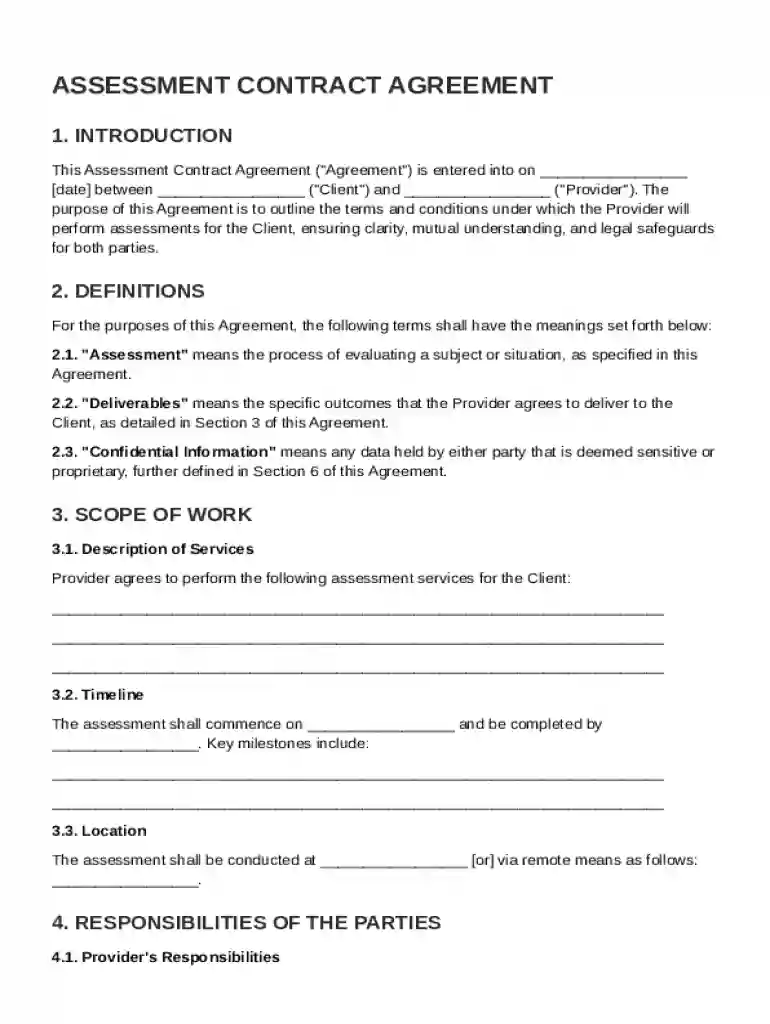
The Assessment Contract Template is a standardized document used to outline the terms and conditions between a client and a provider for conducting various assessments. This template is designed to ensure mutual understanding and legal protection for both parties involved. It covers essential elements like the scope of work, responsibilities, payment terms, and confidentiality obligations. This type of agreement is crucial for clearly defining each party's expectations, mitigating risks, and providing a framework for resolving disputes.
In practice, the Assessment Contract Template can be used in multiple scenarios. For instance, educational institutions may use this template to formalize agreements with third-party service providers for student assessments. Similarly, a company could implement this contract for hiring an external firm to evaluate its operational processes. In all cases, the document helps ensure that both parties understand the terms under which assessments will be conducted.
The template comprises several key components essential for a complete and enforceable agreement. Here are some core elements typically included:
Each of these elements contributes to a comprehensive and clear contract that reduces misunderstandings.
Completing the Assessment Contract Template involves several methodical steps to ensure accuracy and completeness:
While this is a generic step-by-step approach, different industries might have specific additions. For example, assessments related to financial consultancy might demand rigorous confidentiality provisions compared to academic assessments.
Ensuring the legal validity of the Assessment Contract Template is critical. The template should comply with the contractual laws of the jurisdiction in which it is executed.
Legal validity not only facilitates enforcement but also offers peace of mind to both parties.
Obtaining the Assessment Contract Template can be achieved through various methods:
With platforms like DocHub, users can seamlessly work with digital versions, offering convenience and integration with other digital tools such as Google Workspace. This contrasts with traditional paper versions, which necessitate physical handling and storage.
The Assessment Contract Template is primarily used by a diverse range of users, including:


Apart from these, specialized sectors, such as environmental or health assessments, also frequently rely on such templates to establish clear, legally binding agreements.
Comprehending significant terms related to the Assessment Contract Template is essential for effective use:
Understanding these terms helps in contextual communication, ensuring that both parties have aligned expectations. For instance, clearly defining "deliverables" helps prevent disputes regarding the adequacy of the assessment outcomes.
While the Assessment Contract Template provides a standard framework, consideration of state-specific regulations is necessary for tailoring it to local requirements:
To address these differences, consulting with a legal professional familiar with local contract law is often recommended, especially for contracts that will be executed in multiple states.
Comprehending state variations is crucial for crafting enforceable contracts that respect local legal landscapes.
At DocHub, your data security is our priority. We follow HIPAA, SOC2, GDPR, and other standards, so you can work on your documents with confidence.



Perf. Based - Contract must include adequate reporting, or requires documented delivery of work (deliverables) to ensure required performance is achieved.
Mar 24, 2022 A solid consulting agreement should include the nature of services, fee structure, duration, statement of work, terms and conditions, delivery


