
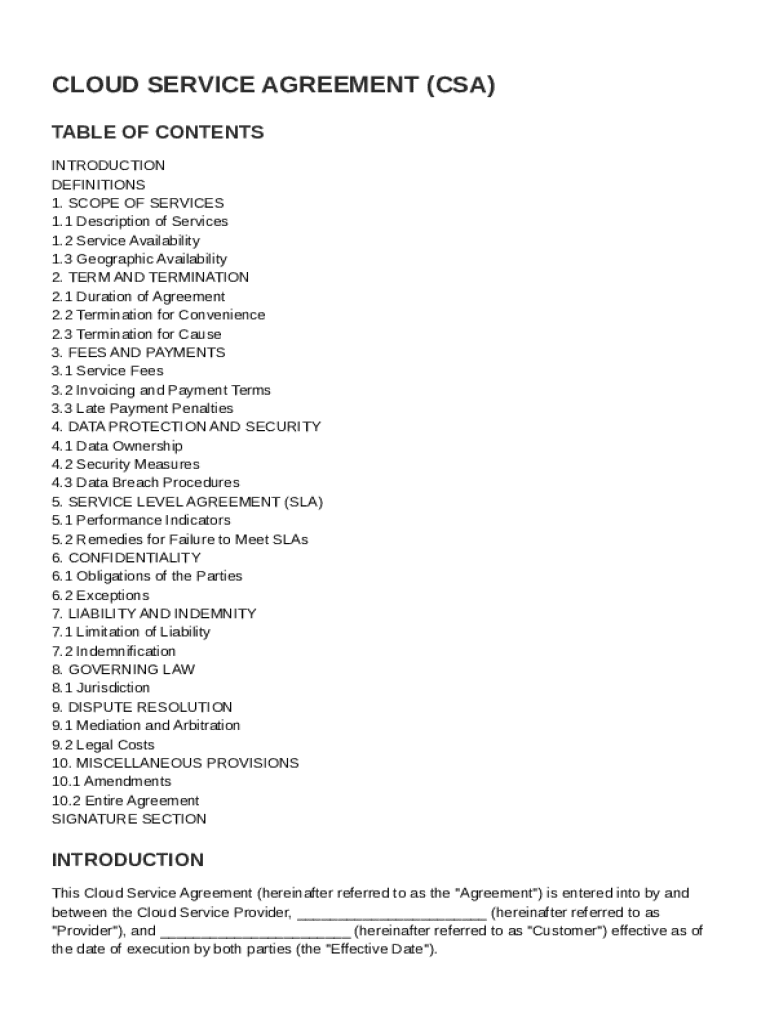







Key Elements of the Cloud Service Agreement Template
The Cloud Service Agreement Template is a comprehensive document that outlines the crucial terms and conditions between a Cloud Service Provider and a Customer. It includes several essential sections, each serving a specific purpose.
-
Scope of Services: This section details the specific services offered by the provider, including limitations and exclusions. It's the foundation for understanding what customers can expect from the cloud services in terms of features and capabilities.
-
Fees and Payments: This part outlines the structure for payments, including billing cycles, methods of payment, and consequences of late payments. It is integral for ensuring transparency in financial transactions between parties.
-
Data Protection: With data security being paramount, this section details how customer data will be protected. It covers encryption, access controls, and compliance with industry standards and regulations to reassure customers about the safety of their data.
-
Service Level Agreements (SLAs): This outlines the expected performance levels for services provided, including metrics for uptime, response times, and resolution times. It establishes accountability and performance benchmarks for the service provider.
-
Confidentiality and Liability: These clauses cover the obligations of both parties to maintain confidentiality of sensitive information, and outline conditions under which liability will be assigned for breaches or service failures.
-
Termination and Dispute Resolution: This part explains the procedures for terminating the agreement and resolving disputes that may arise. It ensures both parties understand the protocol for exiting the agreement and seeking remedies.
How to Use the Cloud Service Agreement Template
Utilizing the Cloud Service Agreement Template effectively involves several critical steps:
-
Review All Sections: Carefully read through each section to ensure all clauses are understood and align with business needs. This prevents future misunderstandings.
-
Customize as Needed: Modify specific parts of the agreement to suit the particular needs of your organization, ensuring it addresses all unique scenarios pertinent to your operations.
-
Consult Legal Counsel: Have a legal expert review the document to make sure it complies with local laws and regulations, offering protection and clarity.
-
Negotiate Terms: Engage with the cloud provider to discuss and finalize terms that may need to be adjusted, ensuring both parties are in agreement.
-
Finalize and Sign: Once both parties agree on terms, finalize the document, sign it, and retain copies for future reference.
Examples of Using the Cloud Service Agreement Template
Several scenarios illustrate the application of a Cloud Service Agreement Template across different industries.
-
Tech Startups: For gaining access to scalable computing resources to support app development, a startup would use the agreement to delineate resource availability and uptime guarantees.
-
Healthcare Providers: These organizations may focus on the data protection section to ensure compliance with healthcare data regulations, such as HIPAA.
-
E-commerce Platforms: Ensuring payment processes are secure and reliable could be a primary concern, thus necessitating a well-defined fees and payments section in their agreements.
Who Typically Uses the Cloud Service Agreement Template
This template is widely used across various sectors to formalize cloud service engagements.
-
IT Managers and CIOs: They frequently implement this agreement when onboarding new cloud services to ensure alignment with organizational IT strategies and policies.
-
Legal Teams: Legal professionals use these templates to establish clear terms and mitigate potential disputes or mismatches in expectations.
-
Procurement Departments: During the acquisition of IT services, procurement professionals rely on such agreements to negotiate favorable terms and ensure service reliability and performance.

State-Specific Rules for the Cloud Service Agreement Template
While the Cloud Service Agreement Template serves as a standard framework, certain state-specific regulations must be considered.
-
California: Compliance with the California Consumer Privacy Act (CCPA) is crucial, impacting data protection and confidentiality clauses within the agreement.
-
New York: New York's financial sector regulations may influence how service agreements are drafted, especially regarding data handling and security features.
-
Texas: In Texas, energy companies might include specific provisions addressing remote data access and operational continuity during emergency conditions.
Understanding these state-specific nuances is essential to ensure that agreements adhere to local legal frameworks, thereby avoiding compliance issues.
Legal Use of the Cloud Service Agreement Template
Ensuring legal compliance when utilizing a Cloud Service Agreement Template necessitates adherence to pertinent legal frameworks.
-
Intellectual Property Rights: Define how intellectual property is managed and protected, particularly when proprietary software is involved.
-
Data Residency Laws: Adhere to laws governing where data can be stored and processed, which can affect multinational operations.
-
Dispute Resolution Mechanisms: Include legally recognized methods for dispute resolution, such as arbitration or mediation, to streamline conflict resolution efficiently.
Important Terms Related to Cloud Service Agreement Template
Understanding the key terms within the Cloud Service Agreement Template enhances comprehension and proper application.
-
Service Level Objective (SLO): This term refers to the measurable performance standards agreed upon in the SLA.
-
Force Majeure: A clause that relieves parties from fulfilling contractual obligations due to events beyond their control, such as natural disasters.
-
Data Encryption: Refers to the process of encoding data to prevent unauthorized access, a critical component of data protection.
Familiarizing oneself with these and other terms within the agreement ensures users can navigate and execute the document with confidence.
Business Types That Benefit Most from Cloud Service Agreement Template
Certain business types see enhanced value from using Cloud Service Agreement Templates due to their inherent operational needs.
-
Small to Medium Enterprises (SMEs): These businesses often rely on cloud services for storage and software accessibility, making service agreements crucial for managing costs and performance expectations.
-
Enterprises with Remote Workforces: With employees distributed globally, these businesses use cloud agreements to ensure consistent service availability and data security across regions.
-
Evolving Tech Companies: Fast-growing tech companies leverage cloud agreements to manage scalability and integration needs as they expand their digital operations.
By understanding these varied applications, businesses can tailor their agreements to better align with organizational goals and industry standards.
Quick Facts
-
Customization: The agreement should be tailored to reflect specific service delivery and security requirements unique to each business.
-
Legally Binding: Proper execution of the agreement ensures it becomes a legally binding document between parties, providing legal recourse options.
-
Template Variability: There are numerous templates available that cater to different industries, regulatory environments, and service complexities.




