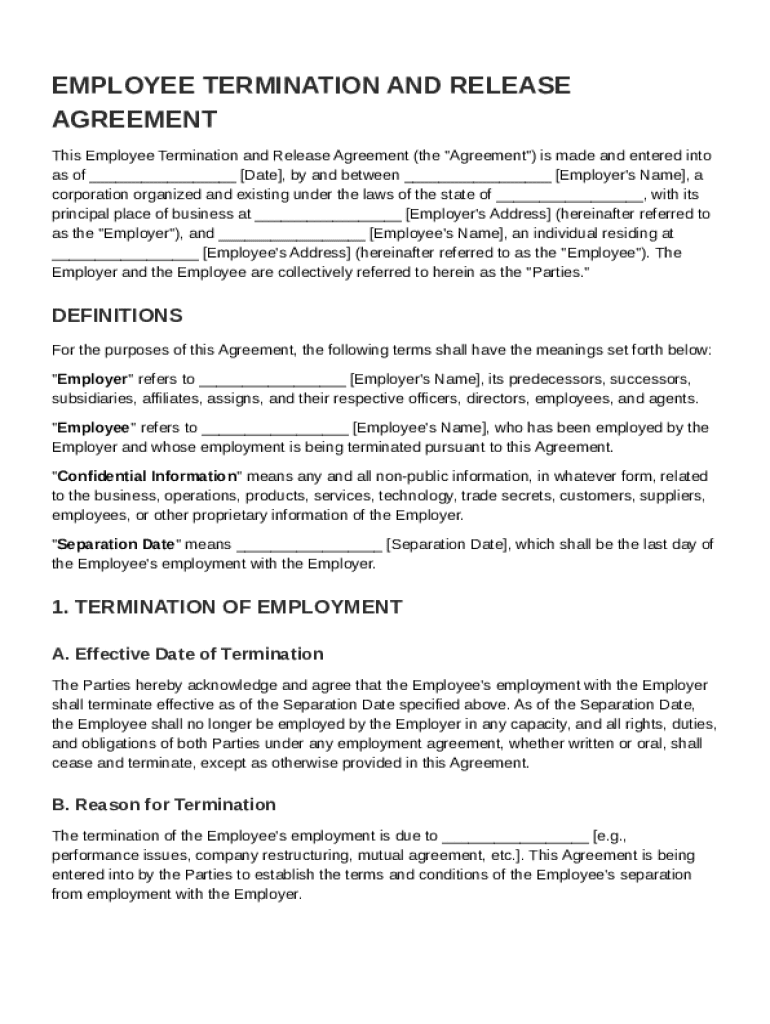







Definition of an Employee Termination and Release Agreement
An Employee Termination and Release Agreement, often used in employment separation contexts, formalizes the terms under which an employee leaves a company. This document serves to protect the interests of both the employer and the employee by detailing the rights and obligations post-termination. Typically, it includes clauses related to termination effective date, reasons for the separation, and details about severance pay or final compensation. Additionally, it involves a release of claims, which means the employee agrees not to pursue legal action against the employer for any issues related to their employment or its termination.
Components
- Effective Termination Date: Specifies the official date when the employment relationship ends.
- Severance and Final Compensation: Details any severance pay, final paychecks, or accumulated benefits owed to the employee.
- Release of Claims: The employee waives the right to any future claims against the employer, promoting a clean break.
- Non-Disparagement Clause: Prevents both parties from making negative comments about each other.
- Return of Company Property: Requires the employee to return all company property, such as equipment or documents.
- Confidentiality Requirements: Mandates the protection of company secrets and sensitive information.
How to Use the Employee Termination and Release Agreement Template
Utilizing the Employee Termination and Release Agreement Template requires careful attention to detail and a comprehensive understanding of the employment relationship being terminated. Here are the steps to effectively use the template:
- Review the Template Content: Begin by carefully reading the entire template to understand each section and its implications.
- Customize the Template: Adjust the template to suit the specific circumstances of the termination, including inserting relevant names, dates, and compensation details.
- Clarify Legal Terms: Ensure that all parties comprehend the legal terminology used in the document, potentially consulting a legal professional for clarification.
- Include Specific Clauses: Add any necessary clauses unique to the situation, such as those relating to proprietary information or ongoing projects.
- Double-check for Completeness: Verify that all sections have been completed and that the document reflects the agreed-upon terms of the termination.
Practical Examples
- Severance Negotiation: During collective layoffs, a company might use this template to uniformly handle severance negotiations, providing a consistent approach for all affected employees.
- Compliance with Local Laws: Adjust the template to align with state-specific regulatory requirements to ensure compliance and reduce legal risks.
Legal Use of the Employee Termination and Release Agreement
The legal framework for using an Employee Termination and Release Agreement is anchored in U.S. employment law, with a focus on ensuring fairness and mutual consent. This agreement holds legal weight when:
- It is Voluntary: Both parties agree to the terms without any form of coercion.
- Adequate Consideration is Provided: The employee receives something of value, such as severance pay, in exchange for agreeing to the terms.
- Clear Language is Used: The language must be explicit and easy to understand, leaving no ambiguities in obligations or rights.
Compliance
- ESIGN Act: Ensures that electronic signatures on the agreement are legally binding, offering a digital solution to physical signature requirements.
- State-specific Legislation: Adapt the agreement to comply with state-specific differences to avoid potential legal challenges.
Steps to Complete the Employee Termination and Release Agreement Template
Completing the Employee Termination and Release Agreement Template involves several precise steps to ensure legal compliance and full clarity. Here’s a guide:
- Prepare the Necessary Information: Gather all relevant employment details, including final pay calculations and pending benefits.
- Draft the Agreement: Use the template to create a draft agreement, populating sections with specific details pertinent to the termination.
- Review with HR and Legal Advisors: Ensure HR and legal teams review the draft for compliance with company policies and legal standards.
- Discuss with the Employee: Present the agreement to the employee, explaining each section thoroughly to ensure understanding.
- Final Revisions: Make any necessary adjustments based on employee feedback or legal advice, maintaining transparency throughout the process.
- Signatures and Execution: Obtain signatures from all parties involved, keeping a record of the signed agreement for future reference.
Key Elements of the Employee Termination and Release Agreement
A robust Employee Termination and Release Agreement contains several critical components that ensure adequacy and legality:
- Identification of Parties: Clearly identifies both the employer and employee involved in the agreement.
- Effective Date and Timelines: Demarcates when the agreement takes effect and outlines relevant timelines for fulfillment.
- Compensation Details: Provides explicit details about payment amounts, payment schedule, and any tax considerations.
- Non-Compete and Non-Disclosure Clauses: Addresses restrictions on future employment and protection of confidential information.
- Dispute Resolution Process: Sets out mechanisms for resolving any disagreements that might arise concerning the terms of the agreement.
State-Specific Rules for the Employee Termination and Release Agreement
State-specific regulations can influence how an Employee Termination and Release Agreement is structured. Here are examples of considerations based on U.S. state laws:
- California: Requires additional wording to comply with the state’s laws regarding severance packages and employee rights.
- Texas: Necessitates explicit language on non-compete clauses, ensuring that they are reasonable in scope and duration.
- New York: Mandates specific requirements for handling final wage payments as per state labor laws.
Potential Scenarios for Using the Employee Termination and Release Agreement Template
Different employment scenarios necessitate tailored use of an Employee Termination and Release Agreement. Below are examples of how it might be utilized:
- Redundancy Program: In cases of company restructuring or downsizing, formalizes severance packages and mitigates risks of future claims.
- Voluntary Resignation: Ensures clarity in terms of final settlements when an employee leaves voluntarily.
- Performance-based Termination: Outlines the basis for termination due to performance-related issues, protecting the employer from potential disputes.
Variations and Adjustments
- Customizing for Executive Roles: Adjust clauses to align with complex compensation structures typical at the executive level.
- Part-time vs. Full-time Employees: Differentiate terms based on employment status to ensure fair and equitable treatment.
Who Typically Uses the Employee Termination and Release Agreement Template
The Employee Termination and Release Agreement Template is a crucial tool for various stakeholders within an organization:
- Human Resources Professionals: Utilize the template to standardize termination procedures across the company.
- Legal Consultants: Provide advice on modifications to ensure compliance with employment laws and best practices.
- Business Owners: Employ the template to handle employee separations in a structured and legally defensible manner.


Usage in Different Industries
- Technology Sector: Often used for layoffs due to project completion or shifts in focus.
- Healthcare Industry: Applied in scenarios of role redundancy or regulatory non-compliance.
- Manufacturing Business: Used to address workforce adjustments due to market demand changes.
Important Terms Related to Employee Termination and Release Agreement
Understanding specific terminology used within the Employee Termination and Release Agreement is vital for interpreting its legal and operational implications:
- Severability: Ensures that if one part of the agreement is deemed unenforceable, the rest remains valid.
- Waiver: Acknowledges the employee's agreement to forego potential claims against the employer.
- Indemnity: Protects one party from legal claims or damages as a result of the other party's actions post-termination.
- Force Majeure: Covers extraordinary events that prevent fulfillment of the agreement terms, such as natural disasters.
Examples of Contextual Usage
- Waiver Specifics: Outlines any specific claims or potential legal actions that the employee agrees not to pursue.
- Indemnity Clauses: Details obligations relating to indemnification to mitigate risks for both parties involved.