




01. Edit your form online
Type text, add images, blackout confidential details, add comments, highlights and more.

Type text, add images, blackout confidential details, add comments, highlights and more.

Draw your signature, type it, upload its image, or use your mobile device as a signature pad.

Send it via email, link, or fax. You can also download it, export it or print it out.
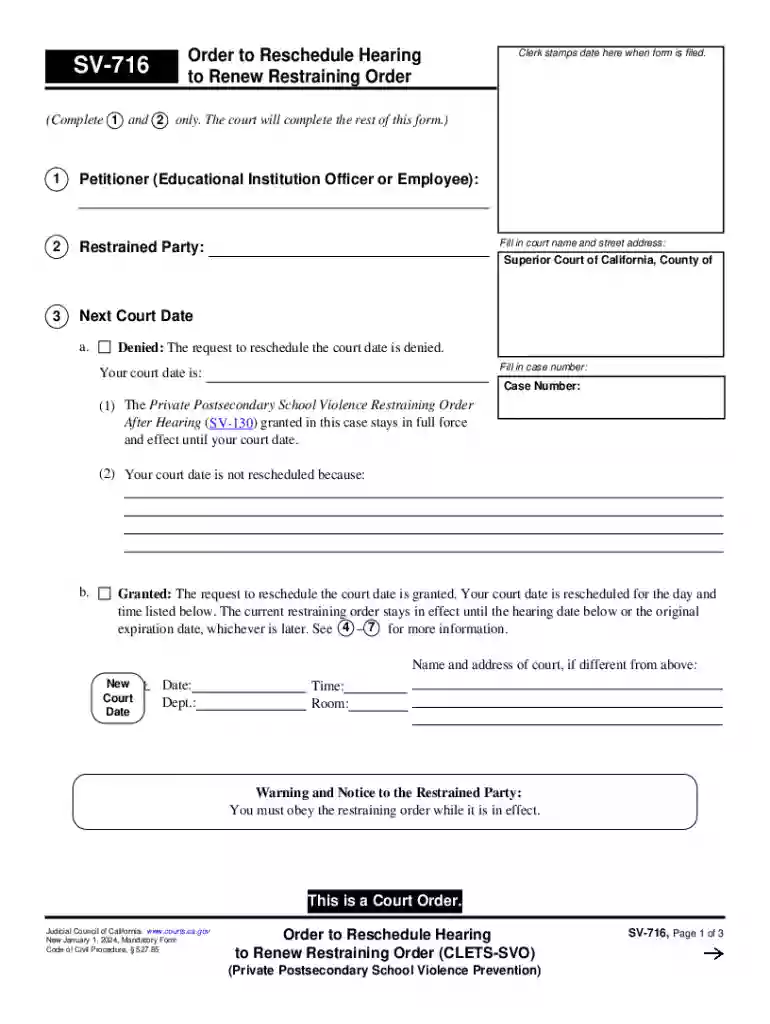
The SV-716 is an official court order used in rescheduling hearings related to the renewal of restraining orders concerning private postsecondary school violence. This document outlines the procedural framework for petitioners and restrained parties when a hearing needs to be rescheduled. It is crucial to understand that the existing restraining order remains in effect until the new court date. This ensures continued protection under the law while allowing for necessary adjustments in scheduling.
To effectively use the SV-716, both petitioners and restrained parties must adhere to specific guidelines outlined within the document. The primary purpose of the SV-716 is to request a change in the hearing date for renewing a restraining order. All relevant parties must follow the instructions provided to ensure compliance and legal validity. It's recommended that individuals consult with legal advisors to avoid missteps in the filing process.
Review the Existing Restraining Order: Before completing the SV-716, ensure you thoroughly understand the terms and timelines associated with the current restraining order.
Fill Out Personal Information: Include accurate personal and contact information for both the petitioner and the restrained party.
Specify the Hearing Details: Indicate the original court date and provide a valid reason for requesting a reschedule.
Submit the Form: After completing the form with all required information, submit it to the appropriate court office. Ensure that you follow any additional instructions specified by your jurisdiction.
Retain a Copy: Keep a copy of the completed form for personal records and future reference.
Certain elements are essential in completing the SV-716. These include:
Understanding the terminology associated with the SV-716 can aid in accurate completion and submission:
The SV-716 is used within a legal context to ensure fairness in hearing procedures related to restraining orders from violence at educational institutions. It helps maintain order by accommodating legitimate scheduling issues while respecting legal protection timelines. Ensure adherence to all instructions for the document's legal acceptance and effectiveness.
While the SV-716 serves a similar function across jurisdictions, there may be state-specific guidelines that dictate its execution. It is important to:
Scenario examples illustrate the SV-716’s application:
Example 1: A petitioner unable to attend the scheduled hearing due to medical emergencies may use the SV-716 to request a new date.
Example 2: If a party is required to attend crucial professional obligations on the hearing date, the SV-716 can facilitate rearranging the schedule while ensuring the restraining order persists.
These examples highlight the importance of a detailed explanation when requesting rescheduling and ensure protection remains uninterrupted.
We've got more versions of the Sv-716 form. Select the right Sv-716 version from the list and start editing it straight away!
| Versions | Form popularity | Fillable & printable |
|---|---|---|
| 2024 | 4.1 Satisfied (58 Votes) |
At DocHub, your data security is our priority. We follow HIPAA, SOC2, GDPR, and other standards, so you can work on your documents with confidence.


Hearing to Renew Restraining Order (SV-716) Tells you that your court date to renew a restraining order has been rescheduled.
There are two 4th century South Italian vase paintings connected with a tragedy of Euripides, Electra. The first one comes from an Etruscan red-figured column


