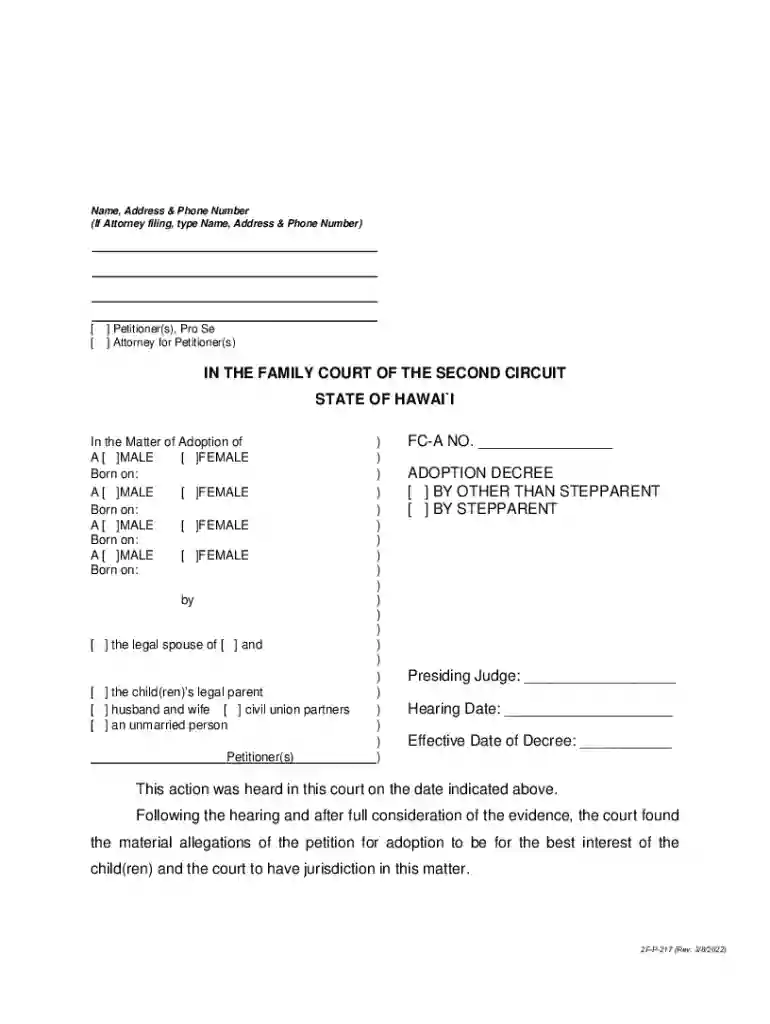
Definition and Meaning of the 2f-p-217
The 2f-p-217 is a comprehensive document utilized in specific legal or business contexts. Often referenced within the framework of regulatory or administrative compliance, this form is designed to facilitate particular processes related to documentation or official records.
- Purpose and Use: It often serves to formalize requests or declarations in a standardized manner.
- Common Contexts: Utilized primarily within state or federal regulatory environments.
Key Components
- Structured Data Fields: The form contains structured sections that allow the entry of specific information pertinent to its intended use.
- Guidelines for Completion: Instructions or annotations accompany the form to assist users in correctly populating each section.
Steps to Complete the 2f-p-217
Proper completion of the 2f-p-217 ensures compliance and facilitates the processing of requests or declarations.
- Gather Necessary Information: Compile all required data documents before beginning the process.
- Fill Out Personal Information: Enter personal or entity details accurately, as specified in the initial sections.
- Complete Specific Sections: Address any particular sections that relate directly to your situation or requirements.
- Review and Verify: Double-check all entries for accuracy to prevent processing delays.
Tips for Accurate Completion
- Read All Instructions: Ensure you understand each requirement before submitting the form.
- Seek Clarifications: When in doubt, contact the issuing authority for guidance.
How to Obtain the 2f-p-217
Acquiring the 2f-p-217 is a straightforward process, often involving direct contact with an issuing body or through official online resources.
- Online Access: Most regulatory agencies or organizations provide downloadable forms on their websites.
- In-Person Requests: Visit official offices where the form is distributed.
Additional Methods
- Request via Mail: Some organizations allow forms to be requested and sent to you by mail upon providing necessary details.
- Software Platforms: Forms may also be available through software solutions compatible with the 2f-p-217.
Important Terms Related to the 2f-p-217
Understanding specific terminology associated with the 2f-p-217 enhances your ability to complete it accurately.
- Applicant: The individual or entity completing the form.
- Submission: The act of officially sending the completed form to the appropriate body.
- Compliance: Adhering to the rules and conditions outlined for the form's usage.
Examples
- Submission Deadlines: The final date by which the form must be filed.
- Confidentiality Requirements: Secure handling of sensitive information contained within the form.
Legal Use of the 2f-p-217
The use of the 2f-p-217 carries legal implications, often tied to broader regulatory frameworks.
- Regulatory Compliance: Ensures adherence to laws or guidelines applicable within the relevant jurisdiction.
- Validation of Information: Provides a legal avenue to standardize information for official purposes.
Considerations
- Jurisdictional Variations: Legal implications may vary based on state-specific laws.
- Updates and Revisions: Keep informed of any legal updates that may affect the validity or use of the form.
Key Elements of the 2f-p-217
The structure of the 2f-p-217 is designed to capture all relevant data necessary for its specific purpose.
- Identification Fields: Includes sections for names, addresses, and official identifiers.
- Purpose Statement: A narrative or structured entry to explain the goal of submitting the form.
Data Input Sections
- Signature Blocks: Areas designated for official signatures to verify accuracy and acceptance.
- Attachments and Appendices: Allowance for additional documentation to support your submission.
State-Specific Rules for the 2f-p-217
Usage of the 2f-p-217 may be influenced by rules varying from one state to another.
- State Guidelines: Each state may provide its own set of instructions affecting form completion and submission.
- Regulatory Differences: Familiarize yourself with local laws to ensure compliance.
Implications
- Penalties for Non-Compliance: Failing to adhere to state-specific rules could result in fines or other legal consequences.
- Amendments and Updates: States may periodically update requirements; staying informed is vital.
Examples of Using the 2f-p-217
To fully understand the 2f-p-217, consider practical examples of its application.
- Case Study 1: An individual submits the form for legal name change documentation as required by local courts.
- Case Study 2: A business files the form for state tax registration purposes, ensuring regulatory acceptance.
Scenarios
- Education Institutions: Might use the form for official administrative records.
- Estate Planning: Could serve as part of the documentation needed in wills or trusts.
Each example illustrates the form's versatility across various legal and regulatory contexts.