







Definition & Meaning
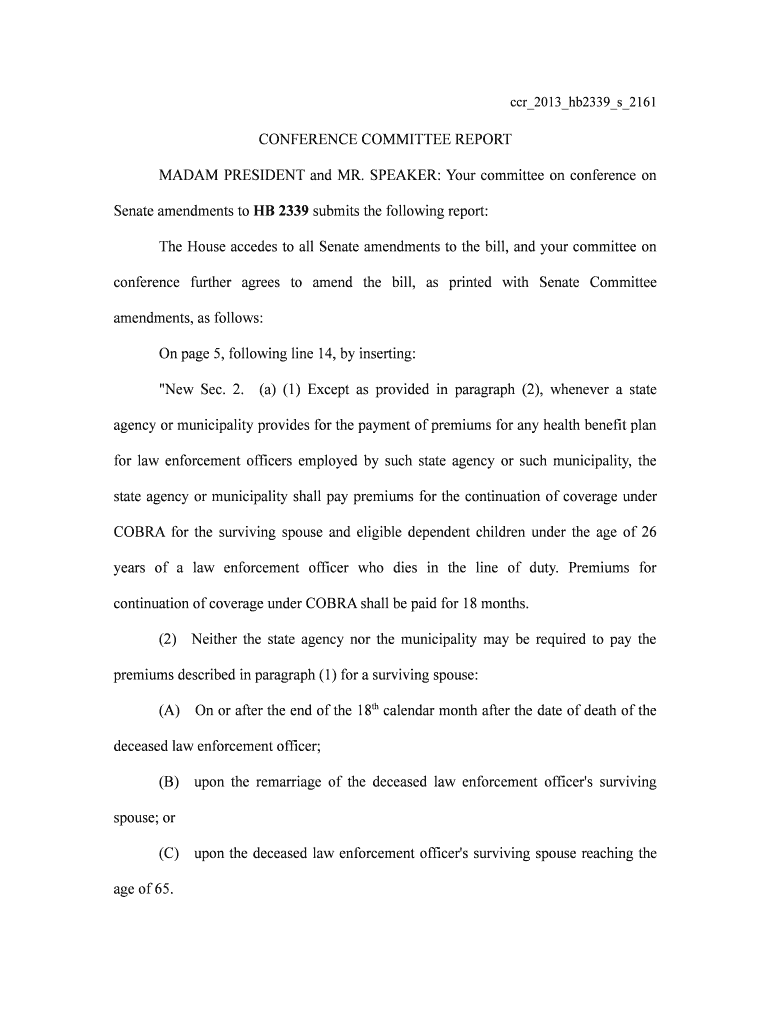
The "ccr 2013 hb2339 s 2161 Conference Committee Report Madam President and Mr - kslegislature" is a legislative document detailing the outcomes of discussions and agreements made by a conference committee regarding specific Senate amendments to HB 2339. This report primarily deals with mandates for state agencies and municipalities to cover COBRA health insurance premiums for the surviving family members of law enforcement officers and firefighters who die in the line of duty. It outlines the conditions for these payments, defines crucial terms such as 'health benefit plan,' and provides details on insurance agent licensing and continuing education requirements.
Important Terms Related to the Report
Understanding the terminology used in the report is critical for anyone dealing with it. Key terms include:
- COBRA Health Insurance: A federal program allowing certain groups to continue their health insurance coverage after it would typically terminate.
- Surviving Spouse and Dependent Children: Refers to the family members of the deceased man or woman eligible for benefits.
- Law Enforcement Officer and Firefighter: As defined in the document, this includes all individuals officially recognized as part of a law enforcement or firefighting body.
- Health Benefit Plan: A detailed description of the coverage options available to individuals eligible under this mandate.
These terms are integral to understanding the document's provisions and impact on affected parties.
Key Elements of the Report
The report includes several critical elements:
- Scope of Benefits: It mandates a period of 18 months during which state agencies and municipalities must cover COBRA premiums.
- Eligibility Criteria: Specific conditions under which surviving spouses and dependents qualify for these benefits.
- Termination Conditions: Circumstances that would lead to the cessation of benefit payments.
- Additional Provisions: Includes insurance agent licensing, continuing education requirements, and more to ensure thorough legislative compliance.
Steps to Complete the Form
When engaging with the "ccr 2013 hb2339 s 2161 Conference Committee Report," follow these steps:
- Review Eligibility Requirements: Ensure the deceased was a recognized law enforcement officer or firefighter.
- Document Necessary Information: Gather all needed personal information of surviving family members.
- Complete Relevant Sections: Fill out required sections, providing detailed and accurate information.
- Submit via Appropriate Channel: Follow the directives outlined in the report for submission, whether online or by mail.
Each step should be performed thoroughly to avoid delays or issues.
Legal Use of the Report
The report serves as an official legal document within the United States, specifically under the jurisdiction of the Kansas legislature. It outlines legally binding obligations for state agencies and municipalities. Adhering to its stipulations is mandatory, with compliance ensured through legislative oversight and enforcement mechanisms.
Examples of Using the Report
Practical applications of the report might include:
- State Agency Implementation: An agency coordinates with insurance providers to cover COBRA premiums as detailed.
- Municipal Level: A local municipal government processes requests from eligible family members of the deceased to extend benefits.
- Educational Initiatives: Organizations might create informational resources to help families navigate their options under this report.
These scenarios illustrate how different entities might utilize the report's guidelines.
Who Typically Uses the Report
Primarily, the report is used by:
- State Agencies and Municipal Entities: For implementing mandates outlined in the report.
- Legal Advisors: Lawyers and policy makers interpreting and ensuring compliance with the report's requirements.
- Affected Families: Surviving spouses and children applying for benefits under the report's provisions.
Understanding the users helps clarify the report's application in various contexts.


Who Issues the Form
The form associated with the "ccr 2013 hb2339 s 2161 Conference Committee Report" is issued by the Kansas legislature. As the governing body responsible for legislative matters, it oversees the form's creation and the subsequent stipulations for its completion and submission. The involvement of a state legislative body underscores the form's legal significance.
State-Specific Rules for the Report
While the report primarily applies within Kansas, each state may have different rules regarding similar benefits and legislative requirements:
- Kansas-Specific Provisions: Outlines specific mandates such as licensing and COBRA payment rules.
- Interstate Differences: Other states may have different laws reflecting local governance priorities.
- Uniform Applications: Some elements, like federal COBRA rules, apply uniformly across states.
Knowledge of these nuances ensures compliance and aids in understanding the broader legislative landscape.




