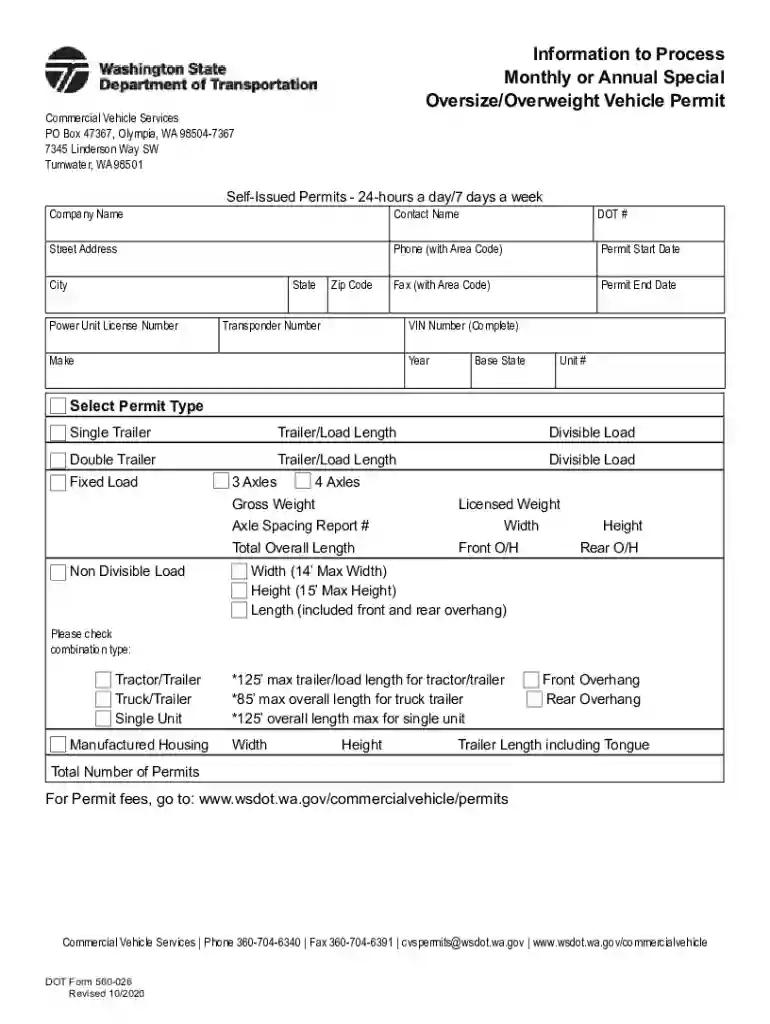
Commercial Vehicle - Oversize overweight permits - Top six 2026

Get Form
Commercial Vehicle - Oversize overweight permits - Top six Preview on Page 1

Here's how it works

01. Edit your form online
Type text, add images, blackout confidential details, add comments, highlights and more.

02. Sign it in a few clicks
Draw your signature, type it, upload its image, or use your mobile device as a signature pad.

03. Share your form with others
Send it via email, link, or fax. You can also download it, export it or print it out.

Definition & Meaning

The "Commercial Vehicle - Oversize overweight permits - Top six" is a regulatory document required for operating commercial vehicles that exceed the standard size or weight limits. This permit ensures that vehicles transporting large or heavy loads adhere to safety and infrastructure preservation guidelines. It is crucial for maintaining public safety and minimizing road damage, guaranteeing that these oversized or overweight transports occur under controlled conditions. Understanding the permit's specifics helps businesses comply with state regulations and avoid penalties.

How to Obtain the Commercial Vehicle - Oversize Overweight Permits

Obtaining the "Commercial Vehicle - Oversize Overweight Permits - Top six" involves several key steps. It begins with determining whether your vehicle qualifies for these permits based on its dimensions and weight.

  1. Eligibility Assessment: Assess your vehicle's size and weight against state-specific regulations to confirm the need for a permit.
  2. Application Preparation: Gather necessary documents, including vehicle registration, dimensions, and weight specifications. Accurate and comprehensive data ensure smooth processing.
  3. Submission Method: Submit your application through approved channels. Most states offer online submission, which is more streamlined; some also accept mailed or in-person applications.

The process may vary slightly depending on state-specific regulations, so reviewing your state's guidelines is crucial for compliance.

Steps to Complete the Commercial Vehicle - Oversize Overweight Permits

Completing the "Commercial Vehicle - Oversize Overweight Permits" requires meticulous attention to detail:

  1. Application Form: Fill out the relevant sections with accurate vehicle details and company information. Include the dimensions and weight as specified in regulatory documentation.
  2. Supporting Documents: Attach any required documents like vehicle registration and insurance proof.
  3. Fee Payment: Calculate and pay the necessary fee, which may vary based on the vehicle's size, weight, and the duration of the permit.
  4. Submission: Follow state guidelines for submitting the completed application package. Ensure that submissions are made before deadlines to avoid delays.
  5. Confirmation: After submission, monitor the status and obtain confirmation upon approval. This often includes receiving a physical or digital permit, which must be carried during operations.

Key Elements of the Commercial Vehicle - Oversize Overweight Permits

Understanding key elements within the "Commercial Vehicle - Oversize Overweight Permits" is crucial:

  • Vehicle Information: Includes registration, dimensions, and load specifics.
  • Route Description: Specifies the driving route, considering weight limits on bridges and road infrastructure.
  • Permit Types: Monthly or annual permits are available, depending on operational needs.
  • Fee Structure: Based on the load type and transport frequency.

These components ensure that operations comply with legal requirements and maintain road safety.

State-Specific Rules for the Commercial Vehicle - Oversize Overweight Permits

State regulations can greatly influence the permit acquisition process. While federal guidelines establish general standards, state-specific rules dictate nuances such as:

  • Size and Weight Limits: Vary by state, necessitating careful review of local regulations.
  • Route Restrictions: Certain states impose restrictions on routes where oversized vehicles can travel.
  • Permit Validity: Duration and renewal processes differ, affecting operational planning for businesses.

Staying informed about state-specific requirements ensures compliance and smooth transport operations.

Examples of Using the Commercial Vehicle - Oversize Overweight Permits

Permits are vital in various sectors:

  • Construction: Transporting large machinery or materials between sites safely and legally.
  • Agriculture: Moving heavy agricultural equipment like combine harvesters across state lines.
  • Logistics: Overseeing the transfer of oversized goods such as large shipping containers or industrial equipment.

These real-world applications highlight the permit's role in facilitating essential business operations without legal complications.

Legal Use of the Commercial Vehicle - Oversize Overweight Permits

The legalities surrounding the use of "Commercial Vehicle - Oversize Overweight Permits" focus on safety and infrastructure protection:

  • Compliance: Vehicles must adhere to route, time, and size constraints outlined in the permit.
  • Penalties: Non-compliance can result in fines, permit revocation, or legal action, emphasizing the importance of adhering strictly to permit conditions.
  • Insurance: Proper insurance coverage is typically mandated to cover potential damages during transport.

Understanding and respecting these legal parameters ensure safe and lawful business practices.

Form Submission Methods (Online / Mail / In-Person)

Permits for oversize or overweight vehicles can be submitted in multiple ways, accommodating different business needs:

  • Online: Most efficient method, offering timely processing and easier error correction.
  • Mail: Suitable for those preferring physical documentation, albeit slower in feedback and processing.
  • In-Person: Provides direct interaction with regulatory personnel, useful for complex queries or immediate feedback.

Choosing the right submission method based on your operation’s needs can optimize the permit approval timeline and ensure compliance.

be ready to get more

Complete this form in 5 minutes or less

Get form

Got questions?

We have answers to the most popular questions from our customers. If you can't find an answer to your question, please contact us.
Contact us
Below is some important oversize permit regulation information for the state of Virginia. In Virginia, you need an oversize permit if your vehicle exceeds 86 wide, 136 high, 65 long or 80,000 pounds. If you need to apply for a Virginia oversize permit, call (888) 737-6483 now or contact us.
Oversize and Overweight Permit Limits in Massachusetts Max Length With Permit: 115 feet. Max Overhang With Permit: Case by case basis. Maximum Width With Permit: 1411 feet. Maximum Height With Permit: 1411 feet.
Vehicles between 12 and 14 wide, over 80 but not exceeding 114 in length and over 13 11 height may travel under permit only during daylight hours (sunrise and sunset) except no travel is permitted between 7:00 am - 9:00 am and 3:30 pm- 7:00 pm, Monday through Friday.
A single trip permit for an oversize load in New Mexico costs $25 (an additional $300 per day if State Police escort is used). A single trip overweight permit costs $25, and for loads over 86,400 pounds, $0.025 per ton/mile.
A Massachusetts Hardship License, also known as a Cinderella License, is a 12-hour license granted to individuals who meet certain criteria. Eligibility for a hardship depends on the circumstances and length of your suspension. You must serve 3 months of a 1-year suspension to be eligible.

Security and compliance

At DocHub, your data security is our priority. We follow HIPAA, SOC2, GDPR, and other standards, so you can work on your documents with confidence.

Learn more
ccpa2
pci-dss
gdpr-compliance
hipaa
soc-compliance

People also ask

The legal limits for a vehicles size and weight are 80,000 pounds, 53 long, 13 high and 8 wide. If your vehicle exceeds those numbers, its likely overweight or hauling an oversize load.

Related links