01. Edit your form online
Type text, add images, blackout confidential details, add comments, highlights and more.

Type text, add images, blackout confidential details, add comments, highlights and more.

Draw your signature, type it, upload its image, or use your mobile device as a signature pad.

Send it via email, link, or fax. You can also download it, export it or print it out.
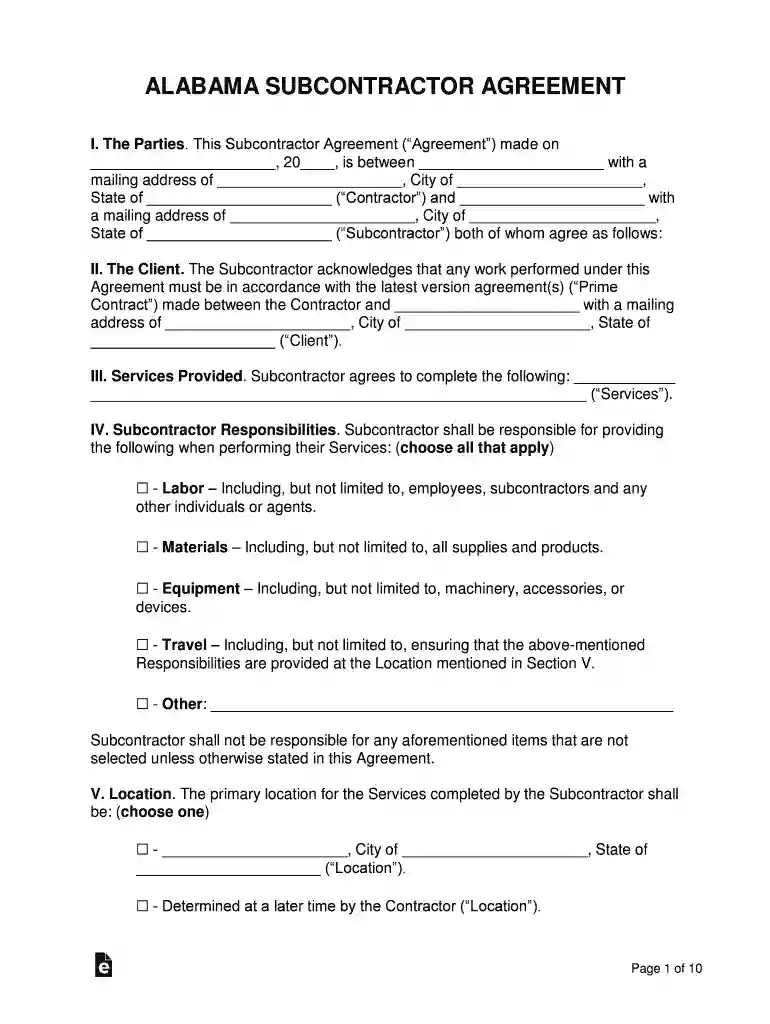
The Alabama Subcontractor Agreement Template is a legal document used to outline the terms and conditions between a contractor and a subcontractor. It serves as a formal agreement that specifies the responsibilities each party will undertake during a project. The template typically includes details about the scope of work, payment terms, timelines, and any specific tasks the subcontractor is expected to perform. By defining these elements clearly, the agreement helps prevent misunderstandings and disputes down the line. It's crucial for establishing a professional and legal binding relationship between the contractor and subcontractor in Alabama, ensuring compliance with state-specific laws.
A comprehensive Alabama Subcontractor Agreement Template includes several essential components that ensure clarity and legal compliance. These key elements are designed to protect both parties involved in the contractual agreement:
Scope of Work: Clearly defines what tasks the subcontractor will perform, providing detailed descriptions to avoid ambiguity.
Payment Terms: Outlines how and when the subcontractor will be compensated, including any conditions for payment and potential penalties for delays.
Insurance Requirements: Specifies the types of insurance the subcontractor must carry, such as liability or worker's compensation insurance.
Dispute Resolution: Establishes the methods for resolving any disputes that arise, whether through mediation, arbitration, or litigation.
Termination Clauses: Details the conditions under which either party can terminate the agreement, including notice periods and grounds for termination.
Confidentiality Obligations: Sets provisions for protecting sensitive information shared during the course of the project.
These components ensure that the agreement is legally sound and provides a framework for both parties to operate within, reducing the chance of conflicts.
Filling out the Alabama Subcontractor Agreement Template involves several steps to ensure that all aspects of the subcontracting relationship are covered comprehensively:
Identify Parties: Clearly state the names and contact information of the contractor and subcontractor.
Define Scope: Include detailed descriptions of the work to be performed by the subcontractor, affirming both parties' understanding.
Set Payment Terms: Clearly outline the payment schedule, including amounts, due dates, and any conditions necessary for payment.
Include Insurance and Licenses: Verify that the subcontractor possesses the required insurance and licenses as per Alabama law, and include these details in the agreement.
Add Legal Provisions: Include clauses for dispute resolution, confidentiality, and the conditions under which the agreement can be terminated.
Review and Sign: Both parties should thoroughly review the completed document to ensure accuracy and mutual understanding before signing.
This structured approach ensures that the agreement is comprehensive and legally binding.
Understanding the terminology included in the Alabama Subcontractor Agreement Template aids both parties in accurately interpreting the responsibilities and obligations outlined. Key terms often found in the template are:
Contractor: The entity or person hiring a subcontractor to perform specific tasks within a larger project.
Subcontractor: The individual or company hired to carry out specified tasks, distinct from the main contractual obligations.
Indemnification: A provision where the subcontractor agrees to compensate the contractor for any losses or damages resulting from the subcontractor's actions.
Force Majeure: Acts of nature or unforeseeable events that may prevent fulfillment of contract terms.
Lien Waiver: A document that ensures subcontractors have received their payment and waiver of any future lien rights on the property.
Understanding these terms fosters clearer communication and helps each party fulfill their role within the agreement.
Alabama law governs the framework within which the subcontractor agreements operate, making it important to align the template with state-specific rules and regulations:
Licensing Requirements: Subcontractors must comply with Alabama's licensing requirements, which vary depending on the type and size of the work.
Payment Bonds: For certain projects, Alabama law mandates that contractors provide payment bonds to protect subcontractors against non-payment.
Lien Rights: The state allows subcontractors to file a mechanic's lien in the event of non-payment, provided specific procedures and deadlines are followed.
Construction-Specific Codes: Adhering to Alabama's building and safety codes is mandatory for the completion of any subcontracted construction work.
Being aware of these state-specific nuances helps both contractors and subcontractors avoid legal pitfalls and ensures compliance.
The Alabama Subcontractor Agreement Template serves as a critical legal tool in construction and other service-based industries. It ensures clarity about each party's roles and legal obligations:
Enforceability: By adhering to legal standards and including all required elements, the template ensures that the agreement is enforceable in court.
Protection: It provides legal protection for both parties, outlining remedies and safeguards against breaches and disputes.
Compliance: Ensures that both parties remain compliant with Alabama state laws and industry regulations throughout the term of the agreement.
Documentation: Serves as an official record of the agreed terms, serving as evidence if disagreements or legal issues arise.
This legal foundation is crucial for upholding the integrity and intent of the subcontractor relationship.
Real-world scenarios can illustrate how the Alabama Subcontractor Agreement Template functions effectively within various industries:
Construction Projects: A general contractor hires a subcontractor to handle electrical installations. The template outlines the scope, payment schedule, and safety requirements specific to electrical work.
Event Management: An event planner contracts a catering company to provide food services. Here, the template specifies menu options, service expectations, and timelines for meal delivery.
IT Services: A tech company uses the template to subcontract a software developer for a project, detailing the development phases, testing protocols, and confidentiality agreements necessary for sensitive data handling.
Through these scenarios, the template demonstrates its adaptability across different sectors, ensuring tailored agreements that suit the specific needs of each project.
The template is highly beneficial for various business entities, especially those in the construction and service sectors:
Construction Companies: Ensure all subcontracted work on building projects complies with safety standards and is delivered on time.
Event Planning Firms: Align service providers such as caterers and decorators with clients' needs efficiently.
IT and Software Development Firms: Leverage specialized skills by contracting out specific tasks such as coding or system integration.
Consulting Firms: Formalize partnerships and projects with industry experts and specialists in various fields.
These businesses gain a framework for harmonizing multiple working relationships under one project, reducing administrative overhead, and adhering to legal expectations.
We've got more versions of the Alabama Subcontractor Agreement Template form. Select the right Alabama Subcontractor Agreement Template version from the list and start editing it straight away!
| Versions | Form popularity | Fillable & printable |
|---|---|---|
| 2019 | 4.8 Satisfied (157 Votes) |
At DocHub, your data security is our priority. We follow HIPAA, SOC2, GDPR, and other standards, so you can work on your documents with confidence.