01. Edit your form online
Type text, add images, blackout confidential details, add comments, highlights and more.

Type text, add images, blackout confidential details, add comments, highlights and more.

Draw your signature, type it, upload its image, or use your mobile device as a signature pad.

Send it via email, link, or fax. You can also download it, export it or print it out.
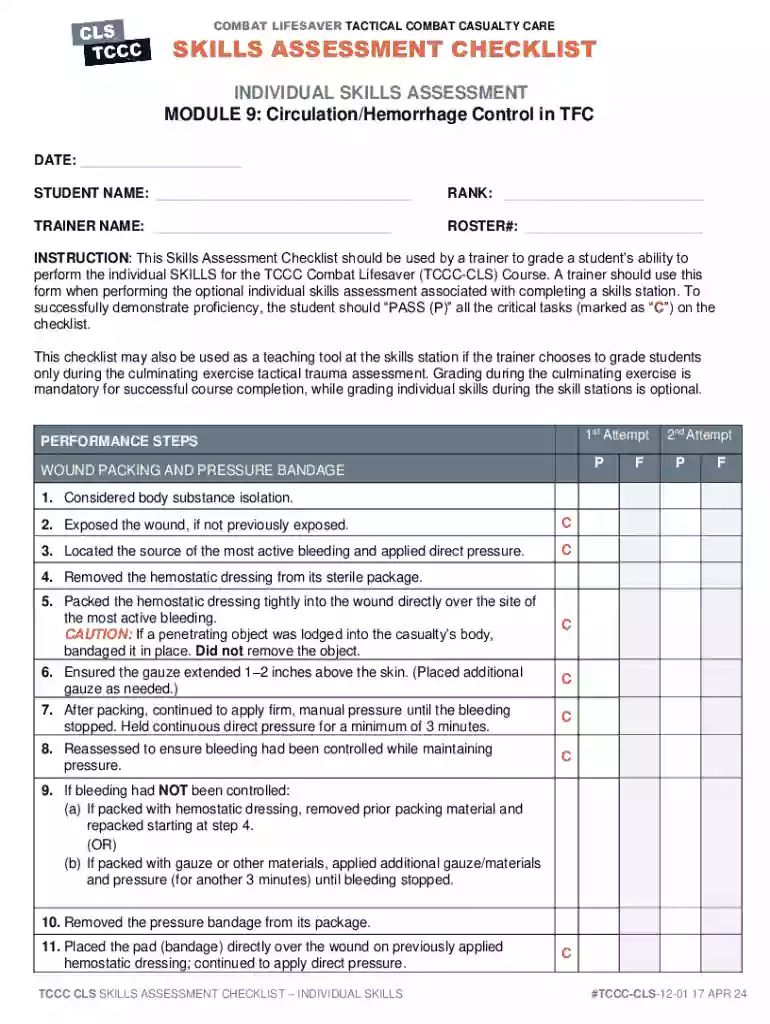
The Combat Lifesaver Tactical Combat Casualty Care Skills Assessment Checklist is a structured document used in the evaluation of specific skills within the Tactical Combat Casualty Care (TCCC) Combat Lifesaver Course. It helps instructors assess a student's proficiency in critical battlefield medical procedures such as hemorrhage control and circulation management. This checklist plays a dual role: guiding students through necessary skills and serving as a grading tool for instructors to recognize competency in trauma management settings.
Understanding the essential components of this checklist is crucial for both trainers and trainees. Key elements include:
These elements ensure that both instructors and students focus on mastering the lifesaving skills important on the battlefield.
Completing the checklist involves the following steps:
This process helps ensure that combat lifesavers are ready to perform essential medical interventions in real-world situations.
The checklist is used as a practical training guide and evaluation tool.
Utilizing the checklist effectively standardizes combat medical training, enhancing overall preparedness.
Primarily used by:
These individuals rely on the checklist to meet military medical training objectives efficiently.


Accessing the checklist is often limited to military resources:
Ensuring access to the most current and applicable version aligns with military protocol and training standards.
Practical application scenarios include:
These examples demonstrate the checklist's role in fostering continuous improvement and operational readiness within military medical protocols.
Understanding key terminology is fundamental:
Familiarity with these terms helps individuals comprehend the checklist's focus and application within combat lifesaving protocols.
We've got more versions of the Combat Lifesaver Tactical Combat Casualty Care Skills Assessment Checklist form. Select the right Combat Lifesaver Tactical Combat Casualty Care Skills Assessment Checklist version from the list and start editing it straight away!
At DocHub, your data security is our priority. We follow HIPAA, SOC2, GDPR, and other standards, so you can work on your documents with confidence.