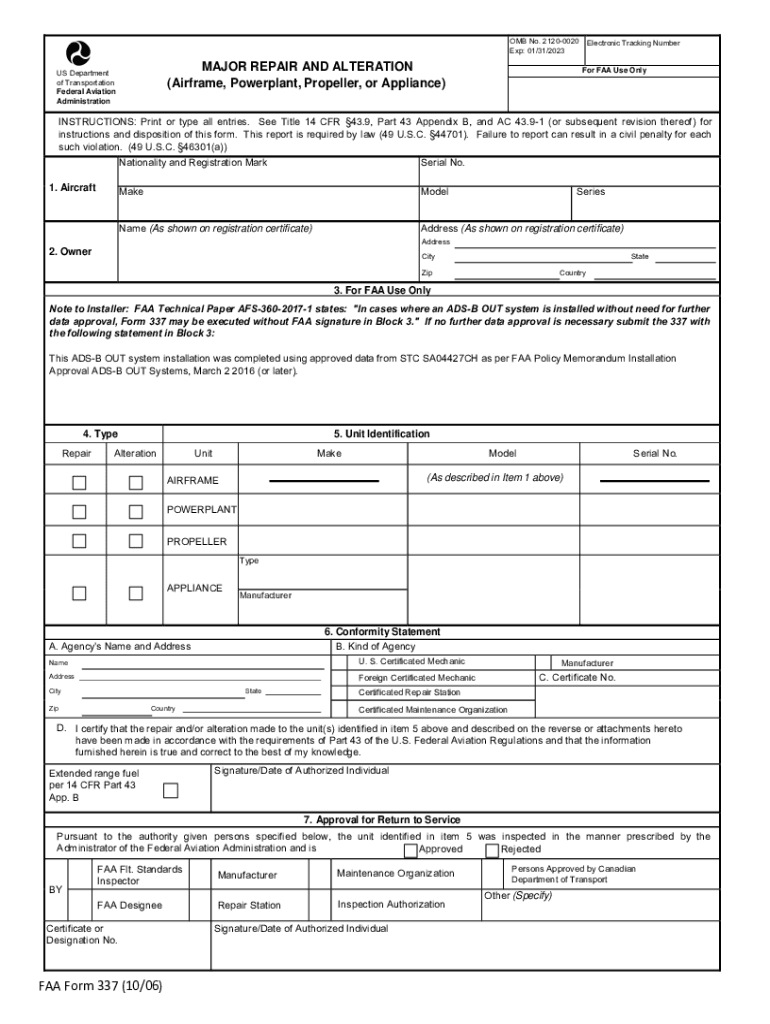







Definition and Meaning of TailBeacon Sample 337
The tailBeacon Sample 337 is a specialized document used within aviation to document major repairs and alterations to aircraft, specifically those equipped with the uAvionix tailBeacon system. Predominantly, the form serves as an official record under the Federal Aviation Administration (FAA) guidelines, ensuring all alterations comply with aviation safety standards. This document outlines the modifications made to aircraft, particularly when the aircraft does not fall under the approved model list supplemental type certificate (AML STC). The use of the tailBeacon Sample 337 ensures that modifications are recorded accurately for legal compliance and aircraft airworthiness.
How to Use the TailBeacon Sample 337
Utilizing the tailBeacon Sample 337 involves meticulous documentation and adherence to aviation regulations. Primarily used by aircraft mechanics and technicians, this form requires detailed entries about the modifications performed. A critical step is to ensure all changes align with the FAA’s maintenance standards. The documentation process involves listing the specific alterations, used parts, and the compliance with FAA regulations such as Advisory Circulars or parts 21, 43, and 91 of the 14 CFR. Once completed, both the mechanic and the aircraft owner must review and sign the form to verify its accuracy before submission to the FAA for approval or records.
Steps to Complete the TailBeacon Sample 337
- Identify Necessary Changes: Clearly outline the repairs or alterations to be made on the aircraft.
- Gather Information: Collect all relevant data concerning the current aircraft specifications and the intended modifications or repairs.
- Documentation: Complete the form with detailed descriptions of the alterations, including the methods, techniques, and parts used.
- Compliance Check: Ensure all procedures comply with the FAA regulations. Use the FAA-approved manuals as references.
- Signature and Review: Obtain the signatures from both the authorized mechanic and the aircraft owner to certify the accuracy of the information.
- Submission: Submit the completed and signed form to the FAA for approval or as part of the aircraft's maintenance records.
Important Terms Related to TailBeacon Sample 337
- AML STC: Approved model list supplemental type certificate, a critical document related to aircraft modifications.
- ADS-B: Automatic Dependent Surveillance–Broadcast, a surveillance technology incorporating the tailBeacon to improve aircraft safety.
- 14 CFR: Title 14 of the Code of Federal Regulations, setting forth the Federal Aviation Regulations.
- uAvionix: The manufacturer of the tailBeacon system used in aircraft.
Who Typically Uses the TailBeacon Sample 337
The form is predominantly used by certified aircraft mechanics, repair stations, and avionics technicians responsible for maintaining and altering aircraft. These professionals use this form to ensure that every modification complies with FAA standards. Aircraft owners who have specific installation and compliance needs for their craft also reference this form to verify that all legal requirements are met, supporting their role in maintaining airworthiness certifications.


Legal Use of the TailBeacon Sample 337
The legal implications of the tailBeacon Sample 337 are significant. Proper completion and submission of this form are necessary to ensure legal compliance with FAA regulations. Failing to accurately document repairs or alterations can lead to penalties or grounding of the aircraft. This form acts as an official record and is often reviewed during audits, inspections, and when transferring aircraft ownership to establish the legal history of major modifications.
Key Elements of the TailBeacon Sample 337
- Aircraft Information: Essential details such as the make, model, and registration number.
- Description of Work: A thorough account of the repairs or modifications performed, including methods used.
- Compliance and References: Major standards observed, FAA regulations adhered to, and any supplemental type certificates referenced.
- Signatures: The names, ratings, and signatures of the individuals responsible for the alterations, establishing accountability.
Digital vs. Paper Version of TailBeacon Sample 337
The tailBeacon Sample 337 is available in both digital and paper formats. The digital version offers ease of filling, sharing, and storing, which is ideal for integrating into electronic record-keeping systems used by larger maintenance organizations. Conversely, paper forms may be preferred in settings lacking in-depth digital infrastructure or for in-person submissions. Both formats need to be filled with precision, emphasizing clarity and compliance with FAA requirements to ensure they serve the intended legal and record-keeping roles effectively.
Examples of Using the TailBeacon Sample 337
For real-world understanding, consider an aircraft undergoing avionics upgrade, replacing older equipment with the tailBeacon system. The technician would document this alteration, including technical specifics like serial numbers and calibration data, on the form. Similarly, if an aircraft owner's aircraft is adding new navigation systems compatible with ADS-B Out compliance, the form would detail this upgrade, showing adherence to FAA safety requirements. These examples highlight how the form serves both as a compliance tool and a protectant of airworthiness certification.