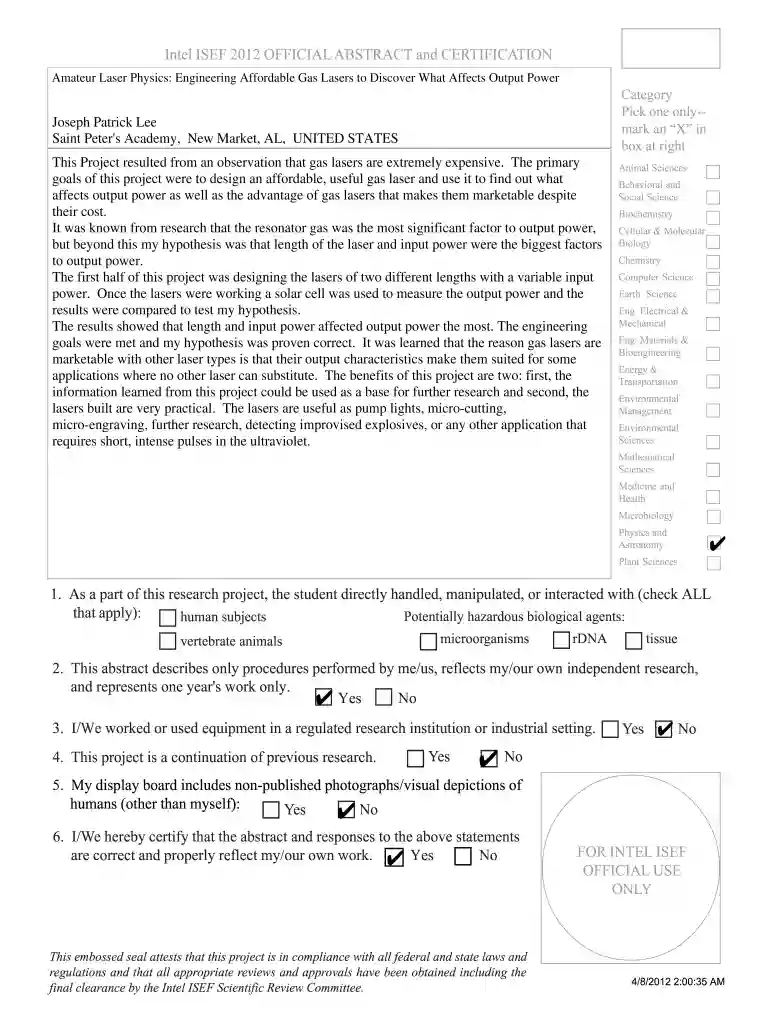
Isef abstract form 2026

Get Form
isef abstract form Preview on Page 1

Here's how it works

01. Edit your isef abstract form online
Type text, add images, blackout confidential details, add comments, highlights and more.

02. Sign it in a few clicks
Draw your signature, type it, upload its image, or use your mobile device as a signature pad.

03. Share your form with others
Send abstract form via email, link, or fax. You can also download it, export it or print it out.

Definition and Purpose of the ISEF Abstract Form

The ISEF abstract form, often referred to as the official abstract for the Intel International Science and Engineering Fair (ISEF), serves a critical purpose in summarizing the essential aspects of a student's research project. This form encapsulates the project's objectives, methodology, and results in a concise format, typically limited to 250 words. The abstract acts as a snapshot of the research, making it easier for judges and reviewers to assess the work at a glance.

The specific elements required in the ISEF abstract include:

  • Title: A clear and descriptive title that reflects the essence of the research.
  • Purpose: An explanation of the problem being addressed.
  • Methods: A brief overview of how the research was conducted.
  • Results: Summarized findings or outcomes of the study.
  • Conclusions: The implications of the results and potential applications.

Submitting a well-crafted abstract using the ISEF abstract form is crucial for students participating in science fairs, ensuring that their work is communicated effectively and meets the competition's standards.

Steps to Complete the ISEF Abstract Form

Filling out the ISEF abstract form requires careful attention to detail and understanding of the project's nuances. Here is a structured approach to ensure completeness and clarity:

  1. Understand the Guidelines: Read the ISEF abstract guidelines thoroughly to understand the formatting requirements, especially the word limit.
  2. Draft the Content: Write drafts for each section — the purpose, methods, results, and conclusions — without worrying about the word count initially.
  3. Edit for Clarity: Refine the draft to ensure clarity, precision, and adherence to the word limit. Focus on using clear language and avoid technical jargon.
  4. Seek Feedback: Share the draft with mentors or peers to gain feedback and improve the overall quality.
  5. Finalize Submission: Once satisfied, transfer the content onto the ISEF abstract form, making sure all formatting and submission requirements are met.

Consideration of these steps ensures that the abstract is not only informative but also engaging to the reader.

Important Terms Related to the ISEF Abstract Form

Understanding terminology associated with the ISEF abstract form is essential for effective communication and compliance within the framework of the competition. Some key terms include:

  • Abstract: A brief summary of the research project encapsulating the purpose, methods, results, and conclusions.
  • ISEF Certification Form: A document verifying that the project adheres to ISEF guidelines and ethical standards.
  • Research Plan: A detailed outline of the intended research, outlining objectives, methods, and expected results.
  • Project Category: The designated area of research, such as life sciences, physical sciences, or engineering.
  • Judging Criteria: The specific standards that the judges will use to evaluate the projects.

Familiarity with these terms aids students in navigating the requirements and expectations of the ISEF abstract form.

Key Elements Required in the ISEF Abstract Form

The ISEF abstract form consists of essential components that must be included for a successful submission. Each element plays a critical role in conveying the significance and scope of the research:

  • Project Title: This should be catchy yet descriptive.
  • Purpose Statement: A concise statement outlining the project's intent.
  • Methodology Overview: A brief description of experiments or research methods utilized.
  • Findings: A summary of key results, highlighting the most significant discoveries.
  • Implications: A statement on the impact or relevance of the findings to real-world applications.

Including these elements not only meets the requirements but enhances the overall presentation of the research.

Examples of Using the ISEF Abstract Form

Real-world examples illustrate the practical application of the ISEF abstract form in student projects. For instance:

  • Environmental Science Project: A student studying the effects of pollutants on local water sources would summarize their research in the abstract, detailing the purpose of their study, methods of data collection (e.g., water sampling), and significant findings regarding pollutant levels.
  • Engineering Innovation: A project focused on developing a cost-effective solar panel model would highlight the problem addressed (energy efficiency), outline the engineering process, and present quantitative results of energy output during testing phases.

These examples demonstrate how to effectively structure research summaries using the ISEF abstract form, ensuring clarity and engagement for judges.

Legal Use of the ISEF Abstract Form

Understanding the legal implications associated with the ISEF abstract form is essential for participants. Certain legal considerations must be adhered to:

  • Intellectual Property: Students should ensure that their work does not infringe on patents or copyrights of existing research.
  • Approval from Institutional Review Boards: Research involving human subjects or animals requires approval from relevant ethical review boards, and this must be documented.
  • Compliance with ISEF Regulations: All submissions must conform to ISEF's ethical standards and guidelines to be considered valid.

Addressing these legal aspects protects students and ensures the integrity of their research in the competition environment.

See more isef abstract form versions

We've got more versions of the isef abstract form form. Select the right isef abstract form version from the list and start editing it straight away!
Versions Form popularity Fillable & printable
2012 4.8 Satisfied (131 Votes)
2002 4.3 Satisfied (221 Votes)
be ready to get more

Complete this form in 5 minutes or less

Get form

Got questions?

We have answers to the most popular questions from our customers. If you can't find an answer to your question, please contact us.
Contact us

Upload your abstract form pdf to DocHub (after you’ve created an account for this). If you need to complete fields in it, use proper tools from the upper pane. For example, add Signature Fields, assign each to specific party, and click on Sign → Request signatures from others. Change your message for your recipients and click Send Request. You can also send your form by fax or as a Signing link instead of using email (you’ll find these options by navigating to the Menu → Send)

When you edit your abstract form template with DocHub, you merely require a stable web connection and virtually any web browser installed on your device. No need to set up any third-party software or research tutorials. Simply open a tab with DocHub, drag and drop your file, and edit it immediately.

An introductory statement providing background, namely the reason, for investigating the project topic. A statement of the problem the research is looking to solve or the questions being tested.
International Science and Engineering Fair.
An abstract is an outline/brief summary of your paper and your whole project. It should have an intro, body and conclusion. It is a well-developed paragraph, should be exact in wording, and must be understandable to a wide audience.

Security and compliance

At DocHub, your data security is our priority. We follow HIPAA, SOC2, GDPR, and other standards, so you can work on your documents with confidence.

Learn more
ccpa2
pci-dss
gdpr-compliance
hipaa
soc-compliance
be ready to get more

Complete this form in 5 minutes or less

Get form

People also ask

This form is filled out by the student researcher and is required for all research involving microorganisms, rDNA and fresh/frozen tissue (including primary cell lines, human and other primate established cell lines and tissue cultures), blood, blood products, and body fluids.
Form 1C: Regulated Research Institutional/Industrial Setting Form.
The abstract should be a brief, yet comprehensive synopsis of the research project. It should seek to highlight the research question(s), experimental procedures, data, and conclusions in a way that is concise and easy to understand.
Human Participants Form (4) If at a Regulated Research Institution, use institutional approval forms for documentation of prior review and approval. (IRB approval required before recruitment or data collection.)
Every project needs at least an Abstract, Forms 1, 1A, 1B, and a Research Plan.

isef certification form