




01. Edit your fl 300 online
Type text, add images, blackout confidential details, add comments, highlights and more.

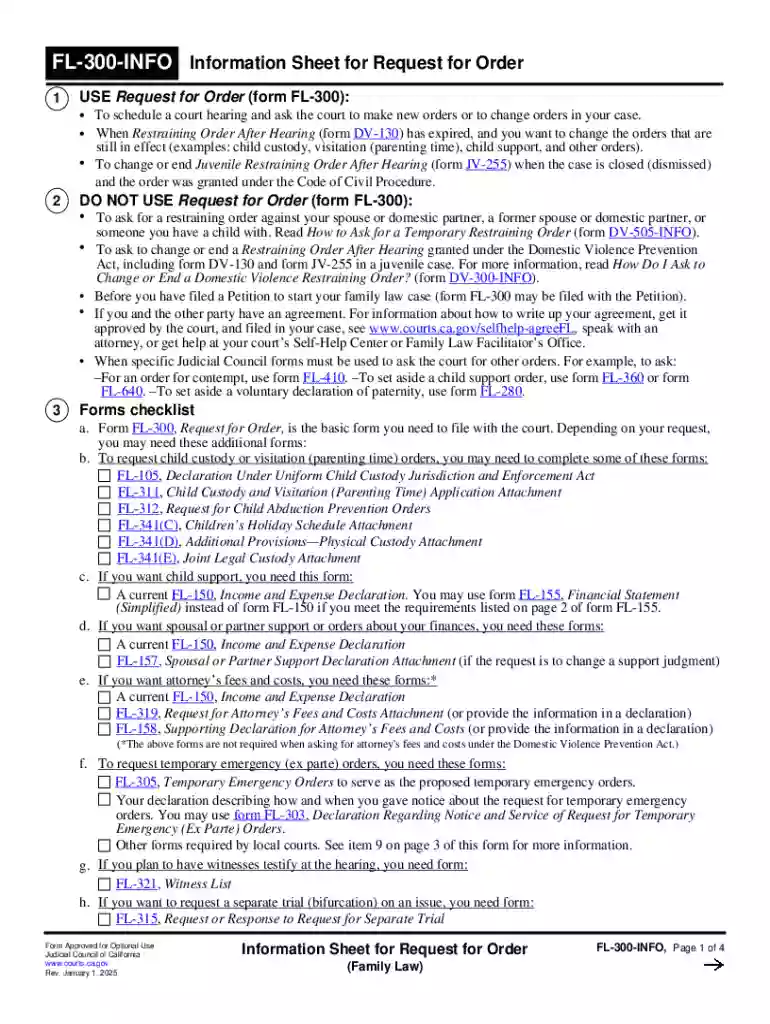
Type text, add images, blackout confidential details, add comments, highlights and more.

Draw your signature, type it, upload its image, or use your mobile device as a signature pad.

Send fl 300 form via email, link, or fax. You can also download it, export it or print it out.
The FL-300-INFO document serves as an informational guide on using the Request for Order form (FL-300) within family law cases. It provides detailed instructions to individuals involved in legal actions, specifically those concerning modifications to court orders. This includes altering arrangements related to child custody, visitation, and support. By providing comprehensive guidance, FL-300-INFO ensures that users understand the circumstances under which the FL-300 form is appropriately applied, thus facilitating smoother legal processes.
Review Eligibility: First, determine whether your legal situation fits within the scenarios outlined in the FL-300-INFO. This step ensures that you're using the form for its intended purpose, such as requesting changes to child custody or support arrangements.
Gather Necessary Information: Collect all relevant details, such as current court orders, to complete the form accurately. This includes specific modifications or requests you are making.
Fill Out the Form: Carefully follow the instructions provided in the FL-300-INFO. Pay attention to each field to ensure that all necessary information is included, such as the names of involved parties and the specifics of the requested modifications.
Compile Required Documents: Along with the FL-300, gather additional documents as specified in the FL-300-INFO checklist, such as existing court orders or evidence supporting the requested changes.
File the Request: Submit the completed form and any other supporting documents to the appropriate court as directed by FL-300-INFO.
FL-300-INFO is legally utilized in family law courts across the United States. Its primary function is to guide users through the process of officially requesting changes to existing court orders. It's crucial that users adhere strictly to the instructions when using FL-300, as any deviation may result in delays or a rejected request. The form must also not be used in situations outside its designated purpose, such as when dealing with restraining orders or cases requiring specific judicial forms.
Individuals involved in family law disputes who need to request a court order modification typically use the FL-300-INFO. This includes parents seeking changes to child custody or support arrangements. Legal professionals working with clients in family law matters also rely on this document to ensure proper form completion and procedural compliance. Understanding this form helps ensure that the request is processed efficiently and effectively within the legal system.


The FL-300-INFO is generally available through several channels:
Ensuring accessibility to this form helps more individuals properly navigate changes in family law orders.
While the FL-300-INFO serves a general purpose across the U.S., state-specific rules and procedures can influence the form's application. For instance, timelines for submitting the form or additional documentation might vary depending on local court regulations. Users must familiarize themselves with their respective state's requirements to prevent potential compliance issues that could delay their legal proceedings.
Understanding key terminology associated with the FL-300-INFO is crucial for properly filling out and filing the form. Important terms include:
These terms and their definitions play a critical role in accurately understanding and utilizing the FL-300-INFO.
We've got more versions of the fl 300 form. Select the right fl 300 version from the list and start editing it straight away!
At DocHub, your data security is our priority. We follow HIPAA, SOC2, GDPR, and other standards, so you can work on your documents with confidence.





) (FL-300-INFO) Explains how to fill out Request for Order (form FL-300) to ask the court to make decisions (orders) in your family law case.
One of the largest philanthropic organizations in the world, we care about freedom, democracy, and human rights.


