
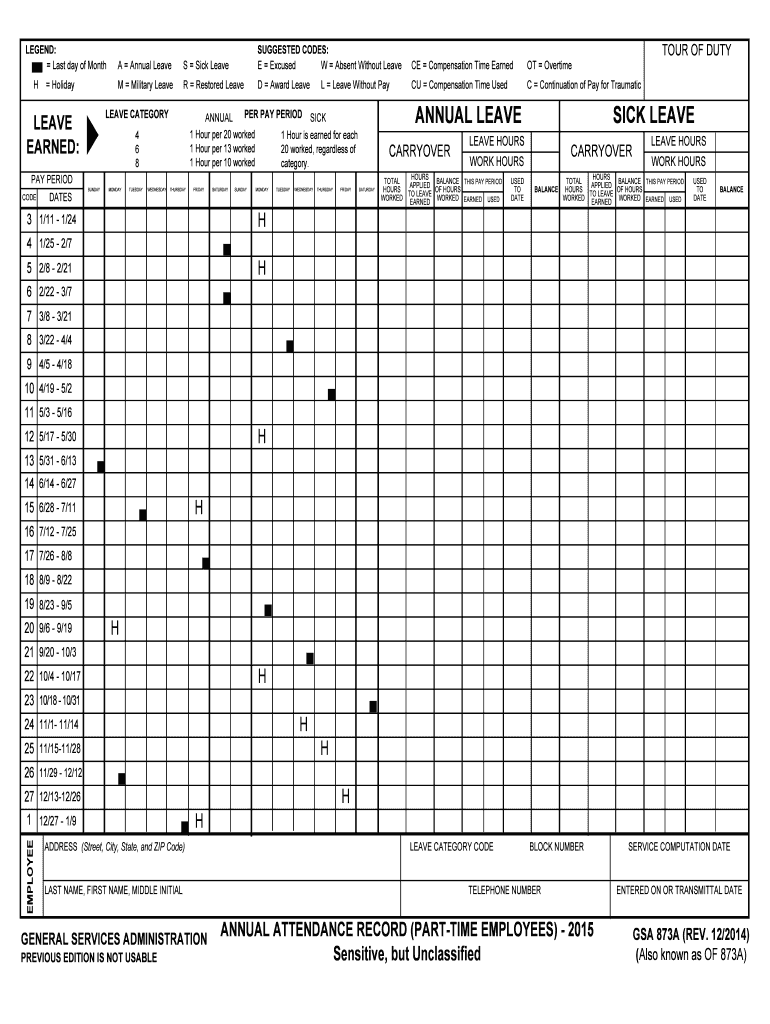







Definition & Meaning
The GSA 873A Rotated-Page1 form is utilized within the General Services Administration (GSA) for tracking pay and leave activities of employees. It is primarily focused on documenting daily and bi-weekly work and leave records, especially for part-time employees. This form plays a key role in aligning individual leave records with official payroll reports. Key aspects include categories for different types of leave and corresponding codes, ensuring meticulous record-keeping for various leave balances.
How to Use the GSA 873A Rotated-Page1 - GSA
Utilizing the GSA 873A Rotated-Page1 involves several steps for accurate documentation:
- Filling Personal Information: Include employee identification number, name, and department.
- Recording Work Hours: Log daily hours worked, including start and finish times.
- Documenting Leave: Input any leave taken, specifying the type (annual, sick, or other) and code.
- Accrual and Usage: Track leave accrued and used to maintain accurate records.
- Verification: Employee and supervisor must review and sign the form to ensure accuracy.
These steps facilitate precise tracking of work and leave, crucial for payroll alignment and leave management.
Key Elements of the GSA 873A Rotated-Page1 - GSA
The form comprises various critical components, including:
- Personal Information: Spaces for employee name, number, and department details.
- Leave Codes and Categories: Specific codes corresponding to different types of leave (e.g., annual, sick).
- Accrual Rates: Sections dedicated to the rates at which leave is accrued.
- Signature Fields: For both employee and supervisor verification to ensure authentic record-keeping.
These elements collectively ensure comprehensive tracking of employee attendance and leave.
Steps to Complete the GSA 873A Rotated-Page1 - GSA
To complete the GSA 873A Rotated-Page1 effectively:
- Gather Required Information: Ensure availability of employee details and department codes.
- Input Work and Leave Data: Fill in daily and bi-weekly data, including hours worked and leave taken.
- Calculate Leave Accruals: Record any accrued leave accurately.
- Complete and Review: After filling the form, conduct a thorough review with a supervisor.
- Sign and Submit: Both employee and supervisor need to sign, followed by submission for payroll processing.
Completing these steps correctly ensures proper alignment with payroll systems and leave policies.
Who Typically Uses the GSA 873A Rotated-Page1 - GSA
This form is predominantly used by:
- GSA Employees: Particularly part-time employees who need to document work and leave hours.
- Supervisors: To verify and approve hours worked and leave taken.
- Payroll Departments: For reconciling leave data with payroll records.
These users ensure that all entries are validated and comply with GSA guidelines.


Important Terms Related to GSA 873A Rotated-Page1 - GSA
Key terminology pertinent to the form includes:
- Annual Leave: Paid leave accrued annually.
- Sick Leave: Paid time off granted for health-related issues.
- Leave Accrual: The rate at which leave hours are accumulated by an employee.
- Bi-weekly Pay Period: The two-week span for which the form captures data.
Understanding these terms is crucial for accurate form completion and record-keeping.
Legal Use of the GSA 873A Rotated-Page1 - GSA
For legal compliance, the form must be used as follows:
- Accurate Reporting: Ensure all data is truthful and aligns with federal labor laws.
- Confidentiality: Maintain privacy of employee information as per regulatory standards.
- Verification: Both employee and supervisor must verify the data to comply with GSA regulations.
Adhering to these legal guidelines ensures proper documentation and regulatory compliance.
Examples of Using the GSA 873A Rotated-Page1 - GSA
To illustrate practical use:
- Scenario 1: A part-time employee records eight hours of work for ten days and three days of sick leave.
- Scenario 2: Another employee uses this form to document 40 hours worked over a pay period, with no leaves, ensuring timely payroll processing.
These examples show how accurate form use aids in maintaining payroll and leave integrity.




