
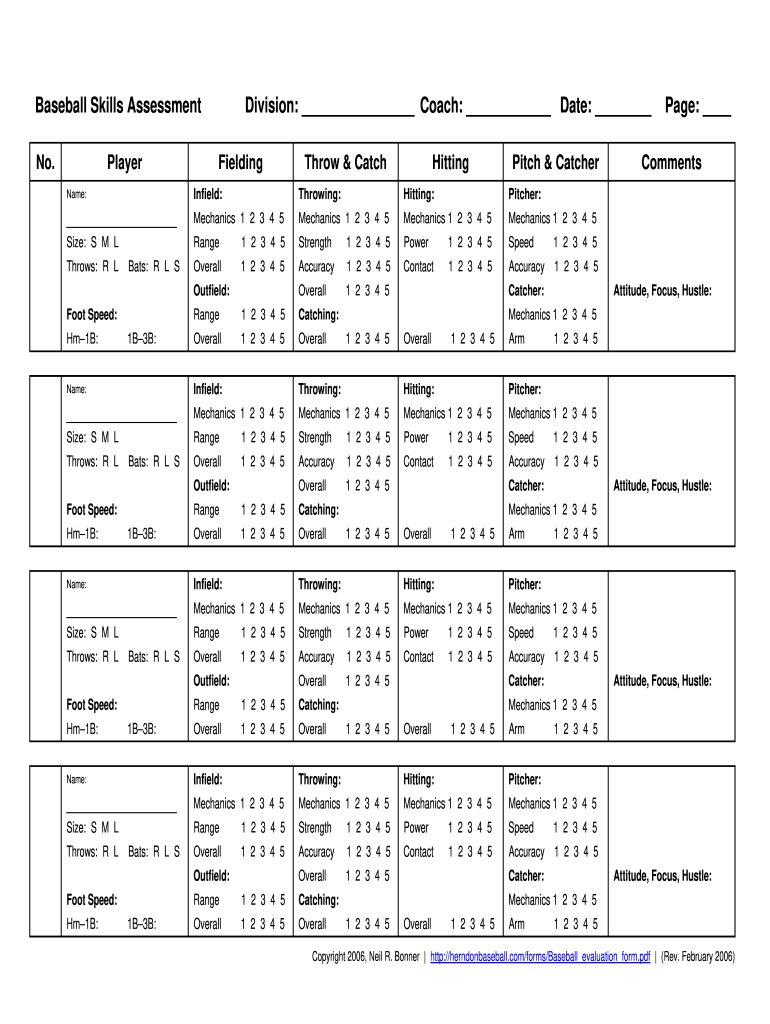







Definition and Purpose of the Baseball Tryout Evaluation Form
The baseball tryout evaluation form serves as a standardized tool used by coaches and scouts to assess the skills and performance of players during tryouts. This form systematically captures data on a player's abilities across various skill areas such as fielding, hitting, pitching, and base running. By providing a uniform structure for evaluation, the form ensures consistency and fairness in player selection for different teams, whether they are youth, high school, or adult leagues. Additionally, it helps identify areas where players may need further development or training.
-
Fielding Skills: Evaluations often focus on the player's ability to catch, throw, and field ground balls efficiently. Analysts look for accuracy, arm strength, and footwork.
-
Hitting Skills: This section typically includes assessments of batting technique, power, and contact ability. Observers examine swing mechanics and consistency.
-
Pitching Skills: For pitchers, evaluations pay attention to pitch velocity, control, and variety. This can involve fastballs, curveballs, and change-ups.
-
Base Running: Speed, agility, and base-running strategy are key factors considered in this area. Timed sprints might be used to gauge quickness on the field.
How to Use the Baseball Tryout Evaluation Form
The practical use of the baseball tryout evaluation form involves collecting data during tryouts and using it to make informed decisions. Coaches deploy these forms during practice sessions or official tryouts to document player performance. It serves as a reference point for discussions and decisions about team placement and training needs.
-
Preparation: Before the tryouts, coaches should familiarize themselves with the form sections to understand what skills and metrics will be recorded.
-
Data Collection: During the tryouts, coaches or designated evaluators record observations and scores in real-time. It is vital to remain as objective as possible to maintain fairness.
-
Analysis: After tryouts, scores are analyzed to rank participants. Coaches can compare results against historical data or team needs to guide player selection.
-
Feedback: Providing constructive feedback to players based on the evaluation data helps them to improve their skills and understand their strengths and weaknesses.
Steps to Complete the Baseball Tryout Evaluation Form
Completing the baseball tryout evaluation form is a step-by-step process that relies on accuracy and clarity. Evaluators should ensure each section is filled out thoroughly to provide comprehensive player assessments.
-
Identify Player Information: Begin by documenting the player's name, age, and contact information. This information ties the evaluation scores to specific individuals.
-
Assess Skills: Use the form to systematically evaluate each skill area. Assign scores based on observed performance, adhering to any predefined scales (often a five-point scale).
-
Take Notes: Include specific observations or notes that provide context to scores. Describing a player’s technique or particular plays can offer valuable insight that raw scores cannot.
-
Review for Completeness: Ensure all sections are complete and scores are tallied correctly. Mistakes or omissions can affect the integrity of the assessment.
Key Elements of the Baseball Tryout Evaluation Form
Key elements of the baseball tryout evaluation form include sections for different skill categories, scoring scales, and areas for additional comments and feedback. Each of these elements plays a crucial role in capturing a full picture of player capabilities.
-
Skill Categories: Such as fielding, hitting, and pitching, form the foundation of the assessment. Clear criteria for each category ensure standardized evaluation.
-
Scoring System: Often a five-point scale, it allows evaluators to rank the proficiency of participants in each skill area.
-
Comments Section: Provides space for detailed observations that can highlight unique talents or areas for improvement.
Who Typically Uses the Baseball Tryout Evaluation Form
The form is predominantly used by coaches and scouts involved in youth, amateur, and professional baseball. It is especially prevalent in environments where multiple players are trying out for limited spots, such as school teams, travel teams, or minor league clubs. Additionally, it serves administrative staff in organizing tryouts and maintaining records for future reference.
-
Youth Leagues: Often use these forms to ensure age-appropriate evaluations aligning with developmental levels.
-
High School Coaches: Use the data for creating competitive school teams and identifying prospects.
-
Professional Scouts: Utilize similar forms for more specific benchmarks and metrics relevant at higher competition levels.


Digital vs. Paper Version of the Evaluation Form
The choice between digital and paper versions of the baseball tryout evaluation form depends on convenience, accessibility, and the context of the tryouts. Each format offers its distinct set of benefits.
-
Digital Versions: Are more accessible for quickly compiling and managing data. They often include functionalities like auto-calculation and cloud storage for easy sharing among coaching staff.
-
Paper Versions: Preferred by those who favor tactile feedback and easy field-use without electronic devices. They are practical where digital access might be limited.
-
Hybrid Approach: Some organizations use both formats, starting with paper in the field and transferring data to digital systems for long-term storage and analysis.
Examples of Using the Baseball Tryout Evaluation Form
The baseball tryout evaluation form can be employed in a variety of scenarios to enhance team-building efforts and player training programs.
-
Travel Team Selection: Coaches can use the form to objectively assess players from different regions vying for a spot on a competitive traveling team.
-
Post-Season Analysis: Reviewing forms from the entire season can provide insights into team needs and help develop training programs for the off-season.
-
Skill Development Sessions: Evaluators can use the forms during training camps to benchmark progress and adjust individual coaching strategies.
Important Terms Related to the Baseball Tryout Evaluation Form
Familiarity with specific terms related to the evaluation form enhances understanding and application. These terms often include evaluation scales, skill criteria, and category-specific terminology.
-
Evaluation Scale: Refers to the numerical rating system used to score players. A five-point scale is common, with points indicating varying levels of proficiency.
-
Skill Criteria: Define the specific abilities being measured within each category, such as accuracy of throws or speed of base running.
-
Metrics: Particular measurements used in evaluations, such as reaction time for fielders or batting average for hitters.
Understanding these components ensures that evaluators can effectively deploy the form to obtain meaningful insights into player abilities, helping shape the future direction and training of their baseball teams.




