




01. Edit your new york city income tax online
Type text, add images, blackout confidential details, add comments, highlights and more.

Type text, add images, blackout confidential details, add comments, highlights and more.

Draw your signature, type it, upload its image, or use your mobile device as a signature pad.

Send nyc city tax via email, link, or fax. You can also download it, export it or print it out.
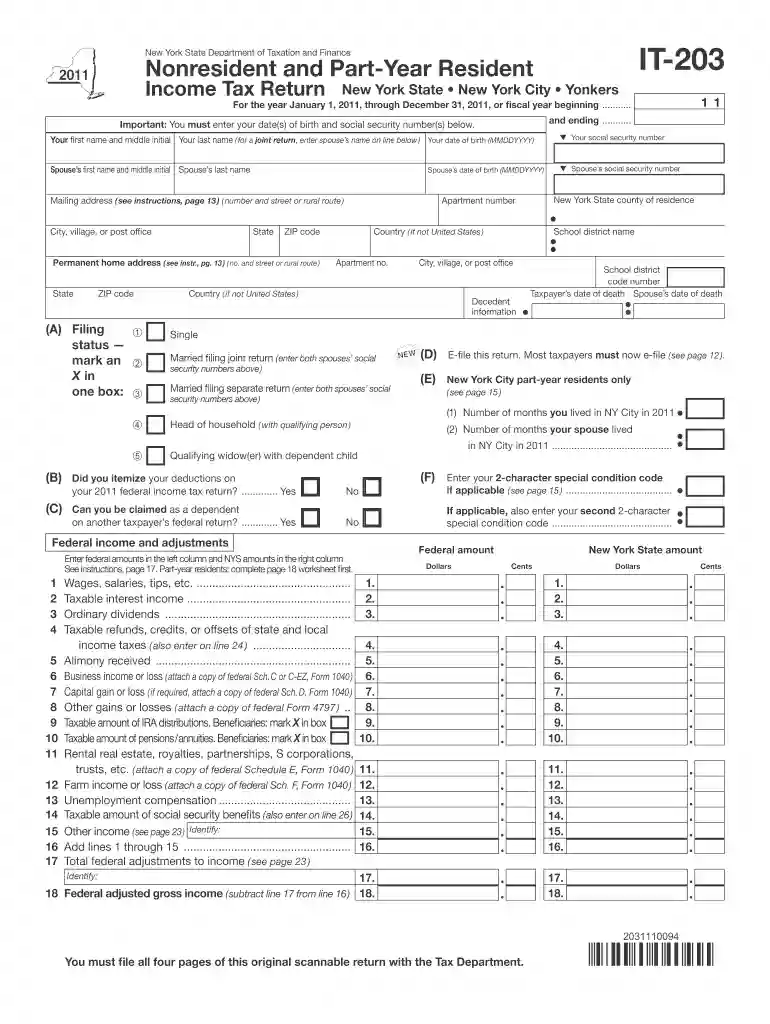
The "New York State New York City Yonkers" tax, commonly known as IT-203, is a specific tax form required for filing the Nonresident and Part-Year Resident Income Tax Return in New York State. This form is essential for individuals who either did not reside full-time in the state or lived in another state but earned income sourced from New York. This form ensures these taxpayers accurately report and pay the appropriate state taxes based on their fiscal activities within New York's jurisdiction.
The IT-203 form is crucial for reporting income, deductions, and calculating taxes owed for part-year and nonresident individuals. Users should collect all necessary income information, verify residency status, and ensure they understand deductible expenses that apply to them. The form has various sections that guide the taxpayer through the necessary computations, helping determine their liability to New York taxes. Proper completion of this form requires careful adherence to instructions and consideration of applicable credits and adjustments.
To obtain the IT-203 form, individuals can visit the official website of the New York State Department of Taxation and Finance, where the form is available for download. Additionally, the form can be sourced from tax professionals or software services like TurboTax and QuickBooks, which often include up-to-date versions as part of their offerings. Taxpayers who prefer physical copies can request them by calling the state's tax department or visiting local government offices.
Gather Personal Information: Start by filling in personal details such as name, address, and social security number.
Determine Residency Status: This affects how income is reported and which sections of the form are relevant.
Report Income: List all sources of New York-based income such as wages, interest, dividends, and business earnings.
Calculate Deductions and Credits: Include standard deductions and any applicable personal credits to reduce taxable income.
Compute Tax Liability: Use provided guidelines to calculate total tax due, considering partial residency or nonresidency status.
Review and Attach Supplementary Documents: Ensure all necessary schedules and forms are attached, e.g., W-2, 1099.
Submit: File the completed form via mail or online through the state's provided platforms.
The IT-203 includes several critical sections:
Filing the IT-203 is a legal requirement for nonresidents and part-year residents earning income from New York sources. Compliance ensures taxpayers adhere to state tax laws, avoiding potential penalties or audits by the state's tax department for misreporting or failing to file.
New York's tax regulations for part-year residents and nonresidents can differ notably from those of other states, particularly concerning income sourced from within versus outside the state. These rules dictate how income and deductions are treated and often require adherence to specific calculations and credits exclusive to New York filings.
Filing IT-203 demands several supporting documents:
The deadline for submitting the IT-203 aligns with the federal tax deadline, typically April 15. It’s imperative that taxpayers mark this date, as delays can result in penalties. Individuals should also account for estimated tax payment due dates if applicable and any state-specific deadline extensions or changes.
We've got more versions of the new york city income tax form. Select the right new york city income tax version from the list and start editing it straight away!
| Versions | Form popularity | Fillable & printable |
|---|---|---|
| 2025 | 4.6 Satisfied (39 Votes) | |
| 2024 | 4.6 Satisfied (43 Votes) | |
| 2023 | 4.1 Satisfied (44 Votes) | |
| 2022 | 4.9 Satisfied (24 Votes) | |
| 2021 | 4.8 Satisfied (81 Votes) | |
| 2020 | 4.4 Satisfied (264 Votes) | |
| 2019 | 4.4 Satisfied (214 Votes) | |
| 2018 | 4.3 Satisfied (118 Votes) | |
| 2017 | 4.2 Satisfied (66 Votes) | |
| 2015 | 4.5 Satisfied (49 Votes) | |
| 2011 | 4.3 Satisfied (74 Votes) | |
| 2010 | 4 Satisfied (51 Votes) | |
| 2002 | 4 Satisfied (26 Votes) |
At DocHub, your data security is our priority. We follow HIPAA, SOC2, GDPR, and other standards, so you can work on your documents with confidence.
Pay online via Credit Card or Electronic Check. Enter the account number (11 digits) exactly as it appears on the City Tax bill.Read more
Target embraces innovation to drive strong financial performance and create new opportunities for profitable growth.Read more
Employers paying wages or other payments subject to New York State withholding must file a return and pay the New York State, New York City, and Yonkers taxesRead more


