




01. Edit your read and sign template online
Type text, add images, blackout confidential details, add comments, highlights and more.

Type text, add images, blackout confidential details, add comments, highlights and more.

Draw your signature, type it, upload its image, or use your mobile device as a signature pad.

Send read and sign form via email, link, or fax. You can also download it, export it or print it out.
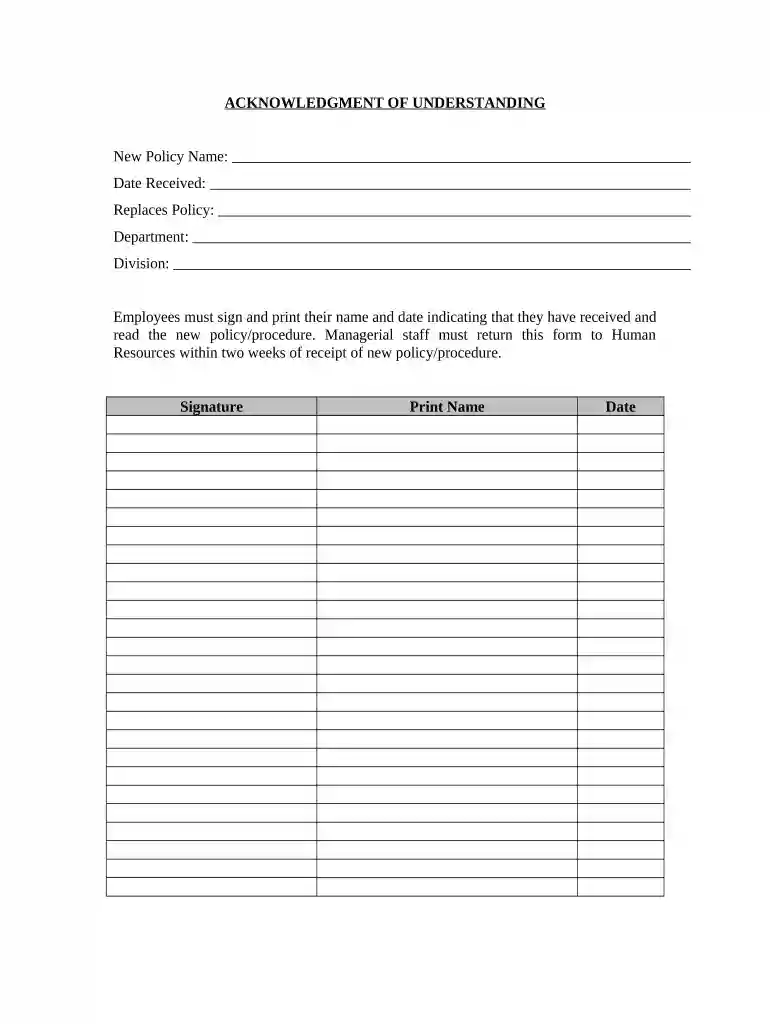
The acknowledgment of understanding serves as a formal document indicating that an individual has received, read, and comprehended the content of a specific policy, procedure, or guideline. This form is essential in various settings, particularly within organizations, as it establishes a record of acknowledgment that employees or stakeholders have been informed about significant protocols. The significance of this acknowledgment lies in its role in promoting compliance and fostering a safety culture within the workplace.
The term encapsulates the agreement that the signatory understands the responsibilities and implications associated with the material acknowledged. It also helps protect organizations by providing documented evidence that they duly informed their employees or clients about essential policies, potentially mitigating liabilities if disputes arise in the future.
Key components typically included in this form encompass the title of the document acknowledged, the date of signature, and the name of the individual attesting their understanding. By signing below, the individual confirms that they have thoroughly read and understood the specified material.
The acknowledgment of understanding plays a vital role in efficiently communicating important information to employees. Organizations often implement new policies or procedures that necessitate clear communication and comprehension from their staff. This acknowledgment serves multiple functions:
Documentation of Compliance: Having a signed acknowledgment provides proof that an employee understands the expectations placed upon them, which can be crucial during audits.
Encouragement of Accountability: By explicitly acknowledging receipt and understanding, employees are more likely to take responsibility for adhering to the established policies.
Risk Mitigation: Clear documentation can help protect employers from legal repercussions by confirming that employees were informed about critical guidelines or changes in procedures.
Clear Communication: It promotes transparency within the workplace, ensuring employees feel connected to the organization’s mission and policies.
Incorporating an acknowledgment of understanding will ensure that all employees are on the same page regarding expectations, ultimately fostering a more informed, responsible, and compliant workforce.
Completing the acknowledgment of understanding is a straightforward process that typically involves the following steps:
Review the Document: Before signing, individuals should thoroughly read the accompanying document that outlines the policies or procedures being acknowledged.
Understand the Content: It is essential to comprehend the key points, implications, and responsibilities that the document entails. If any clarifications are needed, seeking assistance from a manager or HR representative is advisable.
Fill in Required Information: This usually includes personal details such as the individual's name, title, and date when the acknowledgment is being signed.
Sign the Document: The individual must provide their signature, confirming they have read and understood the content. It may also involve providing printed initials on each page of lengthy documents.
Return the Form: Submit the signed acknowledgment to the designated department, typically Human Resources, by the specified deadline, such as two weeks after receiving the policy.
Recognizing the importance of each step will ensure proper completion of the acknowledgment form, fostering compliance and transparency within the organization.
The acknowledgment of understanding is not just a formality; it plays a substantial legal role in various sectors. It helps safeguard organizations by providing written evidence that employees have been informed of crucial policies and the risks involved. Here are significant legal aspects to consider:
Compliance with Regulations: Organizations must ensure compliance with various labor laws and industry regulations that may require such acknowledgments, particularly in sectors like healthcare and finance that involve sensitive information.
Employment Agreements: The acknowledgment can serve as part of employment agreements, informing employees about their roles, responsibilities, and compliance with company policies.
Mitigation of Liability: In disputes regarding workplace conduct or policy violations, the acknowledgment serves as evidence that the employee was aware of the policies and the ramifications of their actions.
Court Admissibility: These documents are often deemed admissible in court as proof that the employee had awareness and access to specific legal material related to their employment.
Having a legal framework for the acknowledgment of understanding not only benefits the organization but also ensures that employees are adequately informed of their rights and obligations.
The acknowledgment of understanding is employed across a multitude of industries and settings, including:
Corporate Environments: Organizations in various sectors utilize this form to ensure employees are aware of company policies, procedures, and workplace expectations.
Educational Institutions: Schools and universities often require students to sign acknowledgment forms regarding codes of conduct or specific academic policies.
Healthcare Providers: Medical staff and patients may sign acknowledgments related to consent forms, patient rights, and operational policies.
Non-Profit Organizations: Non-profits may also utilize this form to ensure volunteers and staff understand their responsibilities and the standards expected of them.
Government Agencies: Public sector organizations often implement acknowledgment forms to ensure compliance with regulations and organizational policies.
This versatility demonstrates the broad applicability and necessity of the acknowledgment of understanding across various sectors, reinforcing the idea that clear communication is vital for successful operations.


At DocHub, your data security is our priority. We follow HIPAA, SOC2, GDPR, and other standards, so you can work on your documents with confidence.




By signing below I acknowledge that I have fully read and understood the course policy. I understand that if I have any questions or concerns about this policy,Read more
You may need certain staff to acknowledge that they have read the policy, understand it, and accept it. Additionally, you can require staff to watch videosRead more


