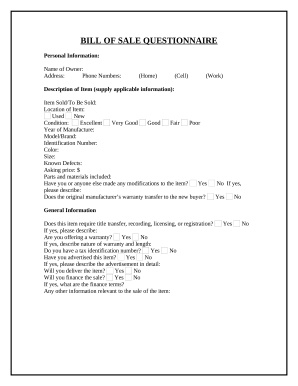
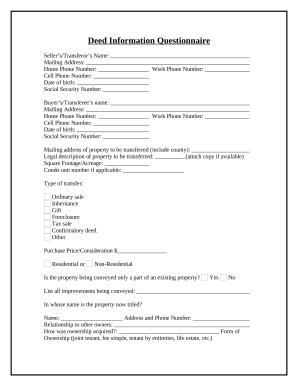
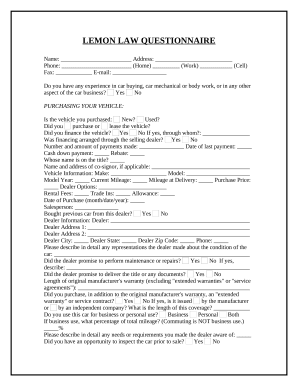
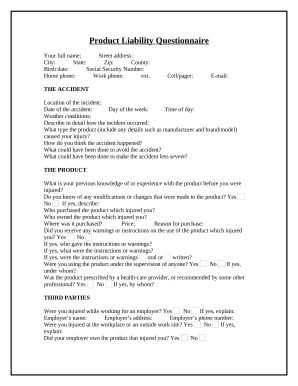
Handle Legal Questionnaires easily online

Document administration can stress you when you can’t discover all the forms you require. Fortunately, with DocHub's considerable form library, you can find all you need and promptly deal with it without changing among programs. Get our Legal Questionnaires and start utilizing them.

How to use our Legal Questionnaires using these easy steps:

  1. Examine Legal Questionnaires and select the form you require.
  2. Preview the template and click Get Form.
  3. Wait for it to upload in the online editor.
  4. Modify your document: include new information and images, and fillable fields or blackout certain parts if required.
  5. Fill out your document, preserve adjustments, and prepare it for sending.
  6. When all set, download your form or share it with your contributors.

Try out DocHub and browse our Legal Questionnaires category with ease. Get your free account today!


Video Guide on Legal Questionnaires management

video background

Commonly Asked Questions about Legal Questionnaires

QUESTIONNAIRES METHOD It consists of a number of questions that may be open-ended or closed- ended. In open-ended questions, the respondent needs to answer the question in his/her way, whereas in closed-ended questions respondent has to choose an answer from a given set of options.
This method is helpful as it implies both quantitative and subjective information can be gotten for the analysis of service quality questionnaire. Types of questionnaires: Exploratory questionnaire (qualitative) Formal standardized questionnaire (quantitative) Open-ended questionnaire. Closed questionnaire.
A question of law is an issue that is always resolved by a judge, not a jury, including: A question regarding the application or interpretation of a law.
Definition Citations: An interrogation put to a witness, for the purpose of having him declare the truth of certain facts as far as he inows them. In practice. A point on which the parties are not agreed, and which is submitted to the decision of a judge and jury.
Here are some examples of legal questions that people might commonly ask: Criminal Law: Is it legal to record phone conversations without the other partys consent in my state? Family Law: What are the legal requirements for filing for divorce in my jurisdiction?
The key here is Justice Barretts definition of the phrase purely legal: issues that can be resolved without reference to any disputed facts.[10] Not were, or must be, but can.
A legal question is a question that needs to be answered by a judge about the law. It can be about how to apply or interpret the law, or what the law is on a particular point. Sometimes, the law has already answered the question, so the judge cannot decide it in a different way.