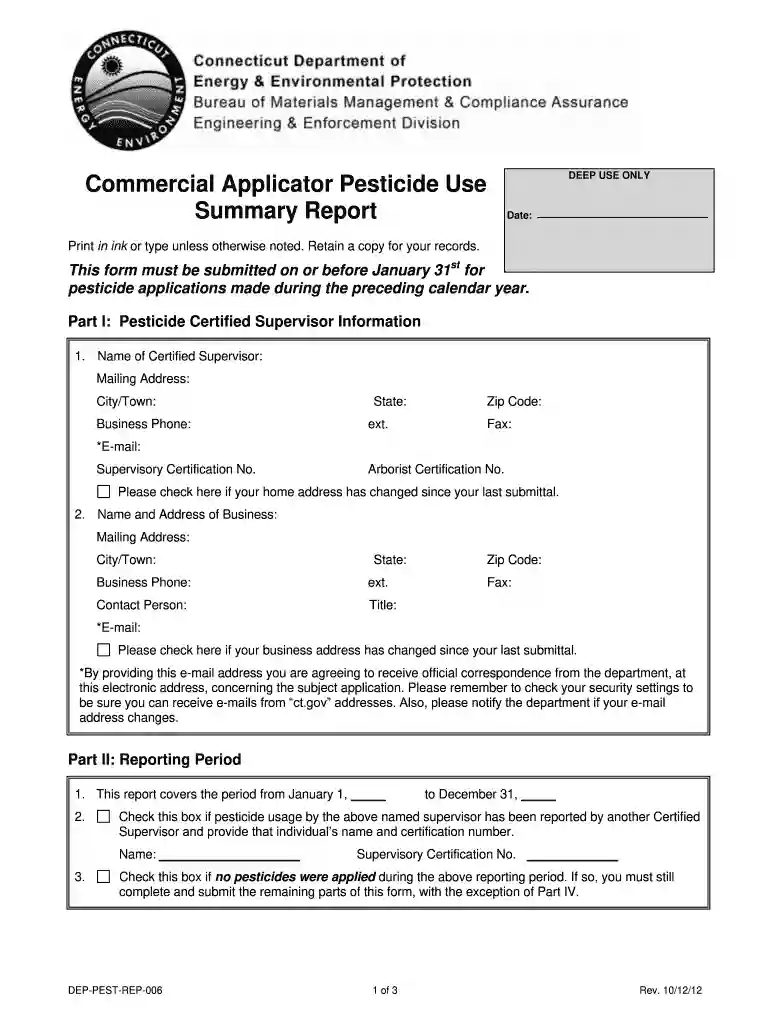
Ct form pesticide 2025

Get Form
ct pesticide use report Preview on Page 1

Here's how it works

01. Edit your ct pesticide use report online
Type text, add images, blackout confidential details, add comments, highlights and more.

02. Sign it in a few clicks
Draw your signature, type it, upload its image, or use your mobile device as a signature pad.

03. Share your form with others
Send connecticut pesticide registration via email, link, or fax. You can also download it, export it or print it out.

How to use or fill out ct form pesticide with our platform

Form edit decoration
9.5
Ease of Setup
DocHub User Ratings on G2
9.0
Ease of Use
DocHub User Ratings on G2
  1. Click ‘Get Form’ to open the ct form pesticide in the editor.
  2. Begin with Part I by entering the Certified Supervisor Information. Fill in your name, mailing address, city/town, business phone, state, zip code, fax number, email, and certification numbers. Ensure all fields marked with an asterisk are completed.
  3. Proceed to Part II: Reporting Period. Specify the reporting period for pesticide usage by entering the start and end dates. If another supervisor has reported usage, check the appropriate box and provide their name and certification number.
  4. In Part III, enter the Certified Applicator’s Information including their name and certification number.
  5. For Part IV: Commercial Pesticide Usage, list each pesticide product used along with its EPA registration number and total amount used before diluting. Check if additional sheets are needed.
  6. Finally, complete Part V by certifying the accuracy of the information provided. Sign and date where indicated.

Start using our platform today to easily fill out your ct form pesticide for free!

See more ct form pesticide versions

We've got more versions of the ct form pesticide form. Select the right ct form pesticide version from the list and start editing it straight away!
Versions Form popularity Fillable & printable
2012 4.9 Satisfied (42 Votes)
be ready to get more

Complete this form in 5 minutes or less

Get form

Got questions?

We have answers to the most popular questions from our customers. If you can't find an answer to your question, please contact us.
Contact us
Pesticides (chemicals used for killing pests, such as rodents, insects, or plants) 2,4-Dichlorophenoxyacetic Acid (2,4-D) Aldrin/Dieldrin. Atrazine. Chlordane. Chlordecone. DDT, DDE, DDD. Endosulfan. Endrin.
Several types of pesticide application equipment are used, including liquid pumps (manual and power operated), liquid atomizers (hydraulic energy, gaseous energy, and centrifugal energy), dry application, and soil application (liquid injection application).
Registration: Under Section 3 of FIFRA, we can register pesticides for use throughout the United States. We register some pesticides for more limited use in certain states. In addition, states, tribes and territories can place further restrictions on pesticides used or sold within their own jurisdictions.
About pesticides Examples include insecticides, fungicides, herbicides, molluscicides, and plant growth regulators. They can exist in many forms, such as solid granules, powders or liquids and consist of one or more active substances co-formulated with other materials.
Plant Protection: How to Use Pesticides Appropriately Correctly identify insect and mite pests. Thoroughly cover all plant parts with spray solutions. Time pesticide applications ingly. Monitor water quality. Rotate pesticides with different modes of action. Apply pesticides frequently enough.

People also ask

Chlorpyrifos, an organophosphate insecticide, is the most widely used insecticide in the U.S. It is used both in agriculture and for pest control in houses and other buildings. Americans are widely exposed to chlorpyrifos. Typical diets, particularly those of children, contain significant chlorpyrifos residues.
Soluble - Able to be dissolved in another substance, usually a liquid. Solvent - A liquid, such as water, kerosene, xylene, or alcohol, that will dissolve a pesticide (or other substance) to form a solution. Suspension - A substance that contains undissolved particles mixed throughout a liquid.

ct deep pesticide usage report