




What the petition means
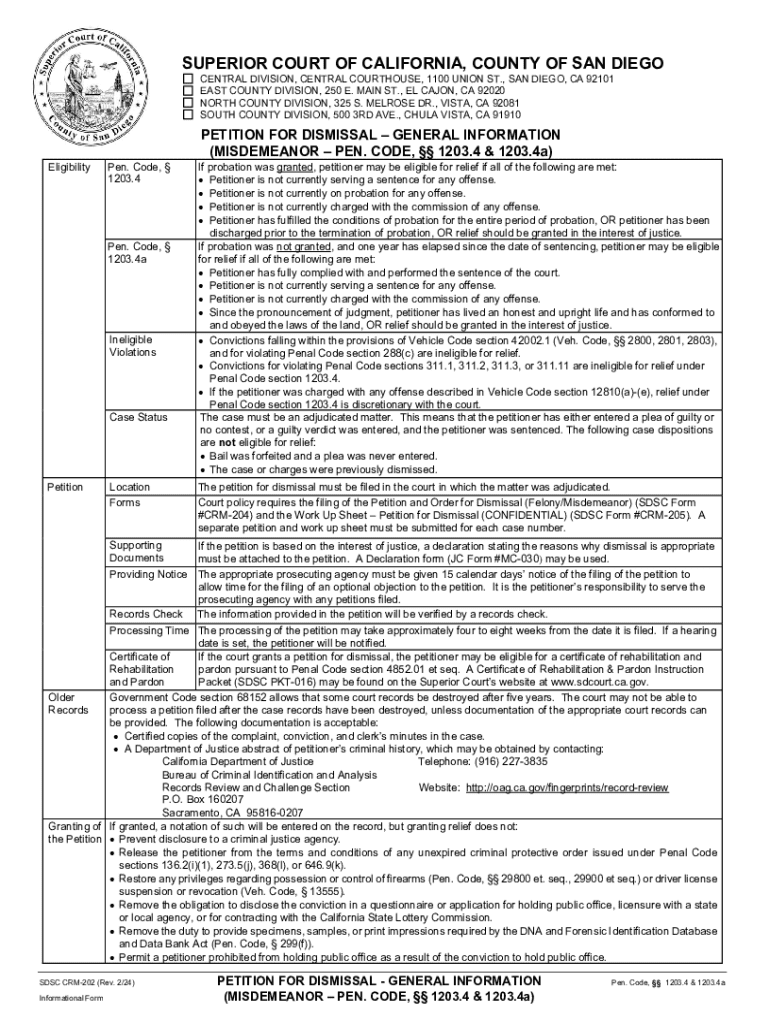
A California misdemeanor petition for dismissal is a request made to a California court to end certain misdemeanor consequences after a case has been completed. In many situations, this is associated with Penal Code section 1203.4, which allows a person to ask the court to withdraw a guilty or no contest plea, or to set aside a verdict, and then dismiss the case.
The practical meaning is not the same as erasing the case from history. The dismissal can help reduce some of the long-term effects of a misdemeanor conviction, but it does not always remove every legal consequence. For example, the record may still exist, and the case may still appear in some background checks or court systems, depending on the type of offense and the context of the request.
This form is commonly used after probation is finished, or after a person has complied with the court’s orders in a case where probation was not imposed. In some cases, the request is straightforward. In other cases, the court must review eligibility issues such as outstanding fines, new convictions, or whether the offense is one that can be dismissed under California law.
The petition is also important because it creates a formal court record of the request. Even when a person is eligible, dismissal is not automatic in every situation. The judge may need to evaluate the case history, probation status, restitution, and any statutory limitations before signing an order.
A common example involves someone convicted of a low-level misdemeanor several years ago, who completed probation, paid all court-ordered amounts, and has had no new arrests. That person may use the petition to ask the court to dismiss the conviction and restore some civil rights or employment opportunities that may be affected by the conviction record.
Another example is a person who pleaded no contest to a misdemeanor DUI-related offense. Depending on the facts of the case and the exact charge, dismissal may or may not be available, and other restrictions may apply. That distinction is one reason the form is often reviewed alongside the criminal case file, not in isolation.
Because the form has legal consequences, precision matters. The court needs identifying details such as the case number, conviction date, charge title, sentencing information, and the specific relief requested. Missing or inaccurate information can delay review or result in a denied petition.
Who usually files it
People who file a California misdemeanor petition for dismissal are typically individuals who were defendants in a criminal case and want the court to reconsider the lasting effect of a misdemeanor conviction. This is often done after the person has already completed the obligations tied to the case.
The most common filer is someone who finished probation successfully. That can include people who completed informal probation, paid fines, attended court-ordered programs, and remained free of new criminal issues. For many people, this petition is part of a broader effort to improve employment, housing, licensing, or educational prospects.
A second common filer is someone who was not placed on probation but completed all sentence requirements. In some cases, a misdemeanor conviction without probation may still be eligible for dismissal if the person has complied with all court-ordered conditions, including restitution.
People with older misdemeanor cases also use this form when they are reviewing their criminal record for professional licensing or immigration-related concerns. The goals in those situations may differ, but the petition is still directed at obtaining a court dismissal where the law permits it.
Some petitioners are represented by attorneys, while others file on their own. Self-represented individuals often rely on the criminal case docket, minute orders, or sentencing paperwork to confirm whether they qualify and what should be listed on the petition.
This form may also be used by people with multiple misdemeanor cases. In those situations, separate case numbers, different conviction dates, and different eligibility issues can make the filing more complex. A person might qualify for dismissal in one case but not another, even if both are from the same county.
The petition is not generally intended for employers, family members, or outside organizations to use on someone’s behalf. It is a court filing made by the person affected by the conviction, unless an attorney or legally authorized representative is acting within the scope of representation.
Eligibility and legal limits
Eligibility is one of the most important issues in a California misdemeanor petition for dismissal. The court does not grant every request automatically, and the law places limits on which convictions can be dismissed, when, and under what conditions. The exact rules depend on the offense, the sentence, and whether probation has been completed.
A person is often eligible if they have finished probation and complied with the court’s orders. That usually means no unpaid fines or fees that the court requires as part of the case, no outstanding restitution unless otherwise addressed, and no current probation violations. Some courts will look closely at whether the person is still serving a term tied to the same case.
There are exceptions. Certain offenses are excluded from dismissal, and some convictions may have special statutory consequences that remain even after dismissal. For example, a dismissal under Penal Code section 1203.4 does not necessarily restore firearm rights, eliminate sex offender registration obligations, or remove immigration consequences. Those issues often require separate legal analysis.
A prior violation or new criminal case can also affect eligibility. If a person was convicted of a new offense after the misdemeanor case, the court may still review the petition, but the result may depend on whether the new case shows compliance or rehabilitation. Some courts focus heavily on whether the petitioner has remained law-abiding since the conviction.
Restitution can be a critical issue. If the original case involved harm to a victim, the court may require proof that restitution was paid in full or otherwise resolved. In cases involving traffic-related offenses, DUI-related charges, or theft, this can be one of the first items the court examines.
Another limitation involves cases that were reduced or dismissed through other procedures. If the conviction was already converted to a different status, or if the relief requested is not legally available for the charge type, the petition may need to be adjusted or may not be appropriate at all.
It is also important to distinguish dismissal from expungement in everyday language. Many people use those terms interchangeably, but in California the petition is usually a request for dismissal under a specific statute, not a true erasure of the record. That distinction matters when explaining the effect to an employer, licensing agency, or court.
Core information the form asks for
The petition generally requires enough information for the court to identify the exact case and confirm whether the request can be reviewed. The most important details usually include the court name, county, case number, conviction charge, plea or verdict type, and the date of judgment.
The form often asks for the petitioner’s full legal name and contact details. These must match the court file as closely as possible. If a person has changed names, uses a former name, or was listed differently on the original case, the petition should usually reflect those differences so the court can match records accurately.
Another key element is the sentencing history. The court may need to know whether probation was granted, whether the sentence included jail time, whether fines were paid, and whether the case was completed. If the petitioner is asking for dismissal after probation, the petition may need to show that probation was terminated or completed successfully.
The petition may also include a request to set aside the plea or verdict and dismiss the accusation. That request language matters because the court’s order should match the statutory authority being used. If the form is incomplete or the wrong legal basis is cited, the court may not process it as intended.
Supporting information can also be important even if it is not technically part of the form itself. For example, a declaration can explain why the person believes they qualify, or a copy of the minute order can show that probation ended. These details help the judge understand the request without requiring the court clerk to reconstruct the whole case history.
If the original case involved multiple counts, the form may need to specify which counts are being dismissed. Some cases contain charges that are eligible and others that are not. That is especially important when a plea agreement resolved more than one count, or when the case included amended charges.
Accuracy in dates, charge names, and court division is essential. A mismatch between the petition and the criminal record can create delays, additional hearings, or the need to file a corrected version. In practice, this is one of the most common reasons petitions require follow-up.
How the filing process works
The process for a California misdemeanor petition for dismissal usually begins with reviewing the criminal case file and determining whether the person qualifies. That review often starts with the sentence, probation status, restitution, and any subsequent convictions that may affect the request.
After eligibility is reviewed, the petitioner completes the form with the identifying case information and the legal basis for the request. Some courts also require a declaration or proposed order. A proposed order is useful because it gives the judge a ready-made document to sign if the petition is granted.
Once completed, the petition is typically filed with the superior court that handled the criminal case. In many counties, filing can be done in person, by mail, or through a court-approved electronic filing system if available for that case type. The proper method depends on local court rules.
After filing, the court may set a hearing date or review the papers without a hearing, depending on the county and case type. Some petitions are decided based on the written submission alone, while others require appearance by the petitioner or counsel. If a hearing is scheduled, notice rules may apply, especially if the prosecutor or probation department has a right to be heard.
The prosecutor may object if there is a dispute about eligibility or compliance. For example, the government may argue that restitution remains unpaid, that the conviction is not eligible under the statute, or that there is a pending matter affecting the request. Those objections can change the court’s review process.
If the court grants the petition, the dismissal order is entered in the case file. The practical effect may include changing the public court record to show the dismissal, though the conviction may still exist for certain purposes such as specific licensing, immigration, or law enforcement review.
If the petition is denied, the court may explain why. Common reasons include ineligibility, incomplete paperwork, unresolved financial obligations, or lack of proof that the person completed the sentence. In some cases, the petitioner can correct the issue and refile later if the law allows it.
Required records and supporting papers
The most useful supporting documents are those that verify the criminal case history. That usually includes the minute order, abstract of judgment, sentencing order, or any paperwork showing the final disposition of the misdemeanor case.
Proof of probation completion can be especially important. If probation was supervised, a letter or record from probation may show that the term ended successfully. If probation was not supervised, the petitioner may still need to show that the sentence was fully completed.
Payment records can also matter. Receipts, court ledger printouts, or documentation showing that fines, fees, and restitution were paid can strengthen the petition. Even when payment is not disputed, having proof reduces the risk of delay or an evidentiary objection.
In some cases, a person may need documentation about related charges, amendments, or dismissed counts. This helps show which charge is the subject of the petition and whether any part of the case remains active. This is especially relevant when the criminal docket includes multiple case numbers or related citations.
A declaration can be useful when the facts are not fully visible from the court file. For example, a petitioner may explain that the conviction has made it difficult to obtain a professional license, or that the person has maintained steady employment and has had no new cases. While the court focuses on legal eligibility, this context can still help explain why the dismissal is being sought.
If the case involved domestic violence, theft, intoxication-related conduct, or a victim restitution order, additional documentation may be needed to show compliance with the sentence. Some courts are particularly attentive to whether all victim-related obligations are resolved before granting relief.
Keeping the paperwork organized is often as important as the content itself. When a petition is supported by clear records, the court can more easily confirm the case history. In practical terms, that can reduce continuances and avoid confusion about what the petitioner is asking the court to do.
Important California rules
California’s rules on misdemeanor dismissal are shaped by statute, court procedure, and county-specific practices. The general legal framework is statewide, but the mechanics of filing, hearing scheduling, and local review can vary from one superior court to another.
A major California rule is that dismissal relief is not the same as removing the fact that the conviction happened. The court may dismiss the case, but the dismissal does not always eliminate the conviction for all purposes. Employers, licensing boards, and government agencies may still have access under certain circumstances.
Another important rule is that some consequences survive dismissal. Firearm prohibitions, immigration consequences, and sex offender registration obligations are examples of issues that may remain in place unless separate legal relief applies. That is why petitioners often need to understand the precise scope of the dismissal order.
California also distinguishes between offenses and sentencing structures. A case involving summary probation may be treated differently from one involving jail time or suspended execution of sentence. The court may also care about whether the person complied with all probation terms, including counseling, classes, or community service.
County practice can matter as well. In one county, the court may accept a petition without a hearing if the record is clear. In another, the court may prefer a hearing or require local forms, a cover sheet, or proof of service. Those procedural differences do not change the underlying law, but they can affect how the petition is processed.
The timing of the request matters. Some people wait until all obligations are completed and the case is closed. Others file later when a job application, licensing review, or background check brings the issue to attention. The law may allow the petition later, but filing before the sentence is complete can cause a denial.
California courts also tend to require exact case identification. If the petitioner has more than one misdemeanor case, each docket must be matched correctly. A mistake here can lead to the wrong case being dismissed or the petition being overlooked in the court system.
Common filing scenarios
One common scenario involves a person who completed probation for petty theft, paid all fines, and has no new convictions. That petitioner may seek dismissal to reduce barriers to retail employment, professional licensing, or housing applications. The court will usually focus on eligibility, completion, and whether the case qualifies under the statute.
Another scenario involves a person convicted of a misdemeanor after a plea bargain, where the person did not receive probation but did complete a short jail term and paid the required amounts. In that situation, dismissal may still be possible if all sentence obligations were satisfied and the charge is eligible.
A student with an older misdemeanor involving alcohol, vandalism, or disorderly conduct may file the petition years later when applying for graduate school or a licensed program. Even if the conviction was minor, schools and professional boards sometimes ask about convictions, so the dismissal may matter for disclosure and record interpretation.
A retired person may use the petition to clear up a decades-old misdemeanor before applying for a volunteer role, a public appointment, or a government clearance. In older cases, records may be harder to locate, so the filing may depend heavily on archived minute orders or court ledger entries.
A self-employed person may seek dismissal after a conviction interferes with a business license, contracting opportunity, or vendor approval process. Even when the business is unrelated to the original offense, the petition can be relevant to reputation and regulatory review.
Some cases are more complicated. For example, a person with a misdemeanor conviction plus a separate probation violation may need to resolve the violation issue before the court will consider dismissal. Another person may have a conviction that looks eligible but is affected by a later offense, unpaid restitution, or a charge type excluded from relief.
These scenarios show why the same form can have different outcomes. The paper itself may be simple, but the underlying case history is often the deciding factor.
Common mistakes and denial issues
A frequent mistake is filing before probation is fully completed or before the court has released all obligations. If a petitioner still has outstanding terms, the request may be premature and may be denied or continued until the record is complete.
Another common issue is incomplete information. Missing case numbers, incorrect charge titles, wrong dates, or a mismatch between the petition and the criminal docket can slow down processing. In some cases, the court cannot identify the case without a corrected filing.
Unresolved restitution is another major denial reason. Even if the person has paid all fines, an unpaid victim restitution balance can be enough to stop the dismissal request. Courts tend to treat restitution seriously, and the petitioner may need proof that the obligation is satisfied or legally addressed.
People also sometimes assume dismissal removes every consequence. That misunderstanding can lead to problems on job applications or licensing disclosures. For example, a dismissed case may still need to be disclosed in certain professional settings, depending on the question asked and the governing rules of the agency.
Another issue involves requesting relief for a charge that is not eligible. Some petitioners use a generic template without checking whether the exact offense falls within the dismissal statute. If the offense is excluded, the court may deny the petition regardless of how well the form is filled out.
Failure to serve required parties, when service is needed, can also create problems. Certain courts or case types may require notice to the district attorney or probation department. If those notices are missing, the court may not proceed.
Finally, petitioners sometimes omit supporting documentation. Even where the law may permit the dismissal, the court may need proof of sentence completion or payment history before ruling. A petition that is technically correct but poorly documented can still face delay.
Related forms and alternatives
The California misdemeanor petition for dismissal is one option within a larger set of post-conviction remedies. Depending on the case, another form of relief may be more appropriate, or it may need to be used alongside the dismissal petition.
For some people, the better option may be a record-sealing process, a reduction of charges, or a certificate of rehabilitation in a different context. Those remedies are not the same as dismissal and are governed by different rules. The right procedure depends on the offense type and the long-term goal.
If a case involved a felony later reduced to a misdemeanor, the relevant paperwork may be different from a standard misdemeanor dismissal petition. In those situations, the petitioner may need to confirm whether the current record reflects the reduced offense or the original charge.
Some counties use local supplemental forms or proposed orders in addition to the main petition. Those forms may help the court process the request more efficiently, especially when the case file is old or there are multiple counts. A petitioner should not assume the main form alone is sufficient in every county.
There are also older versions or county-specific variants of similar paperwork. A petitioner using a form from an older packet should verify that the case number, caption, and statutory references still match current practice. Even small differences in wording can matter when a court clerk reviews the filing.
In practice, the most useful alternative is often not another petition, but a careful review of the original criminal case record. That review helps determine whether the person should be asking for dismissal, reduction, sealing, or some other form of post-conviction relief. The correct choice depends on the case facts, the conviction, and the relief sought.
Filing deadlines and timing
There is not always a single universal deadline for a California misdemeanor petition for dismissal, but timing still matters. The most important trigger is usually completion of probation or completion of all sentencing requirements if probation was not ordered.
Filing too early can cause avoidable problems. If probation is still active, the court may deny the petition or postpone consideration. Similarly, if community service, counseling, restitution, or court-ordered programs are still incomplete, the petition may not be ready for review.
Some people wait months or years after eligibility begins. That is often because they did not know about the option, or because they waited until a job, housing application, or licensing issue made the conviction record more important. Late filing is often allowed if the statute still permits relief, but the court will still review the underlying eligibility.
If there are multiple case numbers, the timing may differ by case. One misdemeanor may be eligible for dismissal now, while another remains open or unresolved. Filing all related matters together can be efficient, but only if the legal status of each case has been confirmed.
Deadlines can also be affected by court processing time. A county with a heavy criminal calendar may take longer to review the petition or schedule a hearing. That means timing is not just about eligibility, but also about how soon the court can act.
A practical issue is whether the person needs the dismissal before an upcoming background check, application deadline, or licensing review. While the petition may be filed promptly, the approval time can still vary, so the court’s pace is part of the timing calculation.
In some cases, petitioners also need to keep copies of filing proof and the signed order for future use. If the dismissal is granted, the date of the order may be important when responding to employment or licensing questions that ask about recent court action.