
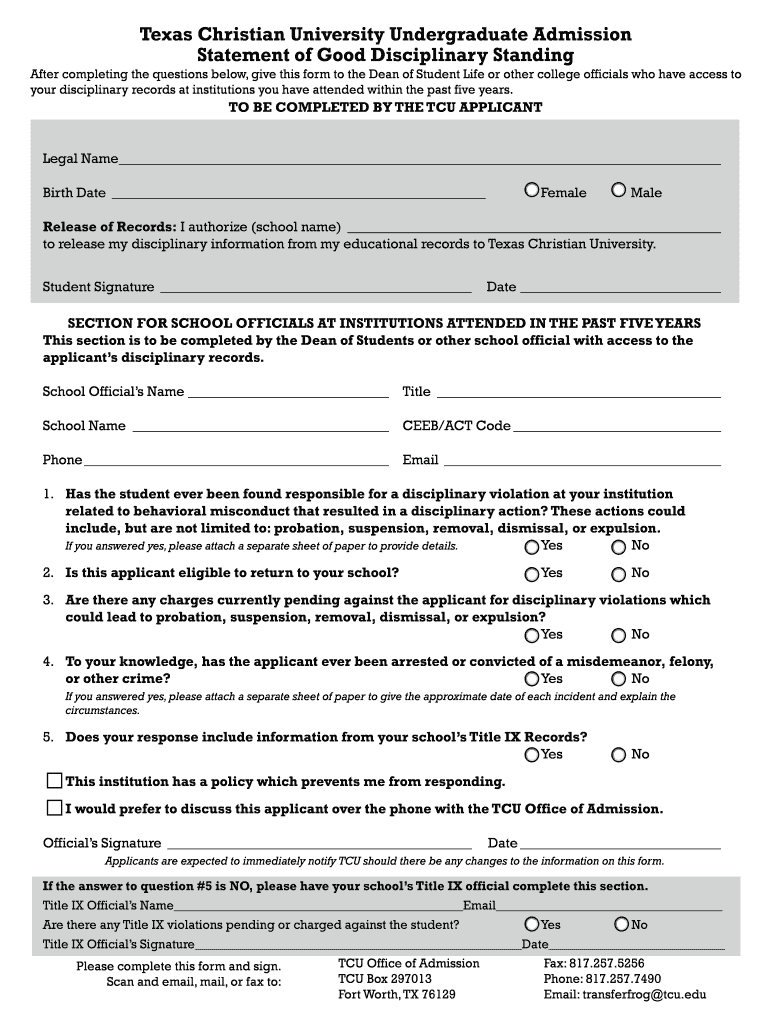







Definition & Purpose of the Texas Christian University Admission Disciplinary Form
The Texas Christian University Admission Disciplinary Form serves as a crucial part of the admissions process, ensuring that prospective students uphold standards of good conduct. This form requires applicants to provide information regarding their disciplinary history, which helps the university maintain its community standards. By reviewing an applicant’s previous conduct, the admissions team can assess the applicant's suitability and potential impact on campus life.
Importance for Applicants
- Establishes a record of accountability and integrity.
- Affects admission decisions based on past behavior.
- Provides the university with necessary context regarding any past issues or resolutions.
University’s Interest
- Maintains a campus environment aligned with TCU’s values.
- Ensures compliance with academic and behavioral expectations.
How to Obtain the Texas Christian University Admission Disciplinary Form
The Texas Christian University Admission Disciplinary Form can be acquired through several convenient methods:
-
Online Access:
- Visit the official TCU admissions webpage.
- Navigate to the forms or resources section to find the downloadable PDF version.
-
Admissions Office:
- Request a physical copy by visiting the admissions office in person.
-
Email Request:
- Contact the admissions office through their official email to request the form.
Tips
- Verify the form version: Ensure you are using the most current form available.
- Check compatibility: Confirm that you can fill out the form using standard PDF software.
Steps to Complete the Texas Christian University Admission Disciplinary Form
Completing the Texas Christian University Admission Disciplinary Form involves several key steps to ensure accuracy and completeness:
-
Read Instructions Thoroughly:
- Start by reviewing all provided instructions to understand the form's requirements.
-
Fill Out Personal Information:
- Provide accurate details such as name, contact information, and student ID.
-
Document Past Disciplinary Actions:
- Accurately list any past disciplinary actions, including dates and resolutions.
- Provide additional context if necessary to explain circumstances.
-
Obtain Verifications:
- Secure signatures from appropriate officials such as a dean or student life officer to verify the information.
-
Review and Submit:
- Double-check all entries for accuracy.
- Submit the form via specified methods: online, mail, or in person.
Common Pitfalls
- Missing important details or sections.
- Failing to obtain necessary signatures or verifications.
- Submitting the form past relevant deadlines.
Who Typically Uses the Texas Christian University Admission Disciplinary Form
The primary users of the Texas Christian University Admission Disciplinary Form include:
-
Prospective Students:
- Mainly those applying for undergraduate or graduate programs at TCU.
-
University Officials:
- Admissions personnel who review disciplinary history as part of decision-making.
- Deans or student life officers responsible for verifying the information.


Situations of Use
- Applicants with previous infractions seeking to clarify their records.
- University staff confirming adherence to application protocols.
Key Elements of the Texas Christian University Admission Disciplinary Form
The Texas Christian University Admission Disciplinary Form comprises several crucial components that applicants must complete:
-
Applicant Information:
- Basic personal details and contact information are required at the form's beginning.
-
Disciplinary History Section:
- Detailed account of any past infractions, including incident dates and outcomes.
-
Certification and Signatures:
- Mandatory verification from current or previous educational institution officials.
Essential Documentation
- Copies of relevant disciplinary records may be required to substantiate claims.
- Verification letters from other institutions, if applicable.
Legal Use and Compliance
The form's legality ensures that applicants provide truthful disclosures, which are integral to upholding admissions integrity:
-
ESIGN Act Compliance:
- Electronic submissions must adhere to legal standards for signatures and document integrity.
-
Privacy Considerations:
- Under FERPA, applicants' educational history is protected, and information should only be used for admitted purposes.
Consequences of Misrepresentation
-
Disqualified Applications:
- Falsifying information can lead to application rejection.
-
Disciplinary Actions Post-Admission:
- Discovered discrepancies may result in expulsion or further disciplinary action.
State-by-State Rules and Variations
While the Texas Christian University Admission Disciplinary Form generally follows a standard format, certain state-specific regulations may influence its application:
-
State Education Laws:
- Some states have specific laws governing the disclosure of student records.
-
Regional Behavioral Standards:
- Disciplinary actions categorized differently based on local regulations.
Contextual Implications for Texas
- Texas state education policies impact how disciplinary actions are documented and evaluated.
Digital vs. Paper Versions
Applicants may opt for either digital or paper submissions, each with distinct advantages:
-
Digital Submission:
- Instant submission and processing; ease of electronic verification.
- Requires access to appropriate technology for completion and submission.
-
Paper Submission:
- Traditional method offering a tangible record.
- May be preferable for individuals or institutions favoring physical documentation.
Considerations
- Ensure all submissions, digital or physical, include all required signatures and verifications.
- Be aware of the university's preferred or mandated submission methods to avoid unnecessary delays.




