







Definition and Meaning of the Example Category Determination Form - CT - ct
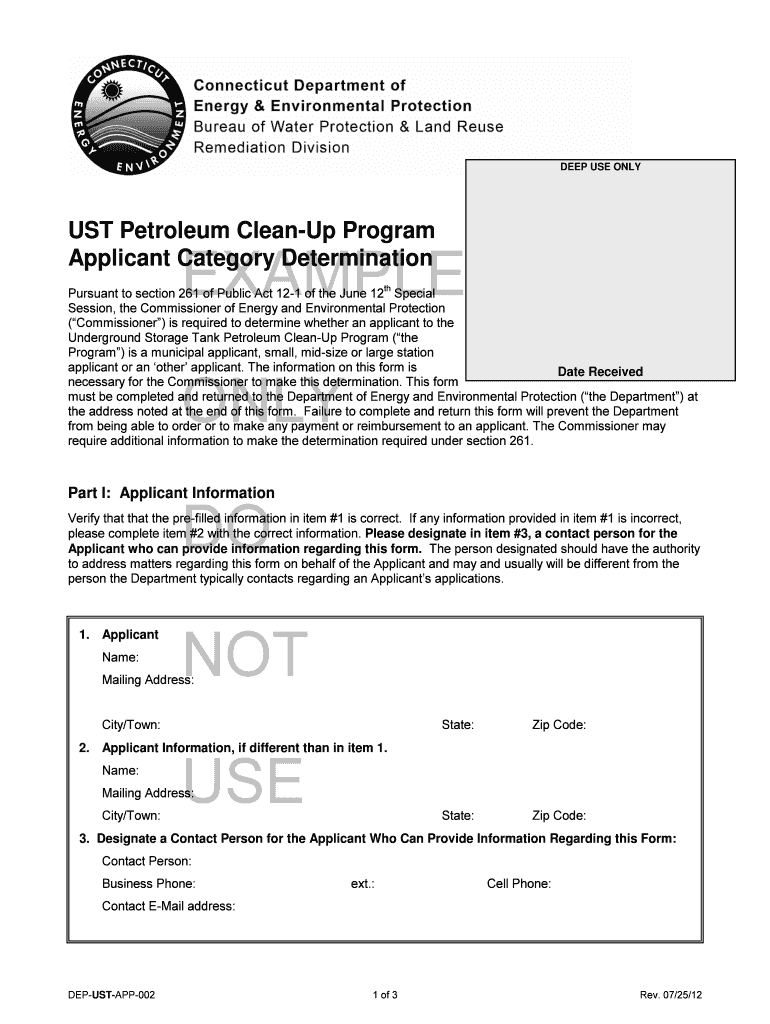
The Example Category Determination Form - CT - ct is designed to help applicants assess their categorization within the Underground Storage Tank Petroleum Clean-Up Program framework. Its primary function lies in identifying whether an applicant falls under the municipal, small, mid-size, large, or other categories, based on the ownership and operation details of underground storage tank systems. This form serves as a critical document for applications seeking to participate in the financial assistance program offered by the Connecticut Department of Energy and Environmental Protection.
Key Elements of the Example Category Determination Form
The form contains specific sections aimed at gathering comprehensive information from the applicant. Key elements include:
- Applicant Information Section: Collects basic identifying details such as name, contact information, and relevant property addresses.
- Category Determination Based on Property Parcels: Requires the applicant to indicate the size and ownership of property parcels to accurately classify their category.
- Certification Statement: The applicant is prompted to sign a statement certifying the accuracy of the information provided, which is necessary for legal compliance and processing.
Steps to Complete the Example Category Determination Form - CT - ct
Filling out the Example Category Determination Form - CT - ct involves several detailed steps to ensure accuracy and compliance:
- Gather Required Information: Collect all necessary details regarding underground storage tanks, property ownership, and operation specifics.
- Complete Applicant Information: Fill in your personal and property-related information accurately.
- Determine and Indicate Category: Use the information about your property parcels to choose the appropriate category.
- Review and Sign Certification: Ensure all information is accurate and sign the certification statement to validate the document.
Important Considerations
- Accuracy is Crucial: Any inaccuracies could result in delays or denials of program participation.
- Specific Details Needed: The form requires precise measurements and ownership details for proper categorization.
Legal Use of the Example Category Determination Form - CT - ct
The form is a legally binding document, primarily used to facilitate participation in the Underground Storage Tank Petroleum Clean-Up Program by correctly categorizing applicants. Its legal significance is underscored by:
- Certification Requirement: Applicants must sign to certify the accuracy of their information.
- Compliance with State Regulations: The form ensures alignment with Connecticut's environmental and safety standards related to underground storage tanks.
State-Specific Rules for the Example Category Determination Form
Connecticut imposes particular regulations pertaining to the management and cleanup of underground storage tanks. These rules dictate:
- Eligibility for Programs: Only applicants who accurately categorize and document their storage systems are eligible for program benefits.
- Property and Operations Standards: Properties and operations must meet specific standards outlined by Connecticut authorities to qualify.
Obtaining the Example Category Determination Form - CT - ct
The form can be acquired through various channels, ensuring accessibility:
- Online Access: Many state websites provide digital copies for download.
- Direct Request from Department: Applicants can contact the Connecticut Department of Energy and Environmental Protection for a physical copy.
Who Typically Uses the Example Category Determination Form - CT - ct
The form is predominantly used by:
- Property Owners and Operators: Individuals or entities owning or operating underground storage tanks.
- Municipal Authorities: Local government bodies managing environmental protection programs.
- Corporate Entities: Companies requiring participation in clean-up programs for compliance and financial assistance.


Penalties for Non-Compliance
Failure to comply with the form's requirements can result in several penalties:
- Denial of Program Benefits: Incorrect or incomplete forms may lead to loss of financial assistance eligibility.
- Fines and Legal Action: Non-compliance with state regulations may incur fines and potential legal consequences.
Importance of Compliance
Adhering to the form’s requirements and accurately determining category classification not only secures potential program benefits but also ensures lawful operation under Connecticut’s environmental laws.




