






Definition and Meaning
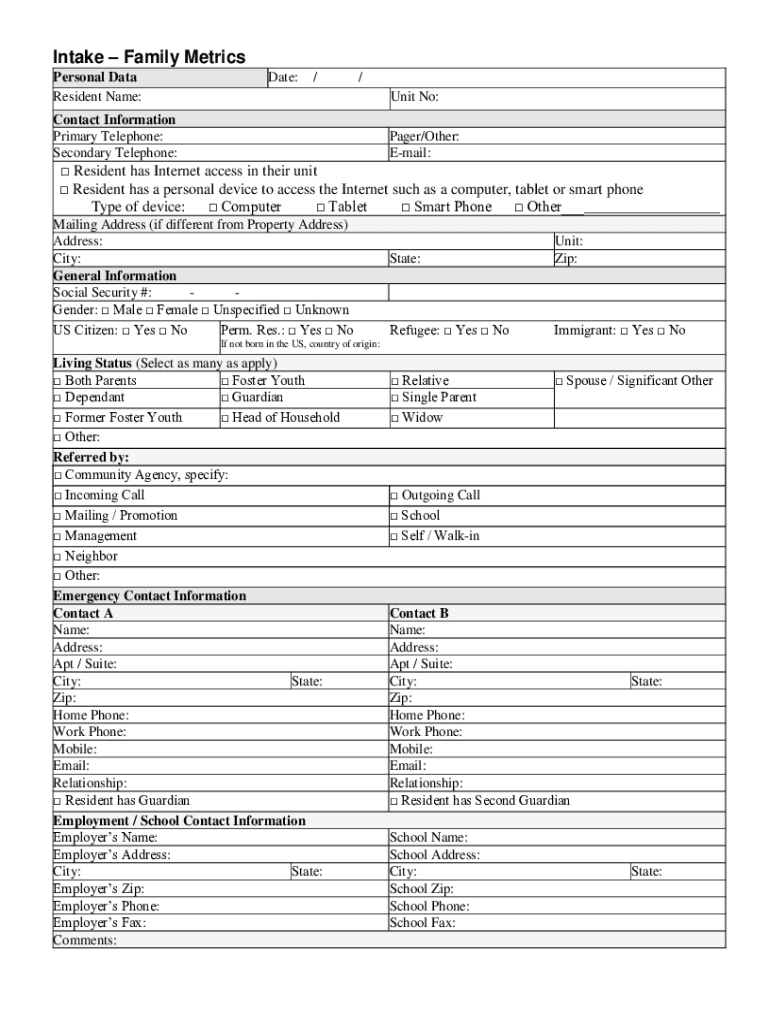
The Family Metrics Intake Form is a critical tool used for collecting essential data about family members, with a focus on various metrics such as demographics, housing, and emergency contact information. This form serves multiple purposes, including facilitating communication between service providers and families, ensuring accurate record-keeping, and aiding in service delivery planning. Its structure is designed to gather comprehensive information that assists organizations in understanding family dynamics and needs.
Purpose and Utilization
The form captures detailed information that supports providers in creating tailored service plans, tracking progress over time, and ensuring compliance with local and federal regulations. It is used by social services, healthcare providers, and educational institutions to streamline processes and improve outcomes for families. An example of its practical application includes assessing eligibility for assistance programs or personalized planning in educational settings.
How to Use the Family Metrics Intake Form
Filling out the Family Metrics Intake Form involves clear guidelines that ensure the efficient gathering of relevant information. Users should start by reading instructions carefully, focusing on providing accurate data in all required fields.
Step-by-Step Completion Process
- Contact Information: Enter primary and secondary contact numbers, email, and mailing address to ensure communication lines are open.
- Demographic Details: Provide personal data for each family member, such as age, relationship to the primary resident, and any special needs that may require attention.
- Housing Situation: Describe the current living arrangements to aid in contextual assessments for service provision.
- Emergency Contacts: List reliable emergency contacts to support prompt reactions during crises.
Practical Examples
A healthcare provider may use the form to record vital statistics and health history, tailoring healthcare services to the family's specific needs. Similarly, educational institutions might utilize demographic data to plan educational interventions.
Key Elements of the Family Metrics Intake Form
Understanding the components of the Family Metrics Intake Form helps in efficiently completing it and ensuring no detail is missed.
Core Sections
- Personal Data: Captures vital statistics like birthdates and gender.
- Contact Channels: Details primary and secondary communication methods.
- Living Arrangements: Includes unit numbers or descriptions of housing situations.
Detailed Examples
For demographic data, including specific cultural or language preferences, the form can help identify additional services, such as translation or culturally appropriate support.
Important Terms Related to the Family Metrics Intake Form
Familiarity with crucial vocabulary enhances comprehension and accurate form completion.
Terms to Recognize
- Primary Resident: Individual responsible for providing most information.
- Unit Number: Specific housing identification used in larger developments.
- Metrics: Quantifiable data points that guide service assessments.
Legal Use of the Family Metrics Intake Form
Using the Family Metrics Intake Form aligns with legal standards set by federal and state laws, ensuring privacy and compliance in data handling.
Compliance Considerations
Maintaining confidentiality and obtaining consent are pivotal when collecting personal data. It's crucial to adhere to regulations such as the Family Educational Rights and Privacy Act (FERPA) when forms include educational information.
Legal Variations by State
Each state may have specific guidelines regarding data collection and protection, affecting how intake forms are utilized. Understanding these nuances is essential for compliance and effective service provision.
Steps to Complete the Family Metrics Intake Form
Completing the form correctly enhances its utility and effectiveness.
- Gather Information: Collect all necessary documents and relevant details before starting.
- Read Instructions: Thoroughly review each section's requirements.
- Fill Out Data Sections: Enter information meticulously, ensuring accuracy.
- Review for Completeness: Double-check all fields to avoid missing data.
- Submit Form: Follow the preferred submission method, whether online or in-person.
Who Typically Uses the Family Metrics Intake Form
The form is used across various sectors to streamline data collection and decision-making.


Common Users
- Social Services: For assessing client needs and determining service eligibility.
- Healthcare Providers: To gather background information and plan care.
- Educational Systems: For enrolling students and planning educational strategies.

Contextual Examples
In social services, caseworkers utilize the form to track familial changes, while in healthcare, it helps in creating personalized care plans that reflect family contexts and needs.
Examples of Using the Family Metrics Intake Form
Practical scenarios demonstrate the form's varied applications in real-world settings.
Case Studies
A school district may utilize the form to understand familial support systems impacting a student's education. In healthcare, families with complex medical needs use it to convey crucial information to care teams, facilitating coordinated and comprehensive care delivery.