






Definition & Meaning
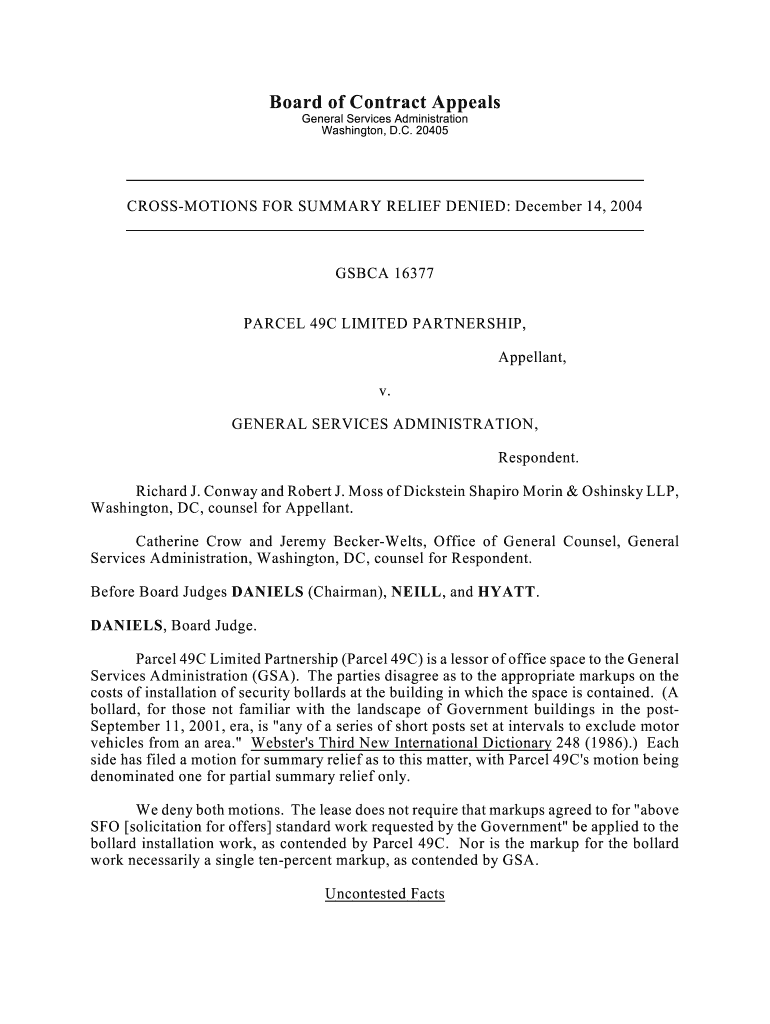
The term "cross-motions for summary relief" refers to a legal process where both parties in a dispute request the court or board to rule in their favor based solely on the facts presented, without going to trial. This specific case, decided on December 14, 2004, involves a dispute between Parcel 49C Limited Partnership and the General Services Administration (GSA) over the markups for security bollards at a leased office. The Board of Contract Appeals denied both parties' motions, clarifying misconceptions regarding contractual markup requirements.
How to Use the CROSS-MOTIONS FOR SUMMARY RELIEF DENIED: December 14, 2004
Understanding this decision is vital for legal professionals dealing with contract disputes involving government leases. The ruling underscores the importance of clearly defined contract terms and the legal standards necessary to challenge or defend a summary relief motion. Legal experts can reference this case to advise clients on similar issues of contractual interpretation and the requirements for successfully securing relief without a trial.
Steps to Complete the CROSS-MOTIONS FOR SUMMARY RELIEF DENIED: December 14, 2004
- Understand Case Details: Review the particulars of the Parcel 49C and GSA dispute, taking note of legal arguments and interpretations.
- Analyze Contract Terms: Evaluate the original lease to comprehend clauses relating to additional work and markups.
- Assess Legal Precedents: Consider how this decision might influence future rulings on similar contractual matters.
Key Elements of the CROSS-MOTIONS FOR SUMMARY RELIEF DENIED: December 14, 2004
- Parties Involved: Parcel 49C Limited Partnership and the GSA.
- Dispute Focus: Disagreement over the necessity and scope of markups for security installations.
- Decision Outcome: Both cross-motions were denied due to a lack of supporting contractual requirements as claimed by Parcel 49C.
Legal Use of the CROSS-MOTIONS FOR SUMMARY RELIEF DENIED: December 14, 2004
This decision has legal utility in illustrating how courts may interpret lease agreements in government contracts. It demonstrates that claims for additional compensation must have explicit contractual support. Legal professionals can use this to guide clients in drafting clear contracts and developing arguments for summary relief.
Important Terms Related to CROSS-MOTIONS FOR SUMMARY RELIEF DENIED: December 14, 2004
- Summary Relief: A judgment granted on the underlying facts without a trial.
- Bollards: Security devices reviewed in the dispute, highlighting the need to classify such installations correctly within contractual terms.
Examples of Using the CROSS-MOTIONS FOR SUMMARY RELIEF DENIED: December 14, 2004
Legal scenarios where this decision might be referenced include disputes over lease terms, unforeseen work charges, and contract modifications. The ruling can serve as a basis for arguing that markups not outlined explicitly in a contract cannot be assumed.
Who Typically Uses the CROSS-MOTIONS FOR SUMMARY RELIEF DENIED: December 14, 2004
Attorneys specializing in government contracts and lease agreements, especially those who handle cases involving federal properties or agencies, are most likely to find this documentation helpful. It provides a precedent for navigating legal challenges related to contractual interpretations and financial obligations in government leases.


State-Specific Rules for the CROSS-MOTIONS FOR SUMMARY RELIEF DENIED: December 14, 2004
While this case specifically pertains to a federal context, understanding the interplay between federal contract law and state laws where the contract execution occurs can be critical. Attorneys should consider local jurisdictional nuances that might impact similar cases.