
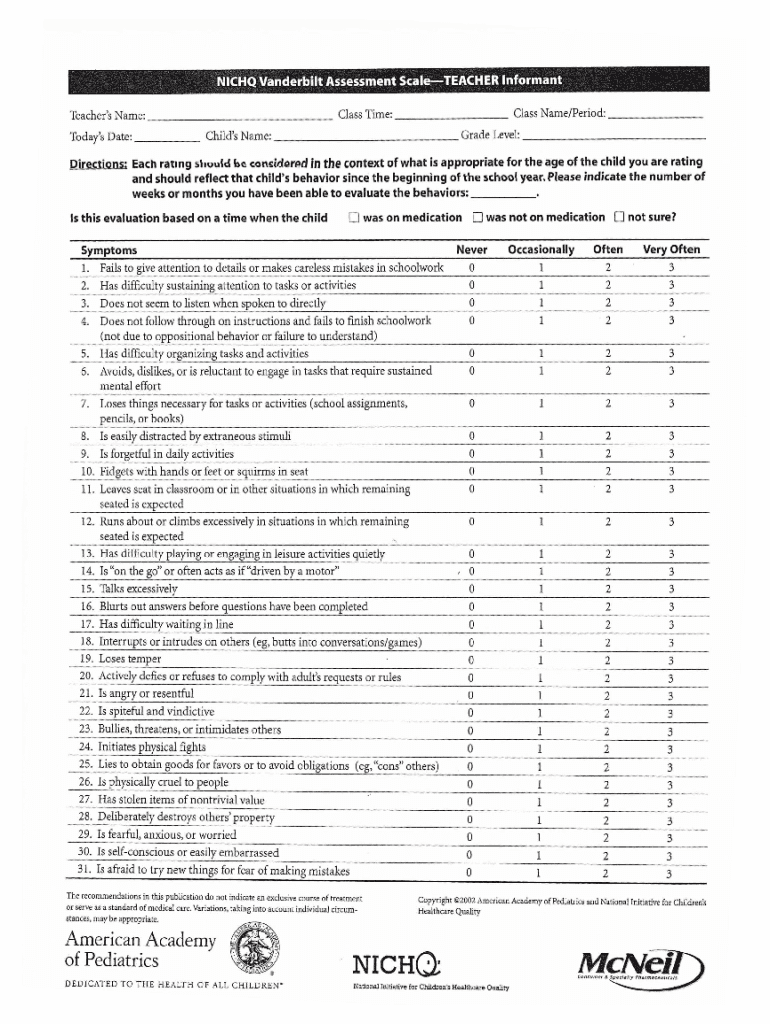







Definition & Purpose of the NICHQ Vanderbilt Assessment Scale Teacher Form
The NICHQ Vanderbilt Assessment Scale Teacher Form is a specialized tool used for evaluating behavioral patterns in children, particularly to identify symptoms consistent with Attention-Deficit Hyperactivity Disorder (ADHD) and other related behavioral disorders. It is designed to be completed by teachers, providing insights based on observed behaviors in a classroom setting. This form plays a crucial role in diagnosing ADHD, helping healthcare professionals tailor appropriate intervention strategies.
Key Objectives
- Assess behavioral symptoms in a structured manner.
- Facilitate diagnosis of ADHD and other behavioral conditions.
- Provide a comprehensive view of a child's performance and conduct in educational environments.
Relevance in Diagnosis
- Supports medical professionals in making informed decisions.
- Complements parental insights with educator observations.
How to Use the NICHQ Vanderbilt Assessment Scale Teacher Form
Utilizing the NICHQ Vanderbilt Assessment Scale Teacher Form involves a series of straightforward steps designed to ensure accuracy and thoroughness. Teachers are required to evaluate each student's behavior against specified criteria, capturing attention deficits, hyperactive tendencies, and other behavioral symptoms over a specific period.
Step-by-Step Usage
- Understand the Criteria: Familiarize yourself with behavioral categories and scoring methodology.
- Consistent Observation: Monitor the student's behavior over several weeks to ensure a representative assessment.
- Detailed Rating: Carefully rate each behavior on the scale, reflecting frequency and intensity.
- Collaborative Review: Discuss findings with parents and healthcare providers for a holistic evaluation.
Practical Tips
- Cross-verify observations with other educators if possible.
- Maintain objectivity; assess behaviors rather than personal perceptions.
Steps to Complete the NICHQ Vanderbilt Assessment Scale Teacher Form
Completing the form accurately requires teachers to systematically observe and record behaviors. It's vital to adhere to the form's structured questions to ensure that the evaluation is comprehensive.
Detailed Completion Process
- Initiate Observation: Begin with weekly logs of specific behaviors.
- Mark Frequency: Use the scale to indicate how often each behavior is observed.
- Provide Comments: Offer additional notes or examples to contextualize ratings.
- Review Submission: Ensure all sections are filled accurately before submitting to healthcare professionals.
Common Pitfalls
- Avoid assumptions; document only what you observe.
- Ensure continuity in observation across different times and settings.
Key Elements of the NICHQ Vanderbilt Assessment Scale Teacher Form
The form consists of several critical components that guide the assessment process, each designed to capture various dimensions of student behavior.
Essential Sections
- Attention-Deficit Indices: Focuses on ratings related to inattentiveness and distractibility.
- Hyperactivity-Impulsivity Measures: Evaluates aspects of hyperactive behavior.
- Academic Performance Indicators: Assesses the child's work quality and engagement in class activities.
Additional Observations
- Emotional regulation and peer interactions are included to provide a broader behavioral context.
Why You Should Use the NICHQ Vanderbilt Assessment Scale Teacher Form
The value of using this assessment scale lies in its ability to transform subjective observations into quantifiable data that aligns with clinical diagnosis parameters for ADHD.
Benefits and Utility
- Informed Clinical Diagnoses: Supports evidence-based diagnostic decisions.
- Targeted Intervention Planning: Facilitates the development of personalized intervention strategies.
- Structured Feedback for Parents: Offers structured insights to parents about their child's behavioral health.
Who Typically Uses the NICHQ Vanderbilt Assessment Scale Teacher Form
This form is predominantly utilized by classroom teachers and other educational professionals qualified to observe and interpret student behaviors in an educational setting.


Common User Profiles
- Primary & Secondary School Teachers: Those involved in daily educational activities.
- Special Education Coordinators: Professionals focusing on students with learning differences.
Collaborative Users
- School psychologists and healthcare practitioners leverage this form for comprehensive assessments.
Legal Use of the NICHQ Vanderbilt Assessment Scale Teacher Form
The form's legal application is significant in contexts requiring documented behavioral evaluations, typically supporting diagnoses aligned with the criteria of ADHD and other disorders. It must be used in accordance with educational and healthcare standards.
Regulatory Compliance
- Adheres to educational privacy regulations such as FERPA.
- Consistent with clinical guidelines for behavioral disorder assessment.
Privacy Considerations
- Ensure that all data is handled confidentially and shared only with authorized personnel.
Examples of Using the NICHQ Vanderbilt Assessment Scale Teacher Form
The form has been employed in various real-world scenarios to foster a deeper understanding of children's behavioral health needs.
Case Studies
- Case Study 1: A middle school teacher used the form to validate initial observations of a student's attention issues, leading to an ADHD diagnosis and subsequent intervention.
- Case Study 2: Through structured assessments, an elementary classroom teacher identified hyperactivity patterns that prompted successful educational modifications.
Interpretive Insights
- These documented experiences highlight the form's effectiveness in standardizing behavioral observations and enhancing communication between educators and medical professionals.




