




01. Edit your sf 700 pdf online
Type text, add images, blackout confidential details, add comments, highlights and more.

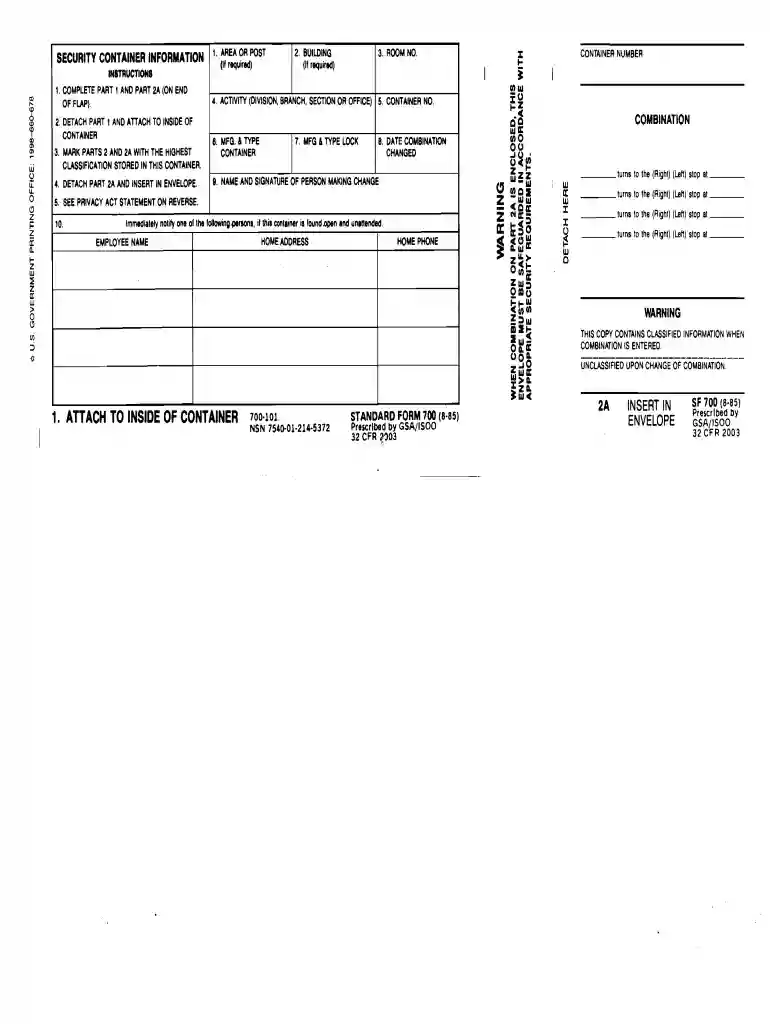
Type text, add images, blackout confidential details, add comments, highlights and more.

Draw your signature, type it, upload its image, or use your mobile device as a signature pad.

Send sf 700 via email, link, or fax. You can also download it, export it or print it out.
SF-700, known as the Security Container Information form, plays a crucial role in safeguarding sensitive information within secure storage containers. This form records vital security details, such as combination changes and container identification, which are essential for maintaining high-level security protocols in government and other sensitive environments. It's commonly prescribed by the General Services Administration (GSA) and the Information Security Oversight Office (ISOO) to ensure consistent and effective protection of classified information.
To properly utilize the SF-700, start by identifying the secure storage container utilized to house classified material. This form must be filled out thoroughly—completing Part 1 and Part 2A with details like container number, type of lock, and classification level of the stored materials. Ensure the form is attached inside the container per security guidelines. This accessible yet secure placement aids in quick verification during routine checks or emergencies.
The SF-700 form is typically available through departments that manage classified information. You can readily access it via secure governmental sites that distribute standard security forms. Authorized personnel often distribute printed versions within secure facilities. For any confusions regarding procurement methods, consulting the facility’s designated security officer ensures proper form access and handling.
The form captures essential details about the secure container, such as model and type of lock. This accuracy guarantees the integrity of information security measures.
SF-700 requires users to clearly denote the highest classification level stored. This measure ensures individuals are aware of the sensitivity of the stored materials, thereby mitigating unauthorized access risks.
Recording combination changes, along with names and signatures of personnel involved, provides an audit trail that is crucial for maintaining a reliable security framework. It assists in tracing unauthorized access or incidents efficiently.
SF-700 complies with stringent federal guidelines, including those outlined in 32 CFR 2001 and similar security regulations. It is a cornerstone for ensuring compliance within environments that manage classified information. Mismanagement can result in severe penalties, highlighting the form's legal and operational importance.
This pivotal term indicates any adjustment made to the lock’s combination, which must be documented meticulously on the SF-700 to prevent discrepancies and unauthorized access.
Refers to any approved storage space by GSA used to house classified information, underscoring the necessity of reliability and integrity in storage solutions.
Entities dealing with classified information, such as defense and intelligence departments, frequently use the SF-700 to maintain robust security infrastructure.
Organizations and individuals who engage with classified data under government contracts must utilize this form to align with federal security protocols.
Upon identifying the necessity for a secure storage solution, the process to employ an SF-700 involves submitting the form to relevant security officials within your organization for approval. The turnaround times can vary depending on the sensitivity of information and institutional workflows.
While not a digital form per se, any management software like QuickBooks or TurboTax used in environments managing classified information may need adaptations to support safe storage and documentation of these forms. Integrating digital solutions that streamline access logs and record management can enhance security protocols.
Firms contracted by government defense agencies require security measures involving forms like SF-700 to protect classified defense projects.
Entities involved in federal research projects or collaborations with government sectors need SF-700 to secure sensitive research materials.
In conclusion, understanding and correctly implementing the SF-700 form is foundational for organizations and individuals handling sensitive or classified information. By fulfilling its requirements, institutions reinforce their commitment to security and compliance, thereby safeguarding critical national interests.
At DocHub, your data security is our priority. We follow HIPAA, SOC2, GDPR, and other standards, so you can work on your documents with confidence.




Security Container Information. Information. Form Number: SF700; Current Revision Date: 04/2001; Authority or Regulation: Special Instructions:.Read more
The security officer will be provided the combination to the locker in a sealed Security Container Information envelope (SF 700). Should the security officerRead more


