
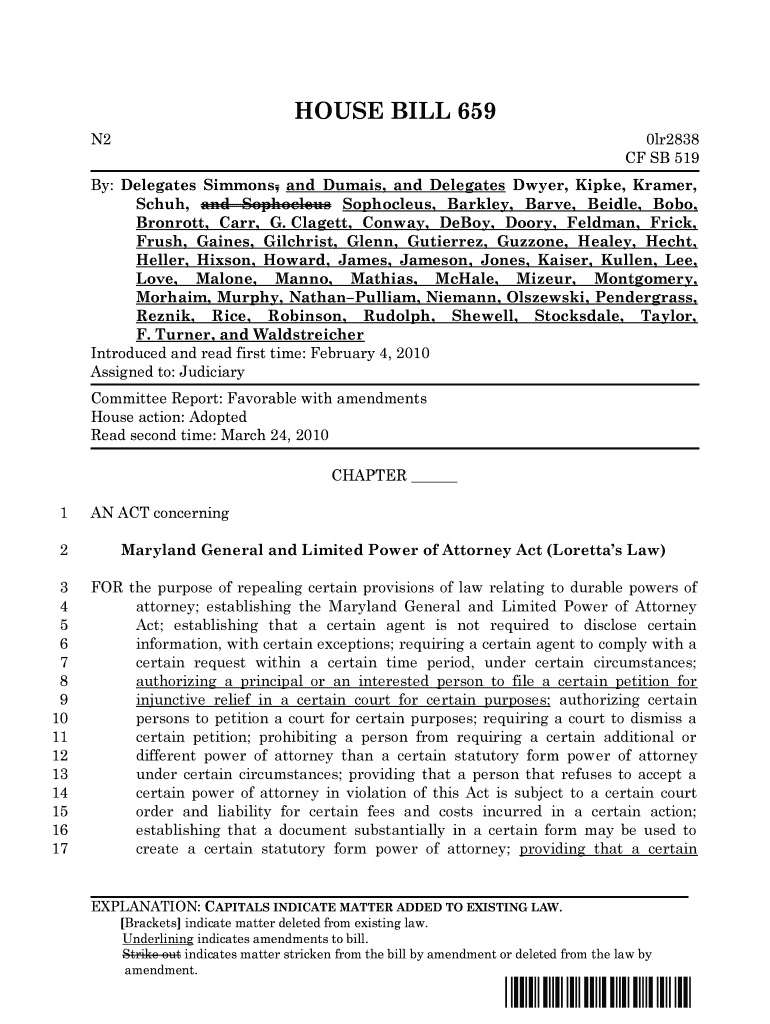







Understanding House Bill 659
House Bill 659, also known as the Maryland General and Limited Power of Attorney Act (Loretta’s Law), fundamentally restructures how powers of attorney are handled in Maryland. This legislation replaces previous laws concerning durable powers of attorney and introduces clear guidelines regarding the responsibilities of agents and the validity of these legal documents. One of the primary objectives is to safeguard the rights of individuals granting power of attorney by ensuring comprehensive regulations are in place.
Key Elements of House Bill 659
The bill includes several crucial components designed to protect those involved in the power of attorney process:
-
Agent Accountability: Establishes expectations for agents who must perform their duties in accordance with the principal's wishes and best interests. Any breach of this duty could result in legal consequences.
-
Durability of Power: Specifies conditions under which a power of attorney remains effective, even if a principal becomes incapacitated. This ensures that the principal's affairs can continue to be managed without interruption.
-
Statutory Forms: Provides templates for statutory forms, offering a standardized approach to creating power of attorney documents. These templates help in reducing confusion and ensuring compliance with the law.
Steps to Create a Power of Attorney under House Bill 659
Creating a power of attorney under this legislation involves a few critical steps:
-
Determine the Type of Power of Attorney: Decide between a general, limited, or durable power of attorney based on the scope of authority needed.
-
Select an Agent: Choose a trusted individual who will act on your behalf. It's vital to consider their reliability and understanding of your wishes.
-
Draft the Document: Utilize the statutory forms provided under House Bill 659 to ensure all legal requirements are met.
-
Sign and Notarize: Both the principal and agent must sign the document. Notarization is often required to authenticate the signatures.
-
Distribute Copies: Provide copies to your agent, alternate agents, and any institution or individual who requires legal proof of the agent’s authority.
Legal Implications of House Bill 659
House Bill 659 enforces a legal framework that grants specific rights and imposes responsibilities on all parties involved. Agents must uphold fiduciary duties, ensuring they act within the legal and ethical boundaries set by the law. The bill also provides principals with the ability to revoke or modify the power of attorney, adding a layer of security and control over their affairs.
State-Specific Rules for Maryland
While House Bill 659 is specific to Maryland, it’s essential to understand how local nuances might affect its implementation:
-
Recognition of Out-of-State Documents: Maryland recognizes power of attorney documents executed in other states if they meet Maryland’s criteria.
-
Revocation Procedures: Maryland law specifies procedures for revocation, which must be followed meticulously to ensure the power of attorney is nullified.
Examples of Using House Bill 659
House Bill 659 is especially relevant in cases where individuals require assistance managing their affairs due to health decline or absence. For instance:
-
Elderly individuals: Often appoint family members to manage financial transactions or healthcare decisions.
-
Military personnel: May grant power of attorney to a spouse or family member before deployment.
-
Business executives: Often use it to delegate authority for specific transactions or decisions.
Required Documents for House Bill 659
To comply with the legislative requirements of House Bill 659, the following documents are often necessary:
-
The Completed Power of Attorney Form: Filled out in accordance with statutory requirements.
-
Identity Verification: Such as a driver's license or passport for both principal and agent.
-
Financial Records: If the power of attorney involves financial transactions, these must be documented.
Who Typically Uses House Bill 659?
The following individuals or entities most commonly engage with House Bill 659:
-
Seniors: Needing assistance with managing personal affairs.
-
Individuals with chronic illness: Who need a trusted person to make healthcare decisions.
-
Business Owners: Needing someone to handle business matters in their absence.
Understanding and implementing House Bill 659 involves recognizing the responsibilities and protections it offers. It ensures that principals can rely on their chosen agents without undue concern over the legality and enforceability of their power of attorney agreements in Maryland.




