






Definition and Meaning of the 07 09 Application for Payment (G702-G703)
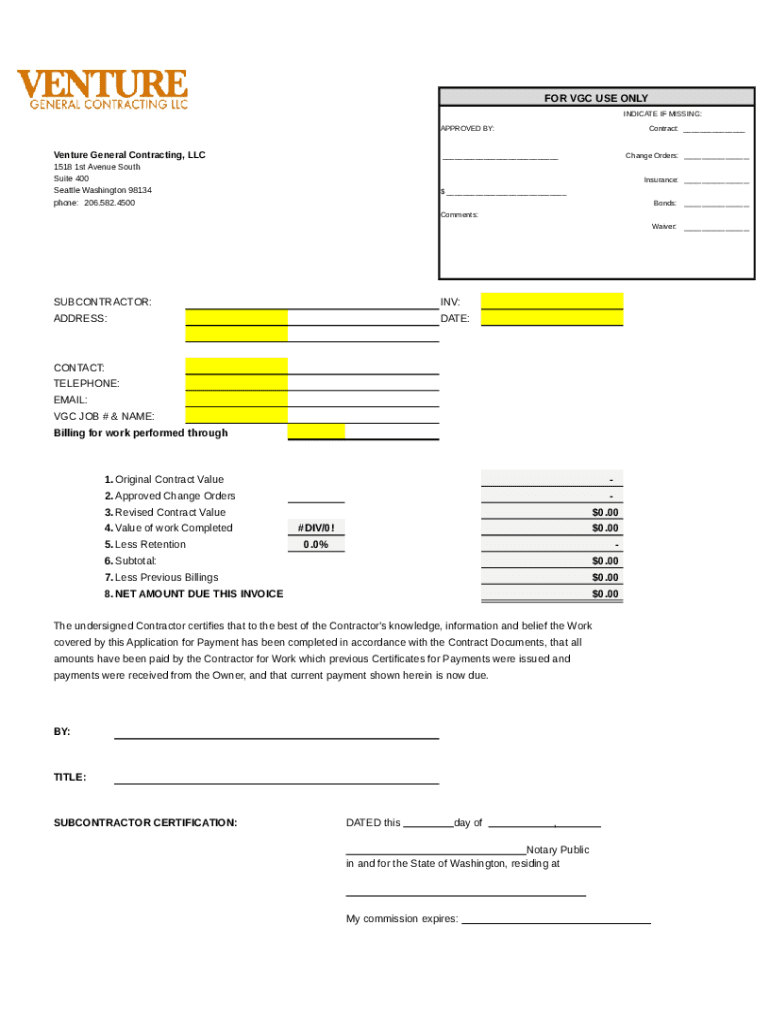
The 07 09 Application for Payment (G702-G703) is a construction industry-standard document used to request progress payments for work completed and materials stored. It is part of the suite of forms from the American Institute of Architects (AIA), specifically designed to streamline the payment process between contractors, subcontractors, and project owners. Known for its comprehensive layout, the form helps define the specific work completed, ensuring both parties agree on the amount to be paid.
-
G702 vs. G703: G702 serves as the cover sheet, summarizing the entire payment request and providing a certification by the contractor. G703 is used to detail the schedule of values, breaking down costs based on phases or sections of the project.
-
Purpose & Usage: This form ensures clear communication regarding payment expectations and progress verification. It helps minimize disputes by clearly outlining the work completed and the payment due.
Steps to Complete the 07 09 Application for Payment (G702-G703)
Completing the 07 09 Application for Payment involves several key steps, ensuring accuracy and compliance with contractual agreements.
- Review Contractual Terms: Understand the payment terms agreed upon in the original contract.
- Gather Documentation: Compile all necessary documentation, such as invoices, receipts, and proof of materials stored on site.
- Fill G702 Cover Sheet:
- Include general project information such as project name, owner, and contractor details.
- Provide the current payment period and summary of total completed and stored work.
- Certify the application by signing as the contractor.
- Detail G703 Schedule of Values:
- Break down the project into line items corresponding to phases or components.
- Indicate quantities of work completed and stored materials for each line item.
- Calculate the total payment due based on the percentage of work completed.
- Verify and Submit: Double-check all entries for accuracy and submit according to the project owner or lender's protocol.
Who Typically Uses the 07 09 Application for Payment (G702-G703)
The G702-G703 form is predominantly used by entities involved in the construction industry, catering to various roles and business entities.
- General Contractors: Primarily responsible for submitting the application to project owners or developers.
- Subcontractors: Often use the form when independently contracted and required to bill for specific elements of a project.
- Project Owners or Managers: They review and approve the completed forms to facilitate payment processing.
While frequently used by general contractors, nearly any entity requiring structured documentation for payment approval in construction can benefit from it.


How to Obtain the 07 09 Application for Payment (G702-G703)
Obtaining this form involves a few straightforward steps, especially for those within the construction sector.
- Purchase From AIA: Available directly from the American Institute of Architects, forms can be bought as paper copies or digital files.
- Using Third-party Services: Platforms like DocHub provide editable templates, allowing easy form filling online with additional features like e-signatures and collaboration tools.
- Project Documentation Packages: Contracts and administrative resources often include these forms in project initiation documentation.
Key Elements of the 07 09 Application for Payment (G702-G703)
Understanding the fundamental components of the G702 and G703 forms is central to their effective use.
- Contract Information: Includes job number, location, and relevant contracting parties.
- Payment Summary: Total claimed for work performed and stored materials, minus retainage.
- Certification: Contractor's signature certifying completion and document authenticity.
- Schedule of Values: A detailed breakdown of costs involved, detailing what work pertains to each relevant financial figure.
Legal Use of the 07 09 Application for Payment (G702-G703)
Legally, the G702-G703 is acknowledged and widely utilized in the U.S. construction industry for ensuring fair payments.
- Compliance with Agreements: Its primary legal function is to ensure compliance with previously agreed payment structures.
- Dispute Resolution: Provides a formalized process for resolving payment disputes through clear documentation.
Its design underscores maintaining transparency and agreement adherence, limiting financial risks and misunderstandings.
Examples of Using the 07 09 Application for Payment (G702-G703)
Using the G702-G703 form provides a structured approach to requesting and receiving progress payments.
- Residential Construction: Contractors working on multi-phase residential projects utilize these forms to request incremental payments as each phase is completed.
- Commercial Projects: Large-scale commercial developments where multiple subcontractors are involved require regular submission of these forms to ensure timely payments for work achieved and resources used on-site.
These real-world scenarios highlight the form’s essential role in bridging communication and payment action between stakeholders in varied construction contexts.
Form Submission Methods (Online / Mail / In-Person)
Several methods are available for submitting the 07 09 Application for Payment based on project requirements and stakeholder preferences.
- Online Platforms: Services like DocHub allow digital submission, facilitating faster processing and approval cycles.
- Traditional Mail: Some construction projects still employ postal services for submitting formatted hard copies.
- In-Person Handovers: For local projects or urgent payments, direct handover to project owners can expedite approval.
Each option carries its advantages based on the project's specific needs and stakeholder agreements.
Software Compatibility and Integration
The use of G702-G703 forms aligns with various digital platforms and software systems, ensuring streamlined workflows.
- Document Management Systems: Tools like DocHub support integration, allowing users to edit, collaborate, and store forms digitally.
- Accounting and Project Management: Software like QuickBooks and Project Management Systems integrate form data for real-time financial tracking and project oversight.
- Cloud Services: Forms can be stored and retrieved from Google Drive and OneDrive, ensuring accessible and safe data management in the cloud.
Embedding the form’s usage into compatible digital frameworks enhances overall process efficiency and record-keeping precision.