




01. Edit your form online
Type text, add images, blackout confidential details, add comments, highlights and more.

Type text, add images, blackout confidential details, add comments, highlights and more.

Draw your signature, type it, upload its image, or use your mobile device as a signature pad.

Send it via email, link, or fax. You can also download it, export it or print it out.
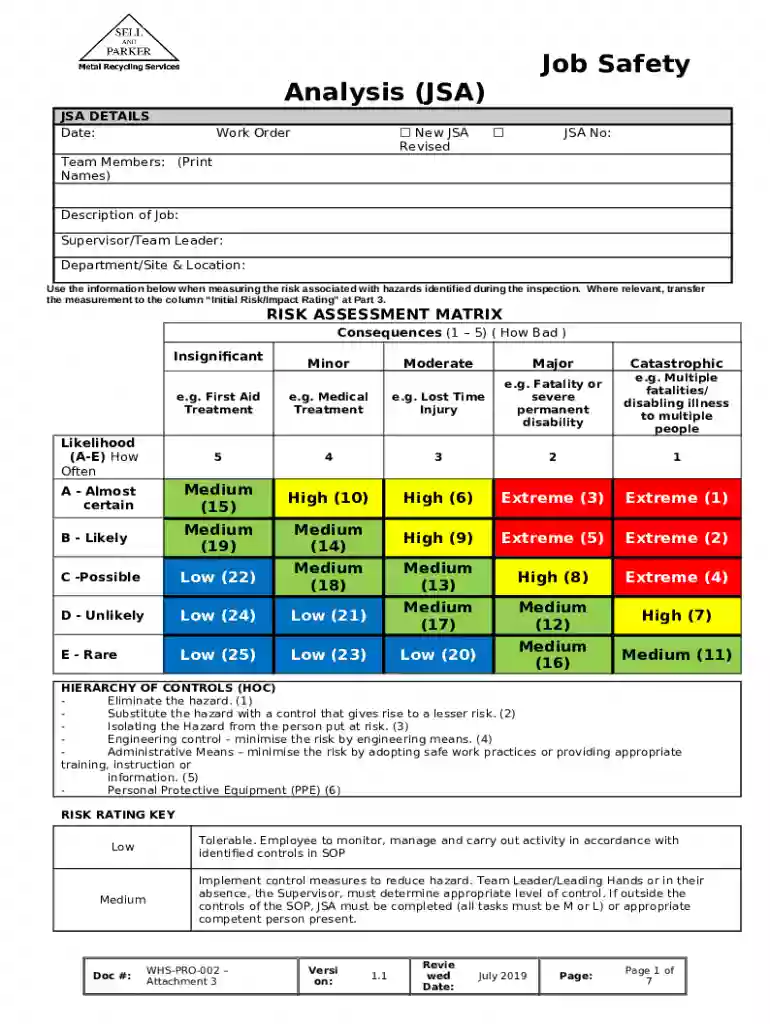
A Job Safety Analysis (JSA) is a systematic process used to evaluate workplace hazards and their associated risks. It involves breaking down a specific job into its individual tasks to identify potential dangers at each step. The primary goal of a JSA is to mitigate risks by implementing control measures, ensuring a safer work environment. This practice is critical for industries with high-risk activities, such as construction and manufacturing, to ensure compliance with Occupational Safety and Health Administration (OSHA) regulations and prevent workplace injuries.
A comprehensive JSA contains several key elements that help identify and control risks effectively:
Select the Job to Analyze: Choose a job with a history of incidents or high potential hazards. Prioritize jobs with high risks or those that have undergone changes.
Involve the Right Personnel: Include a team that represents a mix of roles, such as safety officers, supervisors, and the workers performing the job.
Break Down the Job: Divide the job into individual tasks or steps. Each step should be clear and should not overlap with other tasks.
Identify Hazards: Use brainstorming sessions, checklists, or inspections to identify potential hazards associated with each task.
Assess Potential Risks: Employ tools like a risk assessment matrix to evaluate the severity and likelihood of risks and prioritize them.
Determine Control Measures: Develop strategies to eliminate or minimize risks. Focus first on eliminating hazards altogether, followed by engineering controls, administrative controls, and PPE.
Document the JSA: Ensure the JSA is well-documented, with clear descriptions of tasks, hazards, and mitigation measures. Make sure it's accessible to all employees involved.
Review and Update Regularly: Reassess the JSA periodically and after any significant changes. Update it as necessary to reflect current conditions.
Conducting a JSA brings several benefits to the workplace:
A JSA is a valuable tool across various industries but is particularly crucial for businesses where safety risks are prevalent. These may include:
Employers are legally obligated to provide safe working conditions under OSHA regulations. A JSA helps businesses meet these legal requirements by:
Failure to conduct effective JSAs and implement safety measures could result in regulatory fines, increased insurance premiums, and reputational damage.
While JSAs can be documented manually, using software solutions can enhance efficiency and accuracy. DocHub offers features that can facilitate the creation and management of JSAs:
Employing digital solutions can ensure that JSAs are easily accessible, up-to-date, and compliant with industry standards.
At DocHub, your data security is our priority. We follow HIPAA, SOC2, GDPR, and other standards, so you can work on your documents with confidence.



Sep 5, 2015 A comprehensive examination of an organisations policies and practices to identify and permit removal of systemic and attitudinal barriers to employmentRead more
When conducting your own job safety analysis, be sure to consult the Occupational Safety and Health Administration standards for your industry. ComplianceRead more
Task/Operation Description: Enter a brief but detailed description about the task/operation being covered in the JHA.Read more


