Definition & Meaning
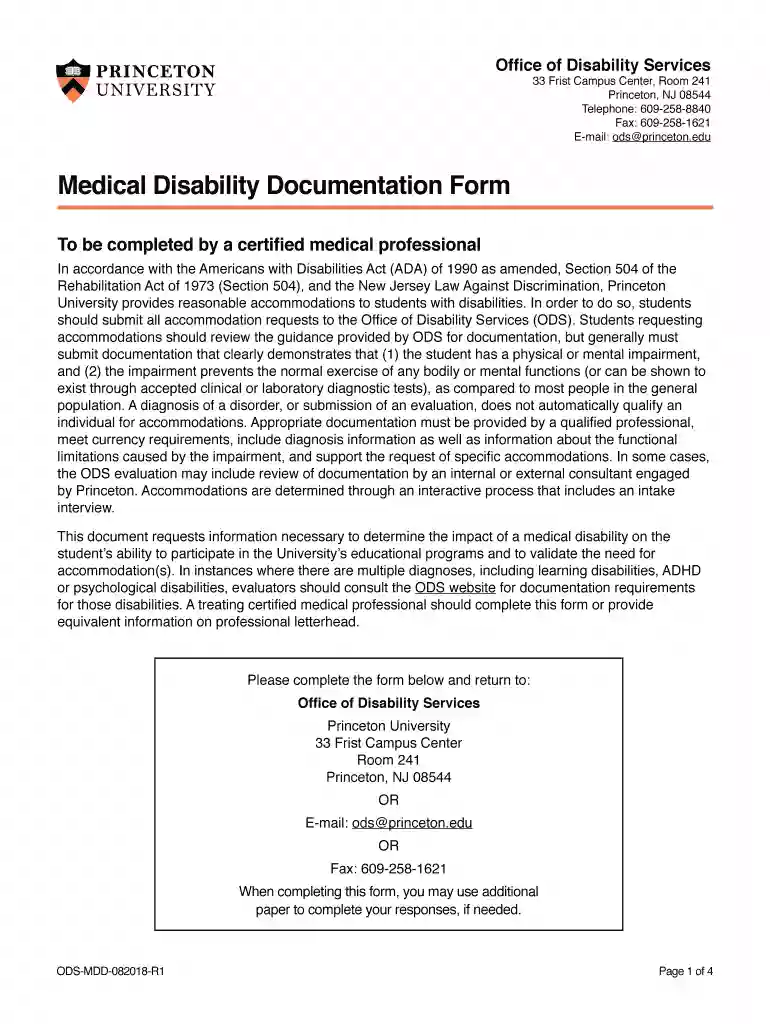
The Medical Disability Documentation Form is an essential tool used by individuals seeking to request reasonable accommodations in academic or professional settings in accordance with the Americans with Disabilities Act (ADA) and other related U.S. laws. Designed primarily for students, this form must be completed by a certified medical professional who provides insight into the individual’s medical condition and necessary accommodations.
Key Components
- Certifying Authority: A section for a licensed healthcare provider to confirm the diagnosis and describe the medical condition.
- Accommodations Needed: This part outlines specific adjustments or support services required to assist the individual in their environment.
- Confidentiality Assurance: Highlights the privacy standards that apply to the information contained within the document.
Practical Application
The form is used at institutions like Princeton University, where students submit it to illustrate their need for accommodations due to a medical disability. The information collected helps the Office of Disability Services to tailor support to the individual's needs.
How to Use the Medical Disability Documentation Form
Using the Medical Disability Documentation Form involves a few critical steps to ensure that it meets its intended purpose effectively.
Steps to Completion
- Obtain the Form: Secure a copy from the relevant department of disability services within your institution or organization.
- Complete Personal Information: Fill out sections related to your personal and educational details accurately.
- Medical Evaluation: Have a certified medical professional complete the diagnostic and treatment history sections, providing detailed information on your condition.
- Recommendations: Ensure the medical professional includes clear recommendations on the accommodations needed.
- Submission: Return the completed form to the office handling disability accommodations.
Best Practices
- Accuracy: Verify that all information is correct to prevent delays.
- Timeliness: Submit the form well in advance of when accommodations are needed.
- Documentation: Retain copies of any supporting documents required alongside the form.
Key Elements of the Medical Disability Documentation Form
Understanding the structure and sections of the Medical Disability Documentation Form enhances its effective completion and use.
Major Sections
- Student Information: Captures essential personal and contact information.
- Diagnoses: Details the medical conditions diagnosed by a healthcare professional.
- Treatment History: Summarizes past treatments related to the disability.
- Functional Impact: Describes how the disability affects daily life activities and academic performance.
- Accommodation Recommendations: Lists suggested adjustments or tools to mitigate the disability's impact.
Examples of Accommodation
- Extended Test Time: For individuals needing more time due to cognitive processing or attention challenges.
- Accessible Housing: For students requiring wheelchair-accessible dorms or single-floor room access.
- Interpreter Services: For those with hearing impairments requiring sign language support.
Steps to Complete the Medical Disability Documentation Form
Completing the form requires careful attention to detail and cooperation with medical professionals.
Detailed Process
- Initiate the Request: Contact the disability services office to express your need for accommodations.
- Gather Medical Records: Ensure all relevant health documentation is updated and ready for review.
- Schedule Medical Appointment: Arrange a consultation with your healthcare provider to fill out the necessary sections.
- Review and Finalize: Once the medical professional completes their part, review the form for completeness and accuracy.
- Submit and Follow-Up: Deliver the form to the appropriate office and, if necessary, meet with advisors to discuss your needs and any further steps.
Potential Challenges
- Insufficient Documentation: Lacking comprehensive medical records can delay processing.
- Miscommunication: Misunderstanding the accommodations needed can result in ineffective support.
Primary Users
- Students with Disabilities: Primarily for university students needing support in academic settings.
- Disability Services Professionals: Staff who review and approve accommodation requests using the form as the basis for decision-making.
- Healthcare Providers: Physicians, psychologists, or other qualified professionals responsible for diagnosing and recommending suitable accommodations.
Institutional Use
- Universities: To ensure compliance with federal mandates and support inclusive education.
- Workplaces: Organizations may adapt similar forms for employee accommodation requests.
Important Terms Related to Medical Disability Documentation Form
Familiarity with specific terms enhances understanding and accurate completion of the form.
Essential Terminology
- Reasonable Accommodation: Modifications or adjustments to a task, environment, or use of facilities to ensure equal opportunity for individuals with disabilities.
- Functional Impact: The extent to which a disability affects an individual’s capacity to complete activities or tasks.
- Certification: The formal process by which a healthcare provider confirms the existence and nature of a disability.
Contextual Understanding
These terms are integral to the legal framework and operational procedures surrounding disability accommodations, ensuring compliance with ADA requirements.
Legal Use of the Medical Disability Documentation Form
The form serves a crucial legal function in documenting and facilitating disability accommodations.
Compliance and Standards
- ADA Compliance: Ensures requests align with the legal requirements set by the Americans with Disabilities Act.
- Data Privacy: Requires confidentiality protocols to protect sensitive medical information, adhering to HIPAA standards.
Institutional Responsibilities
- Documentation Review: Offices are responsible for reviewing submitted forms and making informed decisions about reasonable accommodations.
- Record Keeping: Maintaining accurate records of accommodations provided as part of institutional accountability.
Examples of Using the Medical Disability Documentation Form
Understanding real-world applications helps in visualizing the form’s utility.
Case Scenarios
- Academic Adjustments: A student with a learning disability might use the form to request extended time on exams.
- Physical Accommodations: An individual with mobility impairments may submit the form to request accessible transportation services within a campus environment.
- Technological Support: Students may request specific software or assistive devices to aid in their studies.
Practical Impact
These examples illustrate how critical accommodations are to leveling the educational playing field for students with disabilities, fostering equal access to opportunities.
Requirements
- Medical Diagnosis: Must be confirmed by a recognized healthcare professional.
- Impact on Functionality: Documented evidence of how the disability impacts major life activities.
- Document Submission: All sections must be accurately completed and submitted per institution guidelines.
Common Eligibility Challenges
- Insufficient Evidence: Failure to provide comprehensive medical evidence can result in denied accommodation requests.
- Misinterpretation: Misunderstanding eligibility criteria may lead to incomplete or incorrect form submissions.