






Definition and Meaning
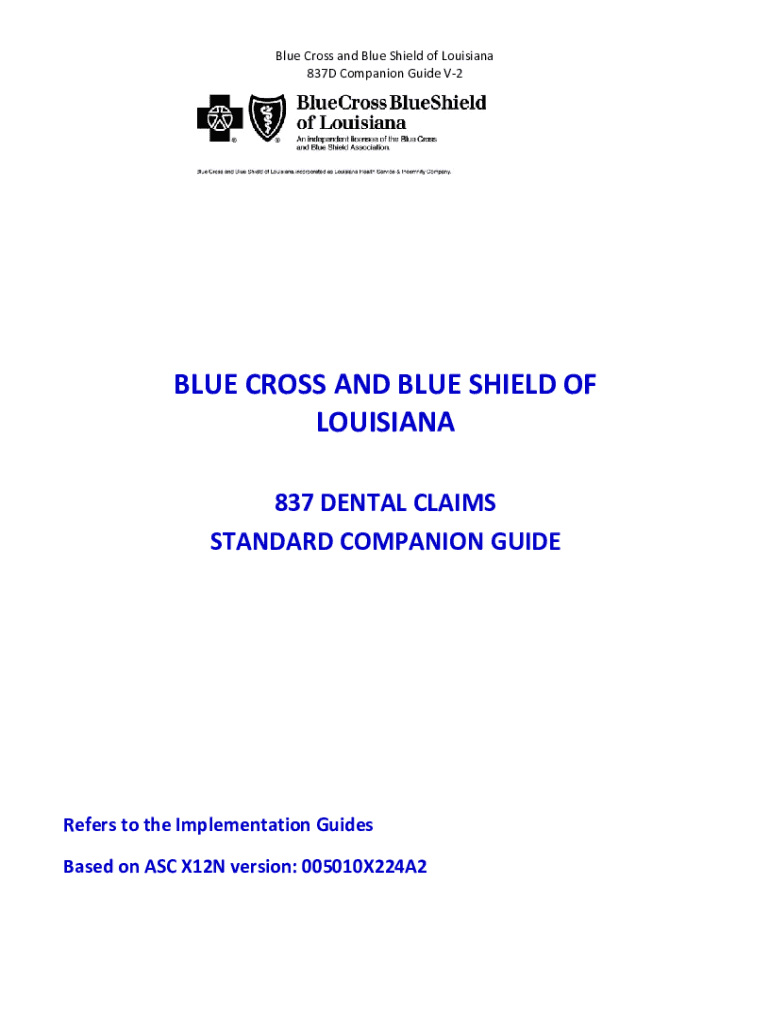
The 837D Companion Guide V-2 is a comprehensive manual that serves as a roadmap for the electronic submission of dental claims. It aligns with the ASC X12N 005010X224A2 standard, providing detailed instructions to ensure accurate claim submission and processing. This guide is essential for dental care providers and insurance trading partners, detailing the regulatory and operational requirements for transmitting claim data electronically.
- Standardization: Synced with ASC X12 version, the guide helps streamline the claims process by standardizing the data format across platforms.
- Information Accuracy: Ensures all necessary information is captured correctly to reduce claim rejections due to errors.
- Operational Clarity: Simplifies understanding with clear explanations of procedures and formats needed for compliance.
Key Elements of the 837D Companion Guide V-2
The guide encompasses various critical elements essential for the successful electronic submission of dental claims.
- HIPAA Compliance: Outlines requirements to align with privacy standards, ensuring data protection.
- Error Handling: Details the error categories and specifies how to rectify common submission mistakes.
- Trading Partner Specifications: Lists communication protocols, document exchange standards, and the necessary software specifications for partners.
Steps to Complete the 837D Companion Guide V-2
Understanding the procedural steps within the 837D Companion Guide V-2 ensures successful claim submissions.
- Registration: Begin by registering as a trading partner with your insurance provider.
- Testing Procedures: Conduct thorough tests to confirm data interchange processes before actual submissions.
- Data Entry Protocols: Enter required information following the specified formats and codes to ensure consistency.
- Transmission: Use standardized communication protocols to transmit data securely.
- Validation: Post-submission, conduct validation checks to ensure transmitted data matches the submitted claims.
Who Typically Uses the 837D Companion Guide V-2
Understanding who typically uses the guide can clarify its application scope.
- Dental Care Providers: Dentists and clinics utilize the guide to submit insurance claims efficiently.
- Insurance Companies: Facilitates insurers in processing dental claims by understanding provider submissions fully.
- Third-party Administrators: Organizations managing insurance claims on behalf of insurers utilize it to comply with claim processing standards.
- Billing Software Developers: Use the guidelines for developing compliant software aligning with the claims submission process.


Legal Use of the 837D Companion Guide V-2
The guide ensures that the electronic claim submission complies with legal requirements.
- Data Privacy: Adheres to HIPAA regulations to protect patient information during the claim submission process.
- Transparency: Provides clear documentation of compliance, which can be essential for audits or legal reviews.
- Regulatory Compliance: Ensures submissions meet federal and state law requirements to avoid legal disputes and claims rejections.
Important Terms Related to 837D Companion Guide V-2
Familiarity with key terms can improve comprehension and application.
- ASC X12N 005010X224A2: The standard format for electronic claims.
- Taxonomy Codes: Essential for classifying providers and services within claim submissions.
- Acknowledgment Reports: These confirm the receipt and processing status of submitted claims.
State-Specific Rules for the 837D Companion Guide V-2
Certain state-specific variations must be considered when using the guide.
- Regional Compliance Differences: Some states might have unique requirements for data submission not covered universally.
- State-specific Codes: While the guide covers federal compliance, states might have additional codes unique to their regulations.
- Localized Testing Procedures: Some states may require local testing of claims processes to ensure adherence to state health laws.
Examples of Using the 837D Companion Guide V-2
Applying real-world scenarios enhances understanding of the guide's practical applications.
- Dental Clinic in California: Implementing the guide ensures compliance with both state and federal laws when submitting patient claims.
- Insurance Company Collaboration: A trading partner uses the guide to ensure data exchange clarity, reducing processing delays.
- Provider Testing Environment: A provider in Texas uses test scripts from the guide to simulate claim submissions, ensuring system compatibility.
Software Compatibility
Compatibility is a vital consideration for electronic submissions.
- Integrated Software: Systems like QuickBooks or bespoke dental management software should align with the guide's standards for processing claims.
- Updates and Patches: Regular updates may be needed to maintain compatibility with the latest standards outlined in the guide.
- Testing with Various Platforms: Ensures that submissions from diverse software platforms are processed correctly by insurers.
Penalties for Non-Compliance
Neglecting the guide can lead to significant repercussions.
- Claim Rejections: Claims may be returned if they do not meet specified standards.
- Fines: Non-compliance with HIPAA or submission regulations can result in monetary penalties.
- Operational Delays: Incorrect submissions can lead to increased processing time, delaying payment cycles.