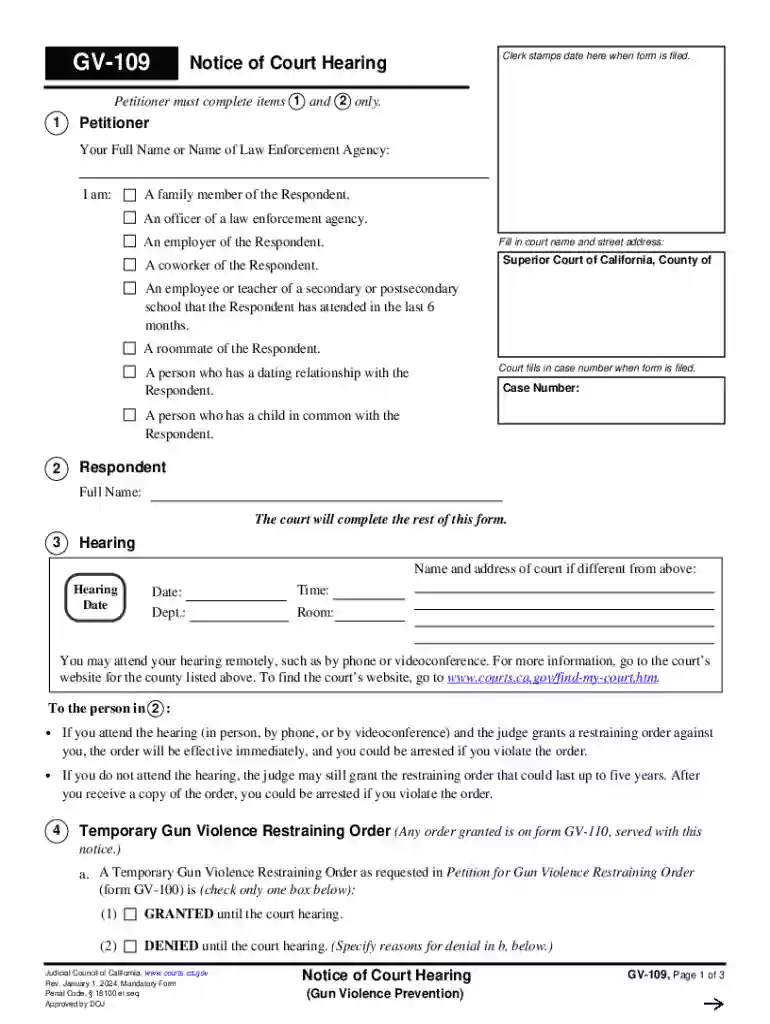
Proof of Personal Service, Elder or Dependent Adult 2026

Get Form
gv 109 Preview on Page 1

Here's how it works

01. Edit your gv 109 online
Type text, add images, blackout confidential details, add comments, highlights and more.

02. Sign it in a few clicks
Draw your signature, type it, upload its image, or use your mobile device as a signature pad.

03. Share your form with others
Send it via email, link, or fax. You can also download it, export it or print it out.

Definition & Meaning

The "Proof of Personal Service, Elder or Dependent Adult" is a legal document used to verify the delivery of court documents to an elder or dependent adult in legal proceedings. This form ensures that the served individual is fully informed of any pending actions or court dates and acknowledges receipt. It is typically part of the due process in legal matters where confirmation of document delivery is essential.

Key Elements of the Proof of Personal Service, Elder or Dependent Adult

The form includes several critical elements to establish credibility and compliance:

  • Personal Details: Information about the person to whom the documents are served, including their full name and address.
  • Server's Information: Details of the person who performed the service, such as name, age, and the relationship to the recipient (if any).
  • Document Description: A clear listing of the documents delivered, specifying the nature of each document.
  • Date and Time: The exact date and time when the service was carried out, which is crucial for legal timelines.
  • Signature: Authentication of the server’s action through their signature, and possibly a notary's seal, attesting the service was carried out according to legal standards.

Steps to Complete the Proof of Personal Service, Elder or Dependent Adult

  1. Prepare the Documents: Gather the necessary legal documents that require service. Ensure all are correctly prepared and organized.

  2. Identify the Server: Select an appropriate person to conduct the service. They should not be part of the case and generally must be 18 years or older.

  3. Serve the Documents: The server delivers the documents directly to the intended recipient. Service cannot be through mail or indirect communication.

  4. Complete the Form: The server fills out the Proof of Personal Service form immediately after delivering the documents. All relevant fields, including details and timelines, must be accurately filled out.

  5. File the Form: Submit the form to the court to demonstrate compliance with procedural requirements. Attach additional documentation as required by the court.

Why You Should Use the Proof of Personal Service, Elder or Dependent Adult

Using this form is essential for:

  • Legal Compliance: Ensures adherence to legal processes, confirming that all parties are notified and have the opportunity to respond.
  • Record Keeping: Provides a documented trail of actions taken, which is vital for accountability in legal proceedings.
  • Avoiding Penalties: Prevents potential legal penalties or the dismissal of cases due to improper service of documents.

Legal Use of the Proof of Personal Service, Elder or Dependent Adult

This form is legally used within the context of court proceedings, particularly:

  • Restraining Orders: In cases of protective orders, ensuring the respondent is informed of proceedings against them.
  • Guardianship Cases: Informing involved parties of hearings and legal rights.
  • Conservatorship Proceedings: Establishing the notification of interested parties in actions affecting an elder or dependent adult’s wellbeing.

State-Specific Rules for the Proof of Personal Service, Elder or Dependent Adult

Rules about personal service can vary by state. Some states may:

  • Permit Alternative Methods: Such as registered mail under specific conditions or if personal delivery fails.
  • Require Additional Documentation: Depending on state regulations, other forms or proofs may be necessary alongside the standard form.
  • Outline Timeframes: Some states have specific deadlines by which documents need to be served prior to court dates.

Examples of Using the Proof of Personal Service, Elder or Dependent Adult

  • Case Scenario 1: In a scenario where a temporary guardianship order needs imposition, the form ensures the alleged guardian is informed of the proceedings.
  • Case Scenario 2: When seeking a restraining order against an individual, utilizing this form secures evidence that the defendant has been duly notified.
  • Case Scenario 3: During a hearing for a dependent adult’s conservatorship, the form is used to notify next of kin or involved parties ensuring they are informed participants in the process.

Who Typically Uses the Proof of Personal Service, Elder or Dependent Adult

Individuals who frequently use this form include:

  • Attorneys: To ensure their clients' documents are properly served and documented.
  • Process Servers: Professionals specifically hired to serve legal documents.
  • Court Officials: Operating within family law or probate courts, where elder or dependent adult issues are common.
decoration image ratings of Dochub

See more Proof of Personal Service, Elder or Dependent Adult versions

We've got more versions of the Proof of Personal Service, Elder or Dependent Adult form. Select the right Proof of Personal Service, Elder or Dependent Adult version from the list and start editing it straight away!
Versions Form popularity Fillable & printable
2024 4.6 Satisfied (50 Votes)
2020 4.8 Satisfied (47 Votes)
2019 4.4 Satisfied (96 Votes)
2016 4.4 Satisfied (161 Votes)
be ready to get more

Complete this form in 5 minutes or less

Get form

Got questions?

We have answers to the most popular questions from our customers. If you can't find an answer to your question, please contact us.
Contact us
An elder is a person of age 60 or older. A dependent adult is a person between the ages of 18 and 59 with physical, mental, or developmental disabilities. The full scope of elder and dependent abuse is limited due to the problems hidden and complex nature.
Someone 65 years old or older; or. A dependent adult, who is aged 18-64 who has mental or physical limitations that limit their ability to carry out normal activities or protect their own rights, regardless of whether they live independently or not.
An applicant or participant over 18 years is considered a dependent adult if: he or she resides with his or her parent or with the parents of his or her spouse: and, he or she does not meet the requirements of financial independence.
The National Institute on Aging generally describes older adults as people age 65 or older, however, definitions of older adulthood vary. When an official or organization uses one of these terms, ask for specifics.
Elder is a comparative term, meaning it compares the ages of two or more individuals in a group, whereas older is a descriptive term that does not imply a comparison.

Security and compliance

At DocHub, your data security is our priority. We follow HIPAA, SOC2, GDPR, and other standards, so you can work on your documents with confidence.

Learn more
ccpa2
pci-dss
gdpr-compliance
hipaa
soc-compliance