





Definition and Purpose of Recognizing Your Demon Dialogue
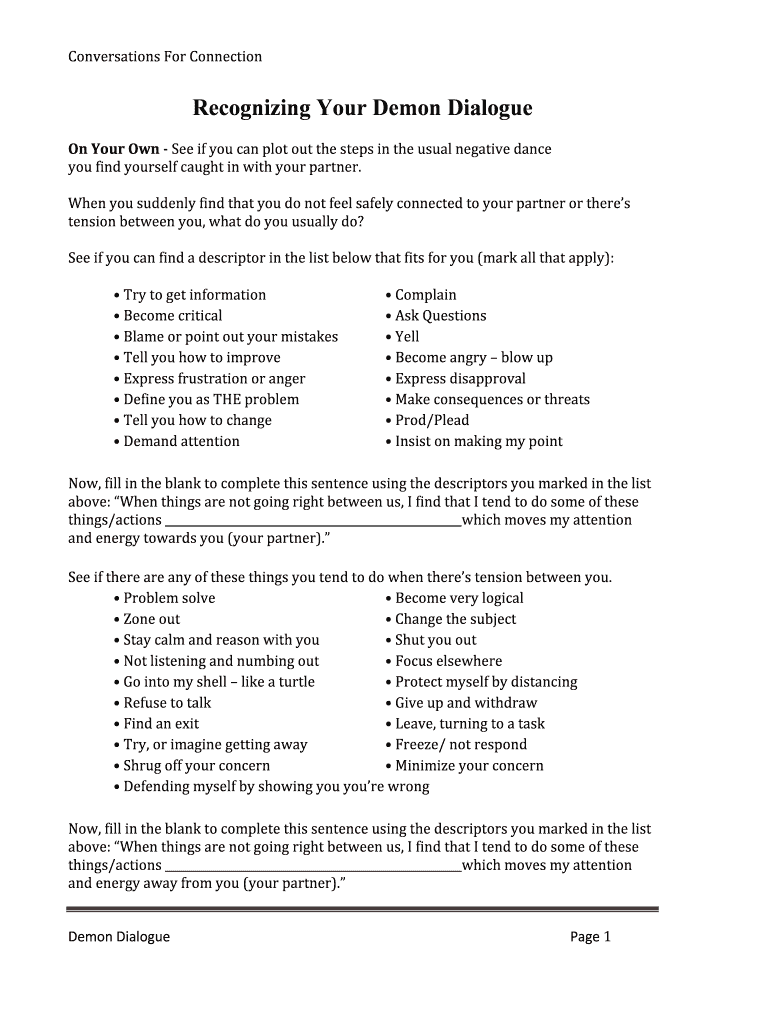
Recognizing Your Demon Dialogue refers to the process of identifying and understanding negative communication patterns, often termed 'Demon Dialogue,' in interpersonal relationships. This approach involves highlighting specific dialogues and behaviors that emerge during conflicts and emotional disconnects between partners. The purpose is to help individuals gain insights into their typical responses and behaviors when genuine communication is hindered. By recognizing these patterns, partners can engage in exercises that aim to improve mutual understanding and foster more meaningful connections.
Utilizing the Recognizing Your Demon Dialogue
To effectively utilize the Recognizing Your Demon Dialogue, individuals are encouraged to participate in structured exercises designed to explore emotional reactions and interaction dynamics. These exercises provide scenarios and prompts that help partners articulate their behaviors and emotional states during conflicts. By using these tools, partners can better understand their contributions to the cycle of tension and work collaboratively towards resolution and improved communication.
Steps to Engage with the Dialogue
- Identify your typical responses and behaviors during conflicts.
- Participate in exercises that encourage emotional exploration.
- Discuss findings with your partner in a neutral and open setting.
- Develop strategies together to improve future interactions.
Steps to Complete the Recognizing Your Demon Dialogue
Completing the Recognizing Your Demon Dialogue involves a step-by-step approach that aids in uncovering and addressing negative communication patterns:
- Awareness: Begin by identifying phrases, gestures, or tones that frequently lead to misunderstandings or conflicts.
- Documentation: Keep a journal or document specific instances where these dialogues occur.
- Analysis: Review these instances to uncover underlying triggers and emotional responses.
- Communication: Share and discuss these findings with your partner in a calm environment.
- Action: Develop an action plan to alter these dialogues or responses in future interactions.
Practical Application
- Use role-playing activities to enact typical 'Demon Dialogue' scenarios.
- Create a safe space where partners can honestly discuss how certain dialogues make them feel.
- Implement agreed-upon cues or signals to de-escalate potential conflicts.
Key Elements of Recognizing Your Demon Dialogue
The Recognizing Your Demon Dialogue process comprises several critical components that aid in navigating and transforming these conversations:
- Emotional Identification: Recognizing the emotions that each partner feels during the dialogue.
- Pattern Recognition: Identifying recurring dialogue patterns that contribute to conflicts.
- Behavior Articulation: Describing one's own behaviors and how they might be perceived by the partner.
- Mutual Understanding: Achieving a shared perception of how these dialogues arise and affect the relationship.
Who Typically Uses the Recognizing Your Demon Dialogue
This approach is particularly beneficial for couples and partners looking to improve their communication skills and emotional closeness. It serves individuals who are willing to examine and alter deep-seated communication habits and improve their relationship dynamics. Therapists and counselors also employ this method in sessions to help clients articulate and navigate their interpersonal issues more effectively.


Examples of Using the Recognizing Your Demon Dialogue
Consider a couple who frequently experiences arguments whenever discussing finances. By working through the Recognizing Your Demon Dialogue:
- They identify phrases that escalate tensions, like "You always spend too much."
- They realize the feeling of insecurity it triggers in one partner and defensiveness in the other.
- By articulating these feelings and patterns, they establish new, non-confrontational ways to discuss budget matters.
Important Terms Related to Recognizing Your Demon Dialogue
Understanding some key terms is crucial for effectively navigating the Recognizing Your Demon Dialogue:
- Emotional Triggers: Specific words or actions that evoke a strong emotional response.
- Cycle of Tension: A recurring pattern where communication leads to conflict, resulting in emotional disconnection.
- Response Patterns: The typical ways individuals react during exchanges that may contribute to escalated dialogues.
Examples of Recognizing Your Demon Dialogue in Action
A typical scenario might involve partners confronting a misunderstanding due to different perceptions. For instance, when one partner expresses that they feel unheard, the Recognizing Your Demon Dialogue framework encourages exploring what actions or words led to this feeling. Through exercises, they both work to understand these triggers and shift their interactions towards empathy and validation.
By comprehensively exploring these aspects, Recognizing Your Demon Dialogue empowers partners to break free from harmful communication cycles and rebuild stronger, healthier relationships. The process is not only about recognition but also about transformation and growth.