
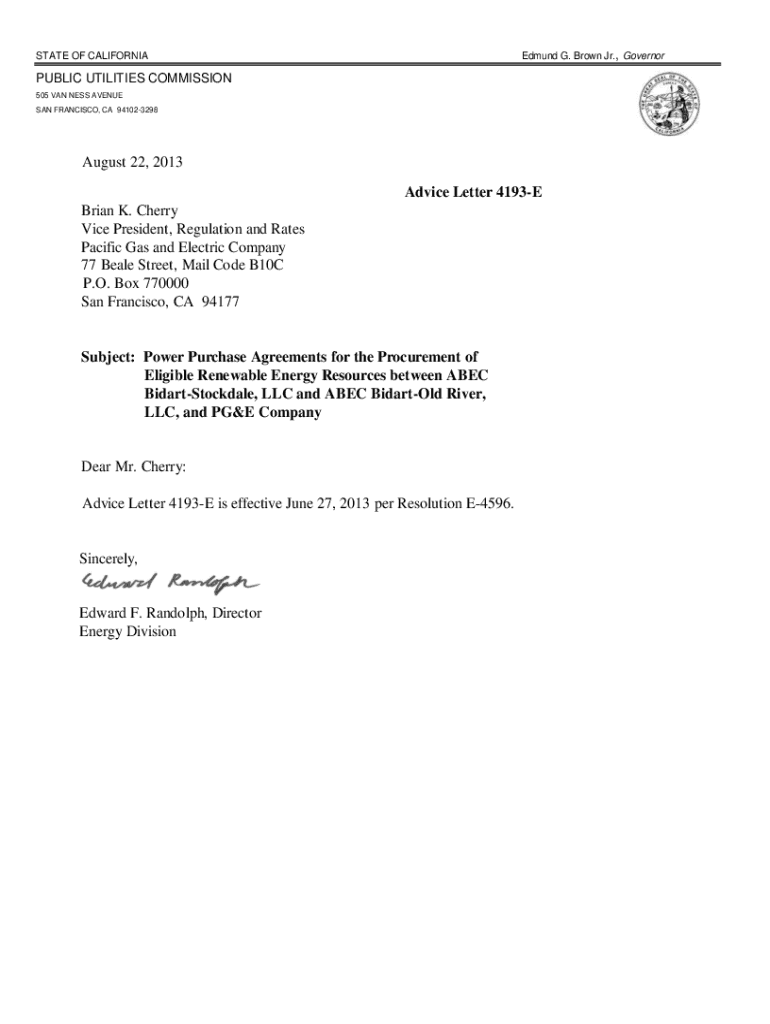







Definition and Meaning of 4193-E - Pacific Gas and Electric Company
The form "4193-E - Pacific Gas and Electric Company" is an advice letter submitted to the California Public Utilities Commission (CPUC) by Pacific Gas and Electric Company (PG&E). It pertains to the approval of Power Purchase Agreements (PPAs) for renewable energy generation. Specifically, this form is used to communicate agreements involving dairy-waste biomethane combustion technology projects, namely ABEC Bidart-Stockdale, LLC and ABEC Bidart-Old River, LLC. These projects contribute to California's Renewable Portfolio Standard goals, aiming to increase the production of renewable energy across the state. The letters within this form also discuss details such as project viability, capacity, interconnection status, and confidentiality concerns.
How to Use the 4193-E - Pacific Gas and Electric Company
To effectively utilize the 4193-E form, users should first understand its purpose. This document is sent to the CPUC to propose and justify PPAs necessary for advancing renewable energy solutions. Users should start by gathering all relevant project data, including prices, capacities, and technologies involved.
Key Steps:
- Compile Project Data: Assemble detailed information about each renewable energy project, such as capacity, technology, and projected environmental impact.
- Detail the Agreements: Articulate terms of the PPAs, focusing on the alignment with regulatory and environmental goals.
- Address Confidentiality: Specify any proprietary information that must remain confidential.
- Submit to CPUC: Deliver the completed form to the CPUC by specified deadlines to facilitate timely review and approval.
Steps to Complete the 4193-E
Completing the 4193-E involves several key steps:
- Preparation: Collect data on relevant energy projects, ensuring accuracy in capacity and technology.
- Documentation: Accurately draft the form, focusing on the PPA details, project viability, and interconnection status.
- Review: Double-check all figures and descriptions to ensure compliance with the CPUC requirements.
- Submission: Send the form to the CPUC by the specified date, often with additional documents if required.
Key Elements of the 4193-E
Renewable Portfolio Alignment
- The form outlines how each PPA aligns with California’s Renewable Portfolio Standard goals.
- It specifies contributions to the state's renewable energy targets.
Project Details
- Each project's capacity, technology used, and expected renewable output.
- Interconnection status with existing energy infrastructure.
Confidentiality and Proprietary Information
- Addresses how confidential information is handled within the form.
- Outlines which data points are kept proprietary and measures in place to protect them.
Important Terms Related to the 4193-E
- Dairy-Waste Biomethane Combustion: A renewable energy source utilizing methane from dairy waste for energy production.
- Power Purchase Agreement (PPA): A legal contract between an electricity generator and a power purchaser.
- California Public Utilities Commission (CPUC): A regulatory body that oversees utilities within California.
Examples of Using the 4193-E
The 4193-E is typically used by PG&E to propose entering into agreements with renewable energy facilities. For example, when PG&E sought approval for PPAs with ABEC Bidart-Stockdale and ABEC Bidart-Old River, the form detailed each project’s expected output and role in meeting California’s climate objectives. It serves as a central document in the process of regulatory compliance and sustainable energy procurement.
Legal Use of the 4193-E
Legally, the 4193-E is a formalized method for PG&E to communicate with the CPUC regarding contracts that impact renewable energy generation. This ensures transparency and regulatory compliance in energy agreements.
Legal Considerations:
- Confidentiality: Handling of proprietary information in line with legal standards.
- Approval Process: CPUC’s role in authorizing PPAs ensures legal standards are met.
State-Specific Rules for the 4193-E
In California, the 4193-E follows state-specific regulations that prioritize renewable energy. The CPUC enforces strict guidelines on forms like the 4193-E to ensure alignment with California's environmental and energy policies. Users must adhere to specific deadlines and expectations for documentation precision to avoid delays in PPA approvals.
Steps for Submitting and Timing
- Ensure Completeness: Verify that all data and PPA details are included.
- Send to CPUC: Submit the form by the stated deadline for timely review.
- Await Response: The CPUC will review and potentially request additional information.
Monitoring submission deadlines and potential follow-ups with the CPUC are crucial to maintaining alignment with regulatory expectations and advancing renewable agenda proficiently.




