






Definition and Meaning
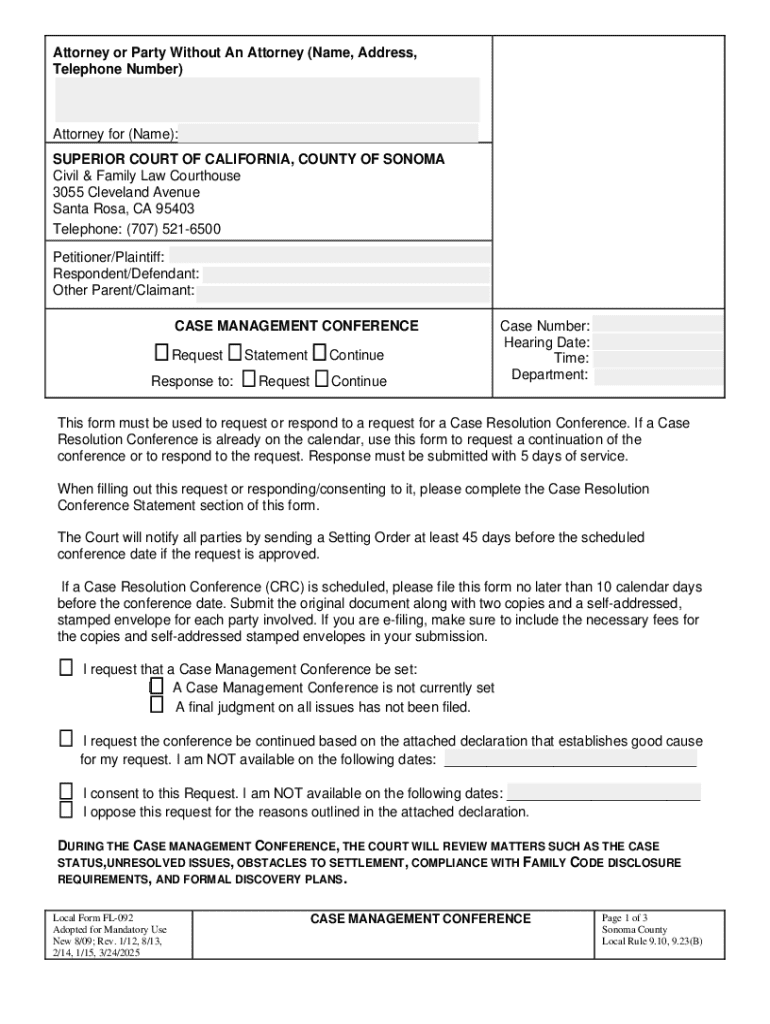
A Case Management Conference Request Form serves as a crucial document in the Superior Court of California, specifically within the County of Sonoma. It is primarily used in civil and family law cases to facilitate the scheduling or responding to a Case Management Conference (CMC). This form helps manage the progression of a case by encouraging parties to identify key issues, establish deadlines, and explore potential resolutions or agreements. The CMC is typically a meeting between the parties involved in a case and the judge to ensure all aspects of the case are on track and any disputes are addressed efficiently. By using this form, parties signal their readiness to move forward with legal proceedings and outline any preliminary matters that may require court intervention.
How to Use the Case Management Conference Request Form
Using the Case Management Conference Request Form involves several stages aimed at ensuring smooth legal proceedings. Initially, involved parties need to fill out the form accurately, indicating whether they are initiating or responding to a case management request. Key areas of focus include listing outstanding legal issues, summarizing previous checkpoints like disclosures or discovery, and proposing possible resolutions outside of court when feasible. An accurate and complete form submission is essential as it guides the subsequent discussions and decisions during the CMC. Parties should collaborate with legal counsel to ensure all details are addressed comprehensively, promoting a seamless experience during the conference.
Steps to Complete the Case Management Conference Request Form
-
Gather Essential Information: Before filling out the form, parties should collect all necessary documentation and information related to the case. This includes any previous filings, agreements, and outstanding issues.
-
Fill Out Party Information: Include detailed information about all parties involved. This should cover names, contact details, and roles in the case, ensuring accuracy and completeness.
-
Outline Case Issues: Clearly define the primary issues and any disagreements that require resolution during the conference. This provides a clear roadmap for what needs to be discussed and settled.
-
Status of Disclosures: Indicate the status of disclosures, ensuring that information is up-to-date and reflects any recent developments in the case.
-
Set Timing and Deadlines: Establish timelines for future actions and submissions. This step involves proposing dates that accommodate all parties for future deadlines.
-
Submit Form: Once completed, parties need to submit the form to the specified court location, following any additional procedures required by the Superior Court of California.
Key Elements of the Case Management Conference Request Form
-
Parties’ Information: Names and contact information for all parties involved, providing clear identification for legal processes.
-
Case Details: Case number, type of case (civil, family), and any related documentation which capture the breadth of the legal matter.
-
Issues and Disagreements: A summary of unresolved issues or any areas where the parties cannot reach an agreement, forming the basis of the CMC.
-
Disclosure Status: Updates on disclosures and evidence exchange status, ensuring transparency and preparedness for the CMC.
-
Resolution Attempts: Documentation of any prior efforts made towards settlement, encouraging earlier resolution without requiring court intervention.
Legal Use of the Case Management Conference Request Form
The legal significance of this form lies in its role in pre-trial procedures and its impact on fair case management. Submitted formally to the court, it ensures that the involved parties are adhering to necessary legal protocols and are seeking to address disputes proactively. Judges rely on the information provided to tailor the scope of the conference and direct case progression effectively. Misrepresentation or omission of crucial information can have legal consequences and negatively affect case outcomes, making it essential for the form to be filled with utmost honesty and thoroughness.
Who Typically Uses the Case Management Conference Request Form
The primary users of this form include legal professionals representing clients in civil and family law cases within Sonoma County. Parties involved in disputes or seeking resolution through the court system must engage with this process to outline their positions. It is also commonly used by self-represented litigants who are involved in such legal proceedings, making it important to understand and complete correctly to ensure that their concerns are voiced and addressed effectively during the CMC.


Important Terms Related to the Case Management Conference Request Form
-
Disclosure: The mandatory sharing of pertinent information related to the case, which must be clearly indicated on the form.
-
Dispute Resolution: Any efforts made by the parties to resolve issues outside of court, a necessary part of the form's submission process.
-
CMC: The acronym for Case Management Conference, describing the outcome toward which the information on the form is directed.
-
Parties: Refers to all participants in the case, including plaintiffs, defendants, or petitioners, who use this form to communicate their legal positions.
Examples of Using the Case Management Conference Request Form
-
Family Law Case: In a divorce proceeding, both parties might use the form to outline child custody disagreements, status of asset disclosures, and potential for settlement talks.
-
Civil Dispute: Businesses involved in a contract dispute might submit the form to identify areas where contract terms are contested and suggest mediation options before involving the court.
-
Self-Represented Litigant Scenario: An individual without legal representation uses the form to present viewpoints on a neighborhood property dispute, indicating the need for court assistance in interpretation and resolution.
Required Documents
To support the form, parties often need to provide accompanying documents such as previous case orders, correspondence, evidence relating to disputes, and any prior settlement attempts. This documentation ensures that the court has a comprehensive view of the case status and facilitates effective management during the CMC. Providing thorough and organized documentation enhances the potential for a successful and expedited legal process, permitting a more attentive judicial approach.
Filing Deadlines and Important Dates
Understanding and adhering to the submission deadlines for the Case Management Conference Request Form is pivotal. These deadlines are often set by the court procedural rules and ensure that there is adequate time for the court and all parties to prepare for the conference. Missing these deadlines can result in delays or unfavorable judgments, making it critical for participants to collaborate with legal advisors who are well-versed in the timing requirements of the Sonoma County court system.
Each section above delves into the integral elements that inform the successful completion and submission of the Case Management Conference Request Form, reflecting the extensive preparatory steps and considerations necessary for effective legal proceedings.