
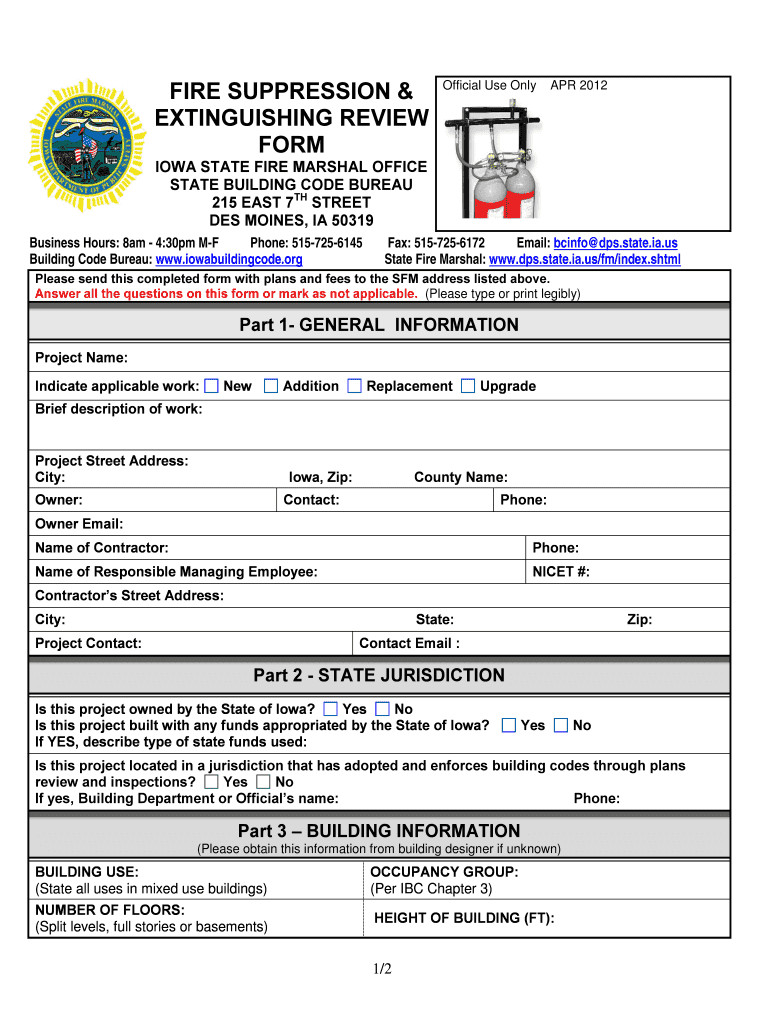







Definition and Purpose of the Fire Suppression and Extinguishing Review Form
The Fire Suppression and Extinguishing Review Form is a crucial document utilized by the Iowa State Fire Marshal Office to ensure comprehensive plan reviews and compliance for fire suppression systems in building projects. This form serves multiple purposes, including the certification of building safety standards and the strategic assessment of fire protection measures. By submitting this form, applicants contribute to advancing fire safety in public and private structures.
Importance of Fire Protection Assessments
- Fire suppression systems are evaluated to enhance building safety.
- Ensures that installations meet applicable codes and standards.
- Assesses the impact of fire systems on overall building design.
How to Use the Fire Suppression and Extinguishing Review Form
Utilizing the Fire Suppression and Extinguishing Review Form involves several critical steps to collect and submit relevant information accurately.
Steps for Effective Use
- Gather Required Information: Collect all necessary project details, including building usage and occupancy data.
- Identify Plan Review Fees: Determine the appropriate fees based on project size and complexity.
- Complete Required Sections: Fill out sections for project valuation, required documents, and acknowledgment of accuracy.
- Submit the Form: Depending on the requirements of the Iowa State Fire Marshal Office, submit via mail or online.
Examples of Projects Requiring the Form
- Commercial building construction
- Large-scale residential developments
- Renovations involving major fire system upgrades
How to Obtain the Fire Suppression and Extinguishing Review Form
The form can be acquired through multiple channels to ensure accessibility and convenience for applicants.
Methods to Access the Form
- Online: Visit state or specific fire marshal office websites to download.
- In-Person: Obtain directly from fire safety or municipal offices.
- Mail Requests: Some jurisdictions offer form delivery upon request by mail.
Online Accessibility Considerations
- Forms are often available in PDF format for easy download.
- Ensure compatibility with document editing software for seamless form filling.
Steps to Complete the Fire Suppression and Extinguishing Review Form
Completing the form involves precise detailing and careful attention to the outlined requirements to avoid errors and ensure timely approval.
Detailed Procedure
- Project Information Section: Enter details such as project name, location, and contact information.
- State Jurisdiction: Specify jurisdictional authority overseeing the fire safety evaluation.
- Building Details: Include building dimensions, purpose, and fire system specifications.
- Verification and Certification: Finalize by certifying the accuracy of the submitted details.
Common Mistakes to Avoid
- Omitting crucial details in the certification section.
- Underestimating the valuation for fee calculation.
- Failing to attach supplementary required documents.
Who Typically Uses the Fire Suppression and Extinguishing Review Form
This form is primarily used by different professionals and entities involved in building construction and renovation projects.


Key Users
- Architects and Engineers: Responsible for system design and safety compliance.
- Building Contractors: Submit plans for new or modified installations.
- Property Developers: Integral in pre-construction planning and permissions.
Relevance to Stakeholder Roles
- Enhancing collaborative planning between architects and contractors.
- Streamlining the compliance process with regulatory authorities.
Key Elements of the Fire Suppression and Extinguishing Review Form
Identifying and understanding the core components of the form is essential for accurate and effective completion.
Core Components
- Project Valuation Data: Provides the financial scope, impacting review fees.
- Fire Protection Systems Details: Includes specifications and design data.
- Certification by Applicant: Legally binds the submitter to the accuracy and truthfulness of the information provided.
State-Specific Rules for the Fire Suppression and Extinguishing Review Form
Regulatory compliance and submission guidelines can vary geographically, with specific considerations for applicants in the United States, particularly Iowa.
Iowa-Specific Considerations
- Adherence to state-mandated fire codes and standards.
- Submission deadlines dictated by local construction phases and timelines.
Jurisdictional Variations
- Differences in fee structures based on regional requirements.
- Variable levels of scrutiny in project review depending on state laws.
Required Documents for the Fire Suppression and Extinguishing Review Form
Submitting a complete set of documents alongside the form ensures a smooth review process and prevents delays.
Necessary Attachments
- Building Plans: Includes detailed design and fire system schematics.
- Occupancy Group Classifications: Clearly defines building use.
- Legal Compliance Certifications: Proof of adherence to local building codes.
Document Format Considerations
- Ensure documents are digitally or physically legible.
- Validate that all plans and documents align with form details for consistency.




