




01. Edit your form 2555 online
Type text, add images, blackout confidential details, add comments, highlights and more.

Type text, add images, blackout confidential details, add comments, highlights and more.

Draw your signature, type it, upload its image, or use your mobile device as a signature pad.

Send 2555 2023 via email, link, or fax. You can also download it, export it or print it out.
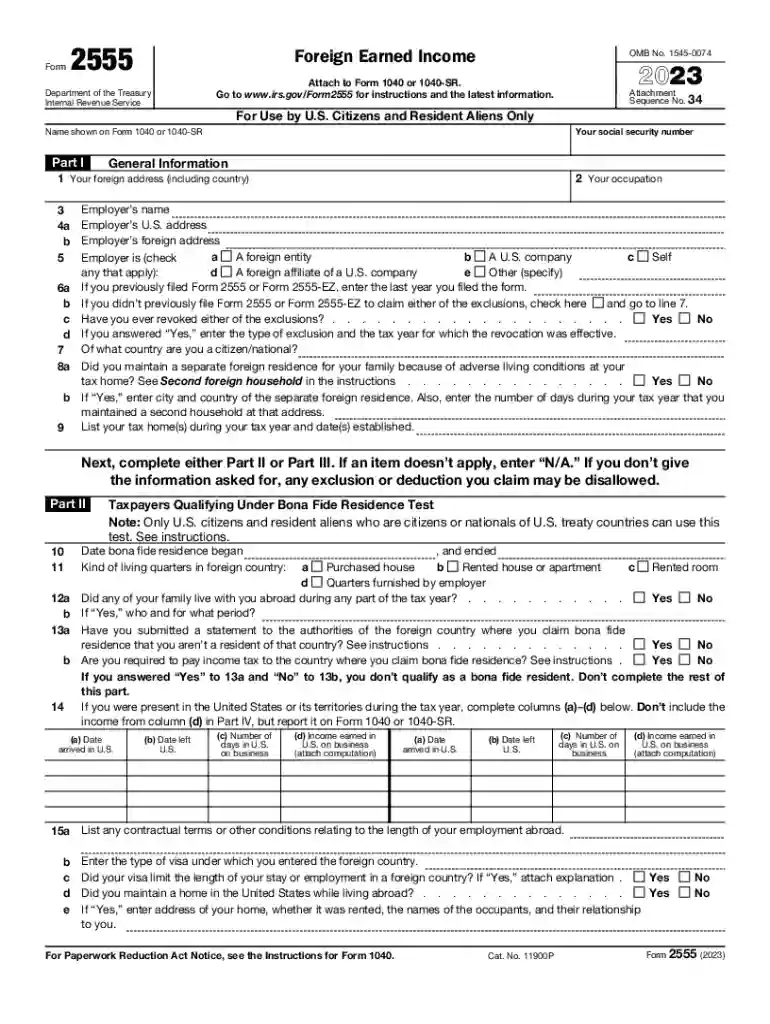
IRS Form 2555, also known as the Foreign Earned Income form, is a crucial document used by U.S. citizens and resident aliens living abroad to report foreign earned income. This form helps several taxpayers claim exclusions and deductions for foreign earned income, effectively minimizing double taxation. It includes comprehensive sections that allow taxpayers to fulfill legal requirements for reporting international earnings, foreign housing exclusion, and housing deductions. Understanding the purpose and nuances of Form 2555 is vital for taxpayers who live and work outside the U.S., ensuring they utilize the available tax benefits while maintaining compliance.
The form is divided into several pivotal sections tailored to gather specific information about the taxpayer's foreign income and housing circumstances. Key sections include:
Comprehension of each section is vital in accurately completing Form 2555, as each entry directly impacts the taxpayer's liability and financial benefits.
Eligibility for completing Form 2555 is dependent on meeting certain residency and income conditions. Essential criteria include:
Verification of eligibility is critical as it directly influences the tax liabilities and benefits claimable under U.S. tax law.


Filing Form 2555 effectively necessitates a structured approach to ensure accuracy and compliance. The steps include:
Following the outlined steps ensures comprehensive and precise form completion, which is essential for avoiding errors and penalties.
The IRS provides detailed guidelines, ensuring taxpayers understand how to complete and file Form 2555 correctly. Compliance requires:
Adhering to IRS guidelines not only facilitates accurate reporting but also protects against potential legal implications of misreporting.
Timeliness in filing Form 2555 is essential. Important dates include:
Understanding and adhering to these deadlines ensures compliance with IRS requirements, avoiding possible penalties linked to late submissions.
To ensure a complete and precise submission, gather the following:
Having comprehensive and organized documentation supports the taxpayer's claims, ensuring expedient form processing and reducing the risk of errors.
Consider these situations to apply the form accurately:
Real-world scenarios and examples elucidate how different taxpayers can utilize Form 2555 to their advantage, tailoring the form to their unique circumstances.
We've got more versions of the form 2555 form. Select the right form 2555 version from the list and start editing it straight away!
| Versions | Form popularity | Fillable & printable |
|---|---|---|
| 2025 | 4.5 Satisfied (59 Votes) | |
| 2024 | 4.4 Satisfied (24 Votes) | |
| 2023 | 4.3 Satisfied (23 Votes) | |
| 2022 | 4.1 Satisfied (28 Votes) | |
| 2021 | 4.8 Satisfied (82 Votes) | |
| 2020 | 4.4 Satisfied (132 Votes) | |
| 2019 | 4.2 Satisfied (54 Votes) | |
| 2018 | 4.3 Satisfied (79 Votes) | |
| 2017 | 4.4 Satisfied (135 Votes) | |
| 2016 | 4.3 Satisfied (92 Votes) | |
| 2015 | 4 Satisfied (29 Votes) | |
| 2014 | 4.2 Satisfied (44 Votes) | |
| 2013 | 4 Satisfied (38 Votes) | |
| 2012 | 4 Satisfied (46 Votes) | |
| 2011 | 4.3 Satisfied (55 Votes) |
At DocHub, your data security is our priority. We follow HIPAA, SOC2, GDPR, and other standards, so you can work on your documents with confidence.
Enter, in U.S. dollars, the total foreign earned income you earned and received in 2000 (see instructions). Be sure to include this amount on Form 1040, line 7
See the Instructions for Form 1040 and complete the Foreign Earned Income Tax Worksheet to figure the amount of tax to enter on Form 1040 or 1040-SR, line 16.Read more
1. You are a U.S. citizen or resident alien. 2. You expect to qualify for the foreign earned income exclusion and/or the foreignRead more


