
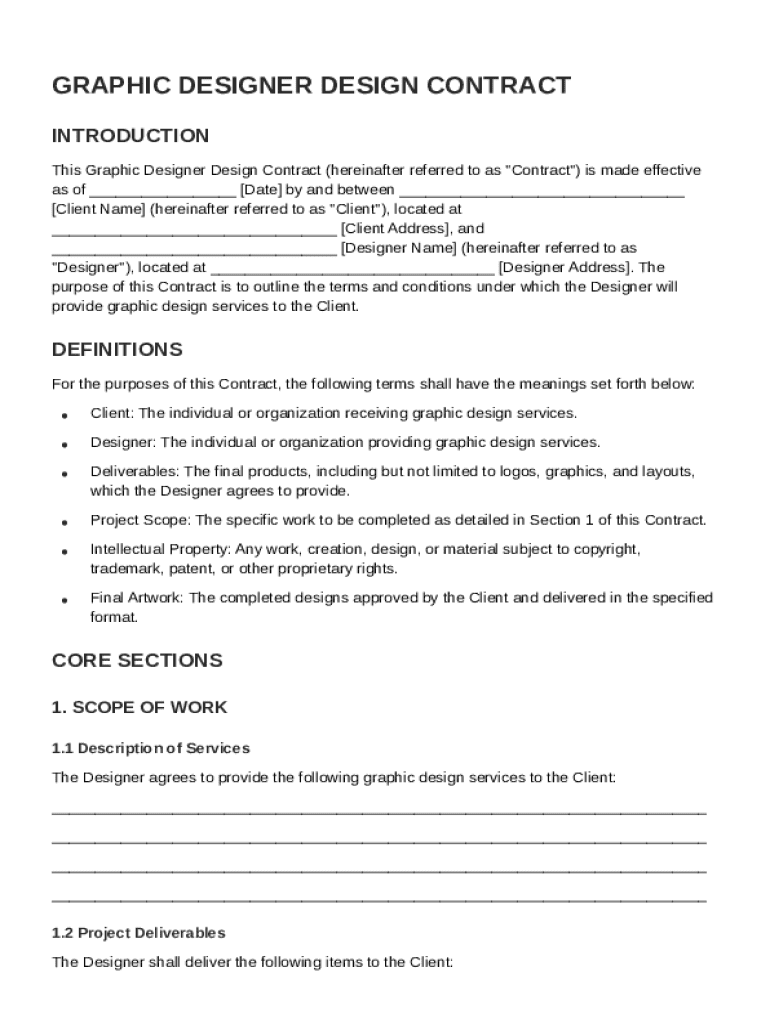







Definition & Overview of a Graphic Designer Design Contract Template
A Graphic Designer Design Contract Template is a legal document that outlines the terms and conditions governing the provision of graphic design services. Primarily used between a Client and a Designer, this contract is essential for ensuring both parties understand their responsibilities and expectations. It covers a variety of crucial elements, such as the scope of work, project timeline, compensation, intellectual property rights, confidentiality, termination conditions, limitation of liability, and governing law. By clearly delineating these components, the contract helps prevent misunderstandings and disputes, ensuring a smooth working relationship.
Key Elements of the Graphic Designer Design Contract Template
Scope of Work
- Clearly defines what services the Designer will provide.
- Outlines any specific deliverables, such as logos, flyers, or web designs.
- Details any additional services that may incur extra charges.
Project Timeline
- Specifies start and end dates for the project.
- Includes milestones for reviewing deliverables.
- Provides flexibility for extensions or modifications if needed.
Compensation
- States the Designer’s fee for the project.
- Details payment schedule and methods.
- Addresses potential additional costs for revisions or extra services.
Important Terms Related to Graphic Designer Design Contracts
Intellectual Property Rights
- Clarifies ownership of the design work after completion.
- Allows the Client to use the designs while protecting the Designer’s rights to their work.
- May include clauses on showcasing work in portfolios or for promotional purposes.
Confidentiality
- Ensures that both parties keep sensitive information private.
- May cover data shared during the project, including business plans or marketing strategies.
- Legally binds the parties to prevent unauthorized disclosure.
Legal Use of the Graphic Designer Design Contract Template
Enforceability
- Recognized as a legally binding contract in the United States.
- Must be signed by both parties to be valid.
- Ensures protection under U.S. contract law, facilitating legal recourse if terms are violated.
Governing Law
- Specifies which state’s laws apply if a legal dispute arises.
- Allows modifications to fit state-specific legal requirements.
Steps to Complete the Graphic Designer Design Contract Template
-
Gather Necessary Information
- Collect all details relevant to the project, including service scope and project timelines.
-
Customize the Template
- Adapt the contract to fit the specific needs of the project.
- Adjust clauses related to intellectual property, confidentiality, and compensation.
-
Review and Revise
- Ensure all terms accurately reflect agreed-upon conditions.
- Make needed adjustments to accommodate any new information.
-
Sign and Execute
- Both parties review the final version.
- Execute the contract with signatures to create a binding agreement.
Software Compatibility and Digital Implementation
Online Platforms
- Templates are often available in DOC, PDF, or TXT formats, ensuring broad software compatibility.
- Can be edited and signed using document management platforms like DocHub.
Digital vs. Paper Version
- Digital contracts allow for easy distribution and archiving.
- Enables faster editing and approval processes compared to paper versions.
Real-World Scenarios and Usability Cases
Use Cases
- Freelancers securing projects with new clients.
- Design agencies engaging with multiple clients and requiring standardized contracts.
- Corporations working with external designers for marketing materials.
Practical Examples
- A freelance graphic designer uses the contract to clarify responsibilities when creating a brand's new logo.
- Design agencies employ these templates across various projects, ensuring consistent legal backing.
Versions or Alternatives to the Graphic Designer Design Contract Template
Alternative Contracts
- Commission contracts for unique artworks.
- Broad design service agreements encompassing multiple projects.
Variations
- Templates customized for different industries, such as tech startups or retail companies.
- Contracts that incorporate recent technologies or digital marketing strategies.
By understanding these components, graphic designers and their clients can use this template to facilitate clear communication and secure successful project outcomes.




