
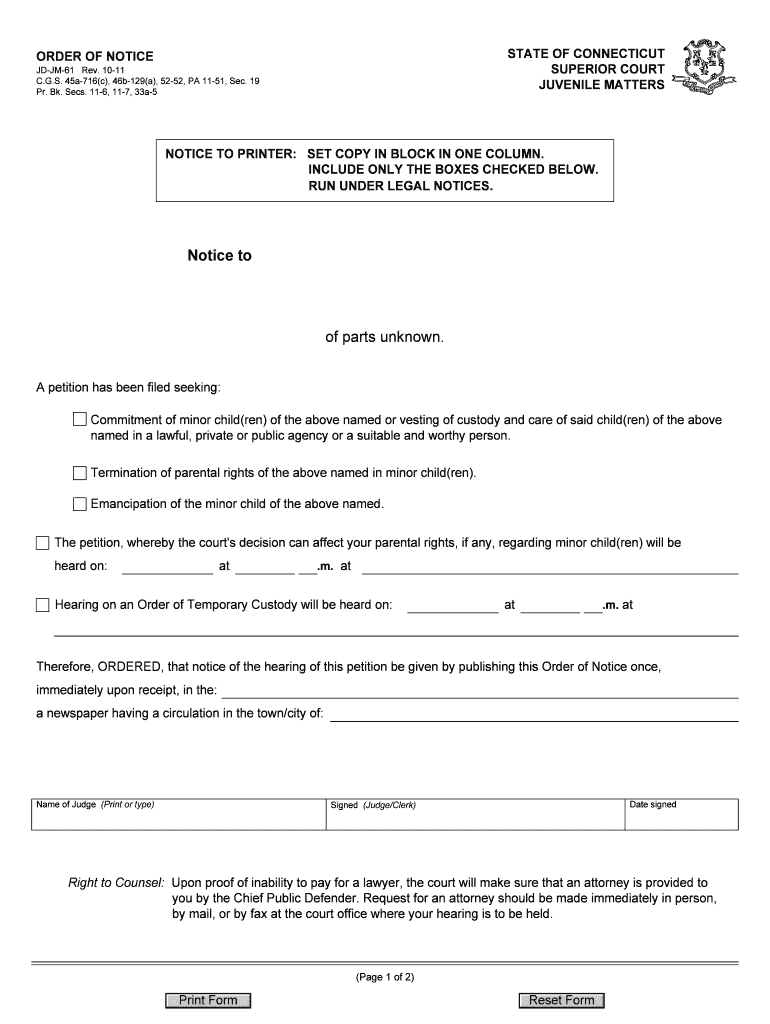



Ct jdjm 61 form 2026

Get Form
ct jd jm 61 Preview on Page 1

Here's how it works

01. Edit your ct jd jm 61 online
Type text, add images, blackout confidential details, add comments, highlights and more.

02. Sign it in a few clicks
Draw your signature, type it, upload its image, or use your mobile device as a signature pad.

03. Share your form with others
Send jd jm 61 via email, link, or fax. You can also download it, export it or print it out.

How to use or fill out ct jdjm 61 form with our platform

Form edit decoration
9.5
Ease of Setup
DocHub User Ratings on G2
9.0
Ease of Use
DocHub User Ratings on G2
  1. Click ‘Get Form’ to open the ct jdjm 61 form in the editor.
  2. Begin by filling in the 'Notice to' section with the name of the individual involved. This is crucial for identifying the parties affected by the petition.
  3. In the next section, select the appropriate petition type by checking one or more boxes that apply, such as commitment of minor child(ren) or termination of parental rights.
  4. Enter the date and time for the hearing in the designated fields. Ensure accuracy as this information is vital for all parties involved.
  5. Fill in the name of the newspaper where this notice will be published, ensuring it has circulation in your town/city.
  6. Complete the judge's name and sign/date at the bottom of the form. This finalizes your submission and ensures it is legally binding.

Start using our platform today to fill out your ct jdjm 61 form online for free!

See more ct jdjm 61 form versions

We've got more versions of the ct jdjm 61 form form. Select the right ct jdjm 61 form version from the list and start editing it straight away!
Versions Form popularity Fillable & printable
2011 4.8 Satisfied (105 Votes)
be ready to get more

Complete this form in 5 minutes or less

Get form

Got questions?

We have answers to the most popular questions from our customers. If you can't find an answer to your question, please contact us.
Contact us
You have a right to represent yourself in all court cases. When you represent yourself, you are called a self-represented party. In some cases, like landlord/tenant and family, the court has developed easy-to-read court forms to help non-lawyers.
The State of Connecticut Centralized Infractions Bureau now allows you to pay infractions online. The link below will take you to the State of Connecticut Judicial Branch to pay your infraction.
To initiate a divorce in Connecticut, you or your attorney must, at a minimum, serve and file a Summons, Complaint, and Notice of Automatic Orders. Generally speaking, these documents explain how you meet the residency requirement, some basic facts about your marriage, the grounds for divorce, and flag requests
Divorce may be granted in approximately 35 days without the need to see a judge. If either spouse has ever received public assistance: Certification of Notice in Family Cases (Public Assistance) (JD-FM-175) You will be assigned your first court date after filing your case.
Fill out the following forms: The Summons Family Actions (JD-FM-3) The Divorce Complaint (Dissolution of Marriage) (JD-FM-159) or, if you are filing to dissolve a civil union, not a marriage, the Dissolution of Civil Union Complaint (JD-FM-159A) The Notice of Automatic Court Orders (JD-FM-158)

Security and compliance

At DocHub, your data security is our priority. We follow HIPAA, SOC2, GDPR, and other standards, so you can work on your documents with confidence.

Learn more
ccpa2
pci-dss
gdpr-compliance
hipaa
soc-compliance

People also ask

What are the court fees for divorce in Connecticut? Court Costs for all types of cases: mediation, collaboration, litigation, or pro se representation are all the same: Court Filing Fee: $350. Sheriffs Fee: $50 $75.
You can file most family case types electronically (on-line), including dissolution of marriage (divorce); legal separation; annulment; and civil union - dissolution, legal separation or annulment, custody application, and visitation petition.
Generally, youths under age 16 are not criminally responsible for their conduct unless they commit specified violent crimes. Cases involving nonviolent youths under age 16 are disposed of in juvenile, instead of criminal, court.

ct jdjm 61 form print

