
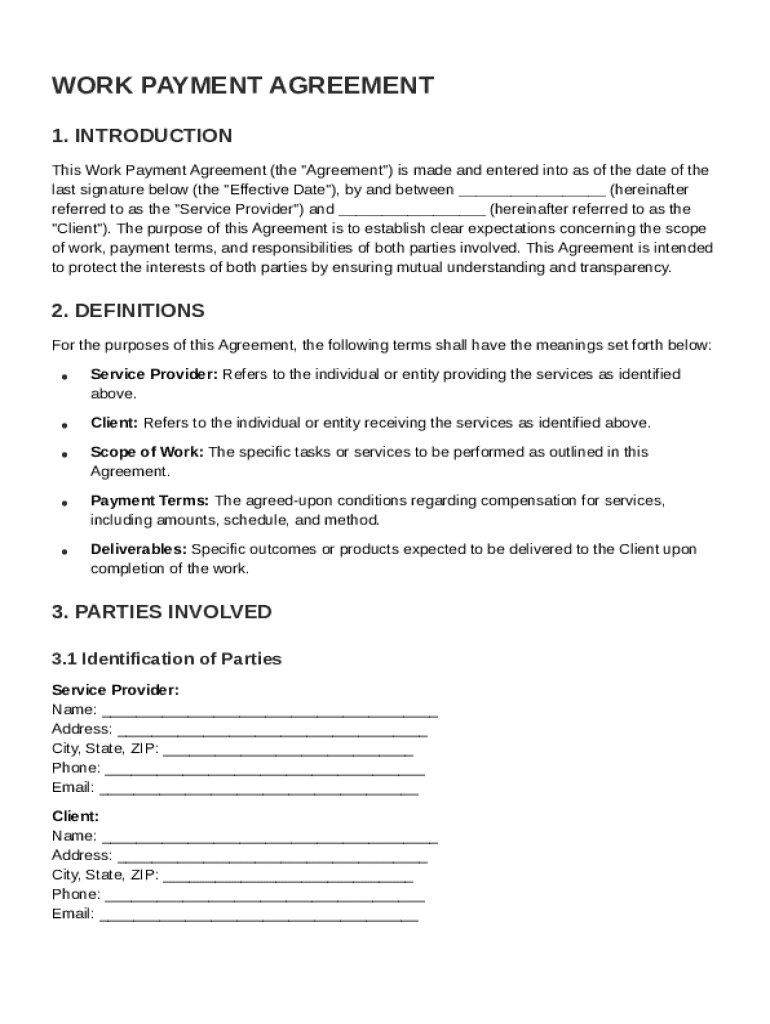







Definition & Meaning
A Work Payment Agreement Template is a legal document designed to establish clear terms and conditions between a Service Provider and a Client. This template sets out the scope of work, payment details, responsibilities of both parties, confidentiality terms, termination conditions, and dispute resolution mechanisms. Its primary function is to provide clarity and protect the interests of both the provider delivering the service and the client receiving it. Examples of services covered could include freelance work, consultancy, or contracting. By defining these elements, misunderstandings are minimized, and a structured framework for professional collaboration is created.
Who Typically Uses the Work Payment Agreement Template
This template is commonly used by professionals in environments where services are contracted out on a project basis. Common users include freelancers, consultants, independent contractors, and agencies. Businesses, both large and small, that frequently engage external service providers to meet organizational needs can also benefit from utilizing this template. For instance, a digital marketing agency hiring a freelance graphic designer would employ such an agreement to formalize the arrangement and ensure all parties have aligned expectations. Similarly, consultants offering services to various clients could use this template to efficiently manage multiple engagements.


Key Elements of the Work Payment Agreement Template
Several critical elements make up the Work Payment Agreement Template, each serving an essential role in the overall document. These include:
- Scope of Work: Detailed description of the services to be provided.
- Payment Terms: Specifies the compensation structure, including rates, payment schedule, and any invoice requirements.
- Responsibilities: Defines the duties of both the Service Provider and the Client.
- Confidentiality: Outlines any non-disclosure agreements or proprietary information protection clauses.
- Termination Clause: Specifies the terms under which the agreement can be ended by either party.
- Dispute Resolution: Details procedures for resolving disagreements, potentially including mediation or arbitration options.
Each element ensures that both parties are on the same page and any deviations from the agreement can be promptly addressed.
Steps to Complete the Work Payment Agreement Template
Filling out the Work Payment Agreement Template involves a structured approach to ensure all necessary information is accurately captured.
- Identify Both Parties: Start with the full legal names and contact information of the Service Provider and the Client.
- Define the Scope of Work: Clearly articulate what services will be delivered, including specific deliverables and timelines.
- Detail Payment Terms: Specify the payment amount, frequency, due dates, and preferred payment methods.
- Outline Responsibilities: Note any obligations or materials each party must provide to support the work.
- Incorporate Confidentiality Terms: If applicable, include clauses to protect sensitive information exchanged during the engagement.
- Establish Termination and Dispute Rules: Set the conditions for terminating the agreement and methods for handling potential disputes.
- Review and Sign: Each party should thoroughly review the agreement terms before signing to confirm their understanding and acceptance.
Taking these steps helps ensure the agreement is tailored to the specific relationship between the Service Provider and the Client.
Legal Use of the Work Payment Agreement Template
In the United States, ensuring the legal integrity of the Work Payment Agreement Template is crucial. While generic templates provide a useful starting point, tailoring the agreement to adhere to specific federal and state laws is essential. For example, confidentiality clauses should comply with intellectual property laws, and payment terms must reflect the Fair Labor Standards Act requirements. Consulting with a legal professional when drafting or modifying the template can help verify compliance and prevent potential disputes arising from legal oversights. Additionally, the legal enforceability of electronic signatures under the ESIGN Act allows the template to be signed digitally, streamlining the execution process.
State-by-State Differences
While the core principles of a Work Payment Agreement Template remain consistent, state-specific regulations can influence certain document elements. For instance, variations in labor laws, contract laws, and payment processing requirements may necessitate adjustments to the template based on the state where the contracting parties operate. California and New York, for instance, have specific disclosures and labor code stipulations that must be reflected in employment-related agreements. Therefore, users should consider state-specific legal guidance when using the template to ensure full compliance. Being aware of such differences can prevent legal complications and enhance the document's validity across jurisdictions.
Important Terms Related to Work Payment Agreement Template
Familiarity with key legal terms within the Work Payment Agreement Template is crucial for both creation and comprehension:
- Indemnity: A clause that secures one party against legal liabilities incurred by the other.
- Force Majeure: A provision that frees both parties from liability or obligation when an extraordinary event occurs, like natural disasters, preventing fulfillment.
- Net Payment: Clarifies the timeframe in which payment is due after a service completion or invoice issuance.
- Non-solicitation Clause: Prohibits one party from soliciting the other's clients or employees post-agreement.
- SaaS Agreement: Relevant for technology services, detailing software usage rights and obligations.
Each term enhances the agreement's clarity, protecting against common misunderstandings and ensuring mutual understanding.
Examples of Using the Work Payment Agreement Template
Consider a freelance web developer working with an e-commerce company. The Work Payment Agreement Template could outline the specific website functionalities to be delivered, associated timeline, payment for each project phase, and provisions for handling proprietary information. Similarly, an independent marketing consultant might use the template to agree on campaign parameters, success metrics, and payment terms with a new client. These examples illustrate the document's flexibility and utility across various industries, highlighting its role in formalizing work relationships and defining success metrics for both parties.




