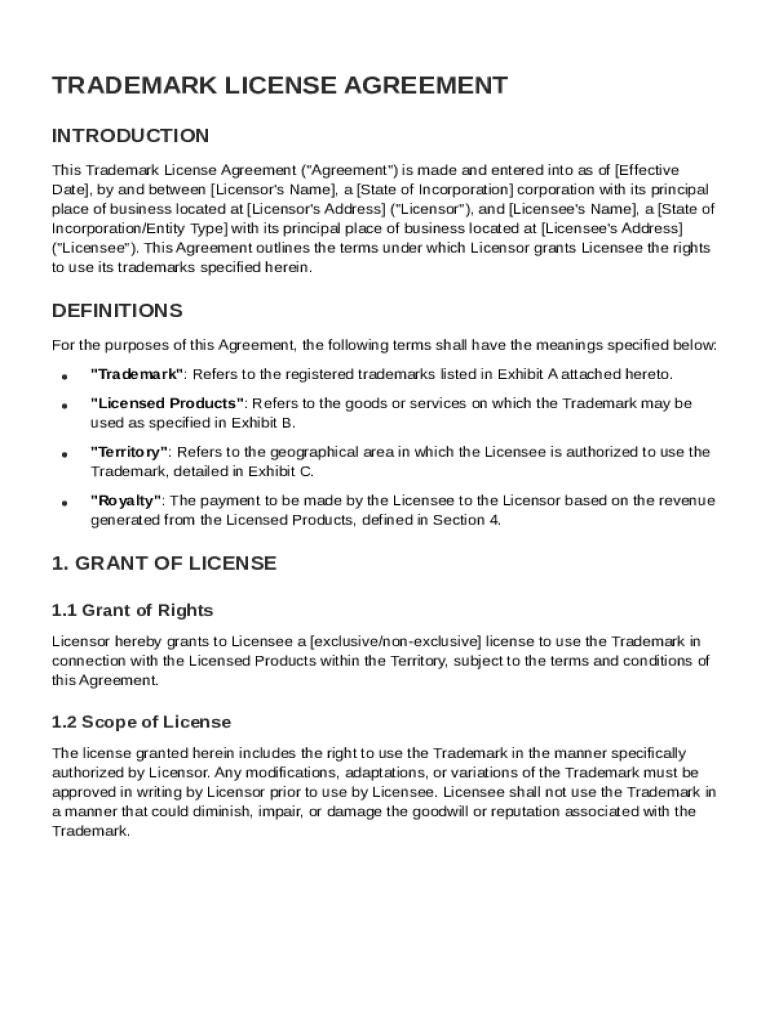







Understanding the Trademark License Agreement Template
A Trademark License Agreement Template serves as a fundamental contract that delineates the terms under which a trademark owner, known as the Licensor, permits another party, known as the Licensee, to use specified trademarks. This arrangement is particularly significant in preserving the brand's integrity and ensuring consistent quality across products linked to the trademark.
Main Components of a Trademark License Agreement
The agreement typically comprises several key sections, each serving a specific purpose in delineating the responsibilities and expectations of both parties involved. Notably, it includes:
- Definitions: Clearly defines the terms used within the agreement, ensuring mutual understanding.
- Grant of License: Specifies the scope of the license, including geographical limitations and any exclusivity.
- Quality Control: Provides guidelines to maintain the quality standards associated with the Licensor's trademark.
- Royalties and Payments: Details the financial terms, outlining how and when royalties are to be paid by the Licensee.
- Term and Termination: Establishes the duration of the agreement and the conditions under which it can be terminated.
How to Use the Trademark License Agreement Template
To effectively utilize the template, it's essential to tailor it to the specifics of the arrangement between the Licensor and Licensee. This involves:
- Customization: Modify sections to reflect the unique terms negotiated, such as license scope and payment structures.
- Review and Agreement: Both parties should review the template thoroughly and agree on all included terms.
- Legal Consultation: Seek legal advice to ensure all terms are compliant with state and federal regulations.
Who Typically Uses the Trademark License Agreement Template
This template is most commonly used by businesses seeking to expand their brand's reach without the upfront investment of establishing new product lines. It is advantageous for:
- Manufacturers: Looking to produce and distribute products using another company's trademark.
- Retailers: Seeking to sell trademarked products.
- Brand Owners: Aiming to monetize their intellectual property without additional capital expenditure.


Important Terms Related to Trademark License Agreement Template
Familiarity with specific terminology is crucial for comprehending the full implications of a trademark license agreement. Important terms include:
- Licensor: The trademark owner granting the license.
- Licensee: The party granted permission to use the trademark.
- Licensed Marks: Specific trademarks covered by the agreement.
- Territory: The specified geographical area where the license is valid.
Legal Use of the Trademark License Agreement Template
The legal integrity of the agreement is paramount to its enforceability. Important legal considerations include:
- Compliance with the Lanham Act: Ensures that the trademark use falls within U.S. trademark law.
- Intellectual Property Rights: Clarifies that the Licensor retains ownership of the trademark.
Key Elements of the Trademark License Agreement Template
For a comprehensive and effective agreement, several key elements must be included:
- Exclusive vs. Non-Exclusive License: Determines if the Licensee is the sole party permitted to use the trademark.
- Performance Standards: Outlines standards the Licensee must adhere to, ensuring consistent quality.
- Indemnification: Protects both parties from potential liabilities arising from infringement claims.
Examples of Using the Trademark License Agreement Template
Real-world applications of the template highlight its utility. For instance:
- A clothing manufacturer licenses a popular cartoon character's trademark for a new line of children's apparel.
- A food company uses a celebrity chef's trademarked name for a range of ready-to-eat meals.
Steps to Complete the Trademark License Agreement Template
Filling out the template is straightforward if approached methodically:
- Input Identifying Information: Begin with the names and addresses of both parties.
- Specify the Trademarks: Clearly list the trademarks to be licensed.
- Define Terms and Conditions: Articulate the duration, territorial scope, and financial terms.
- Legal Consultation: Have a legal professional review the agreement for coherence and compliance.
State-Specific Rules and Considerations
Trademark licensing in the U.S. can vary by state due to differing regulations on contractual obligations and intellectual property. It's important to:
- Research State Laws: Some states may have specific regulations affecting intellectual property agreements.
- Local Legal Advice: Consulting with attorneys familiar with local laws is advisable for ensuring legal adherence.
Business Types That Benefit Most from the Trademark License Agreement Template
Certain business types find particular value in using the trademark license agreement template, such as:
- Franchises: Where consistency in branding is essential.
- Joint Ventures: Involving multiple parties working under a unified brand.
Each block provides detailed information, explaining the nuances of the Trademark License Agreement Template and its application across various scenarios, ensuring comprehensive understanding and utility.