




01. Edit your form online
Type text, add images, blackout confidential details, add comments, highlights and more.

Type text, add images, blackout confidential details, add comments, highlights and more.

Draw your signature, type it, upload its image, or use your mobile device as a signature pad.

Send it via email, link, or fax. You can also download it, export it or print it out.
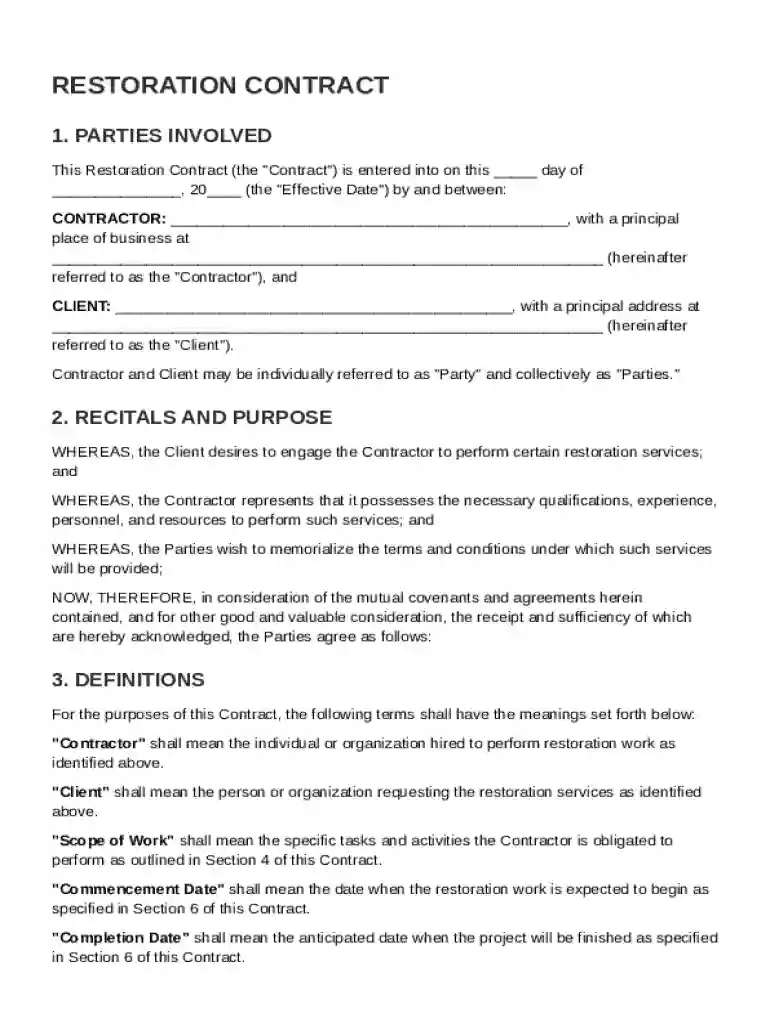
A restoration contract template is a pre-designed document that outlines the specific terms, conditions, and obligations agreed upon between a contractor and a client for services related to restoration projects. This includes repairing and restoring structures or properties to their original or improved condition after damage or deterioration. Such contracts are essential for setting clear expectations and obligations and for protecting the interests of both parties. By using a standardized template, you can ensure consistency, compliance with applicable laws, and the inclusion of all necessary legal provisions.
The template distinctly identifies the parties involved, including the contractor, who will perform the restoration work, and the client, who requires the services. Each party's details, such as their full legal names, addresses, and contact information, should be clearly stated to avoid any ambiguity.
This section details what the restoration work will entail, including specific tasks, timelines, and any deliverables that are expected during the project. Clear definitions help prevent misunderstandings and ensure that all work requirements are documented.
The payment section outlines how and when payments will be made. This could include upfront deposits, milestone payments, or payments upon completion, along with any penalties for late payments. By specifying the amount and schedule, both parties have a clear understanding of their financial obligations.
Review the Template: Examine the standard clauses to ensure they suit the specific restoration project. Look for areas that might need customization based on the project’s unique requirements.
Fill in Party Details: Enter full legal names and contact information for the contractor and the client. Double-check for accuracy to avoid future disputes.
Define the Scope of Work: Clearly outline the tasks to be accomplished, employing detailed descriptions to cover every aspect of the restoration project.
Specify Payment Terms: Agree on payment schedules, methods, and any conditional terms such as penalties for delays or bonuses for early completion.
Add Project Timelines: Specify the start and completion dates, along with any critical milestones that need to be reached during the project.
Include Optional Clauses: Add specific legal terms or additional clauses as needed, such as indemnification or disputes resolution, to tailor the template to suit other specific needs.
Signatures: After thoroughly reviewing the contract, both parties should sign it to indicate acceptance of the terms and to make the contract legally binding.
Restoration contracts must comply with local, state, and federal laws. This usually involves adhering to regulations regarding insurance, building codes, and safety standards. The contract should also have sections that detail how disputes will be resolved, whether through mediation, arbitration, or court proceedings. It is advisable to have a legal professional review the contract to ensure compliance and to include any specific provisions necessary for the jurisdiction in which the contract will be executed.
Different states may have varying requirements on what needs to be included in restoration contracts. These can involve specific licensing like contractor bonds or insurance requirements, prevailing wages, and minimum standards of workmanship. For instance, California requires written contracts for projects exceeding $500 to include a detailed description of the work, total charges, and a notice about the consumer's right to a lien waiver.
For contractors hired to restore homes after natural disasters, the template serves as a vital tool to set expectations with homeowners about work deliverables and financial obligations. By having a clear roadmap, such situations can be managed smoothly with fewer legal issues.
In commercial settings, restoration contracts are essential when dealing with property management companies or corporate clients. The contracts help streamline projects by clarifying the roles of subcontractors and ensuring compliance with commercial property regulations.
Ensure that all necessary licenses and certifications related to practicing restoration work are up to date. Including these documents with the contract can prevent legal challenges later on.
Proof of liability insurance and any other mandatory insurance policies should accompany the contract to protect against potential liabilities during the restoration project.
There are multiple versions of restoration contracts that might be adapted for varying scales of projects, including specialized templates for fire damage, water damage, or a mixture of restoration and renovation. Each version tends to focus on the specific legal and operational requirements associated with a particular type of damage.
Digital platforms like DocHub make it easy to customize and sign restoration contract templates online, allowing for a more streamlined process that accommodates multiple parties working remotely.
By closely following these guidelines for the restoration contract template, parties can ensure a transparent agreement that minimizes disputes and lays a foundation for successful project execution.
At DocHub, your data security is our priority. We follow HIPAA, SOC2, GDPR, and other standards, so you can work on your documents with confidence.

Contractor shall be responsible for all expenses incurred while performing services under this Agreement. This includes automobile, truck, and other travel
Dec 7, 2020 3 Agreement to Occupy Office Premises (template) (PRA Annex 3). 4 Agreement to Occupy for Works (Worksite Possessions) (template) (PRA Annex 4)*.


