
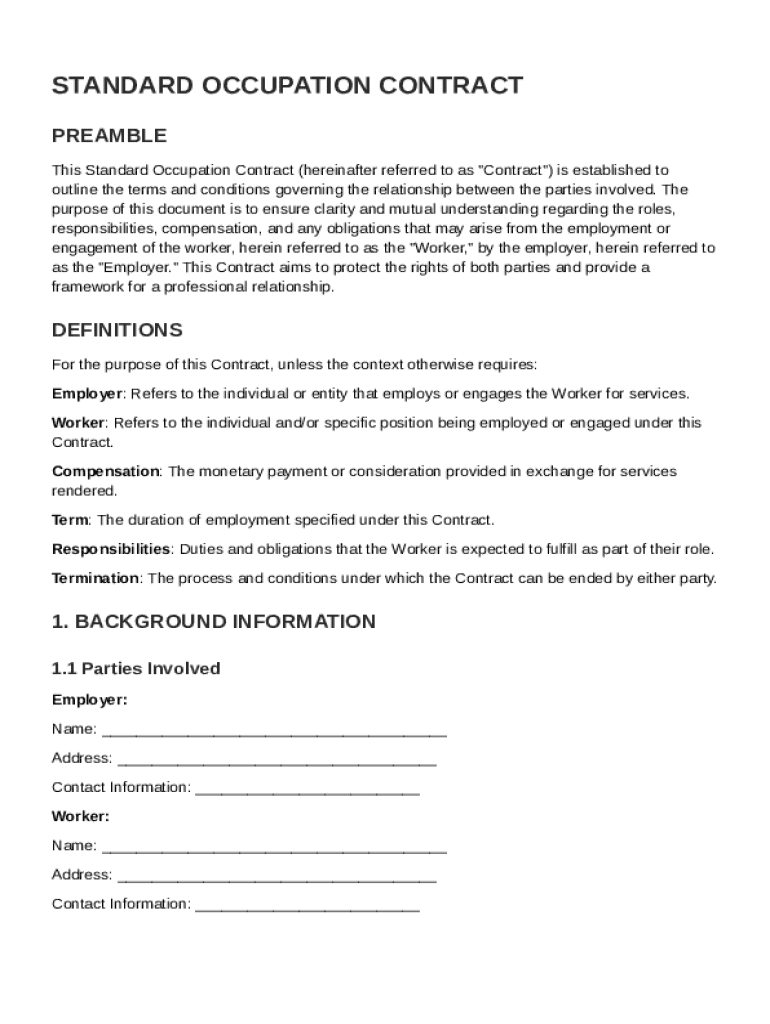







Definition and Purpose of the Standard Occupation Contract Template
The Standard Occupation Contract Template serves as a comprehensive document that clearly delineates the employment terms and conditions between an employer and a worker. It outlines specific aspects like roles, responsibilities, compensation, and obligations. This template is pivotal in establishing a mutual understanding between both parties, thereby preventing future disputes and protecting rights. Additionally, it covers essential employment details such as position title, duties, and termination provisions, ensuring both parties operate with clear expectations.
Key Elements of the Standard Occupation Contract Template
A Standard Occupation Contract Template includes several critical elements to offer comprehensive coverage of an employment relationship. These elements might typically comprise:
- Employment Details: Definitions including the position title, job duties, and responsibilities ensure clarity.
- Compensation and Benefits: Details regarding salary, bonuses, benefits, and compensation methods.
- Rights and Obligations: Clearly defined rights and duties of both the employee and employer, directly impacting daily operations.
- Termination Provisions: Guidelines on how either party can terminate the employment and under what circumstances.
- Dispute Resolution: Processes for resolving conflicts that may arise during the employment term.
- Amendment Procedures: Steps for formally amending the contract when necessary.
Exploring these elements in depth helps both parties understand their commitments, enhancing transparency and trust.
Steps to Complete the Standard Occupation Contract Template
Completing a Standard Occupation Contract Template involves several structured steps to ensure accuracy and legal compliance. These steps typically include:
- Review the Template: Start by examining the entire document to understand the required sections and any customization needed.
- Fill in Employment Details: Insert the employee’s name, position, job description, and other essential employment information.
- Specify Compensation: Detail the salary structure, payment terms, and any additional benefits or allowances.
- Define Rights and Obligations: Clearly state the roles, rights, and duties of both employee and employer.
- Include Provisions: Add sections on termination, dispute resolution, and any other specific terms applicable.
- Review for Accuracy: Ensure there are no errors and that all information is current and accurate.
- Obtain Signatures: Once finalized, both parties should sign the document to make it legally binding.
Each step requires careful attention to ensure the contract is tailored to the specific employment situation and complies with applicable laws.
Legal Use of the Standard Occupation Contract Template
The Standard Occupation Contract Template holds legal significance by preventing misunderstandings and disputes. It is drafted to comply with employment laws and regulations applicable in the United States, offering a legally recognized framework for employment relationships. Legal use of this template can prevent costly legal battles by setting clear terms agreed upon by all parties involved.
Furthermore, the inclusion of provisions such as termination and dispute resolution follows U.S. labor laws, which help both the employer and employee recognize their rights and obligations. Following legal advice when completing this template can also ensure adherence to state-specific employment laws.
State-Specific Rules for the Standard Occupation Contract Template
While the Standard Occupation Contract Template provides a baseline framework applicable across the U.S., states may have specific requirements that necessitate adjustments to the contract. These can include:
- Minimum Wage Laws: Varying wage thresholds that determine minimum compensation.
- Employment at Will: Specific conditions under which an employment relationship may be terminated.
- Worker Protections: State-specific worker safety and discrimination rules.
- Leave Policies: State-mandated paid or unpaid leave policies such as family leave.
Employers should verify state-specific laws and incorporate necessary changes into the template to ensure full legal compliance. Such verification helps in preventing penalties or invalidation of the contract due to noncompliance with local regulations.
Important Terms Related to the Standard Occupation Contract Template
Understanding key terms associated with the Standard Occupation Contract Template enhances clarity. Essential terms typically included are:
- At-Will Employment: Describes the flexible nature of the employment relationship, allowing termination by either party under certain conditions.
- Confidentiality Clauses: Provisions that protect sensitive company information.
- Non-Compete Agreements: Restrictions on employees working with competitors for a certain period post-employment.
- Probation Period: A set period at the start of employment during which either party can terminate the contract without heavy repercussions.
Familiarity with these terms is crucial for both employers and employees to comprehend their rights and commitments fully.
Examples of Using the Standard Occupation Contract Template
Practical examples of employing the Standard Occupation Contract Template demonstrate its versatility across various scenarios, such as:
- New Hire Situation: A small business uses the template to formalize the hiring of a new employee, providing transparency over roles and compensation.
- Remote Work Agreement: Adapted to incorporate telecommuting provisions and ensure clear expectations regarding remote work responsibilities.
- Promotion within the Company: Updated from a previous agreement to reflect new responsibilities and compensation after a promotion.
Real-world applications highlight the template’s adaptability to different employment contexts, supporting diverse business needs.
Versions or Alternatives to the Standard Occupation Contract Template
Alternatives to the standard version of the occupation contract may exist based on specific industry requirements or varying employment scenarios. These may include:
- Freelance Agreements: Contracts tailored for freelance or gig workers, focusing on short-term engagements.
- Part-Time Employment Contracts: Offers greater flexibility and focus on fewer hours or restricted work days.
- Collective Bargaining Agreements: Designed for unionized environments involving negotiated terms between employers and unions.
Selecting the right variant addresses the unique needs of different types of employment relationships, catering to specialized business scenarios or employee statuses.
Each of these sections offers comprehensive details and insights essential for employing the Standard Occupation Contract Template effectively. Exploring these areas delivers robust guidance on drafting and utilizing such contracts with legal precision and flexibility specific to business needs.




