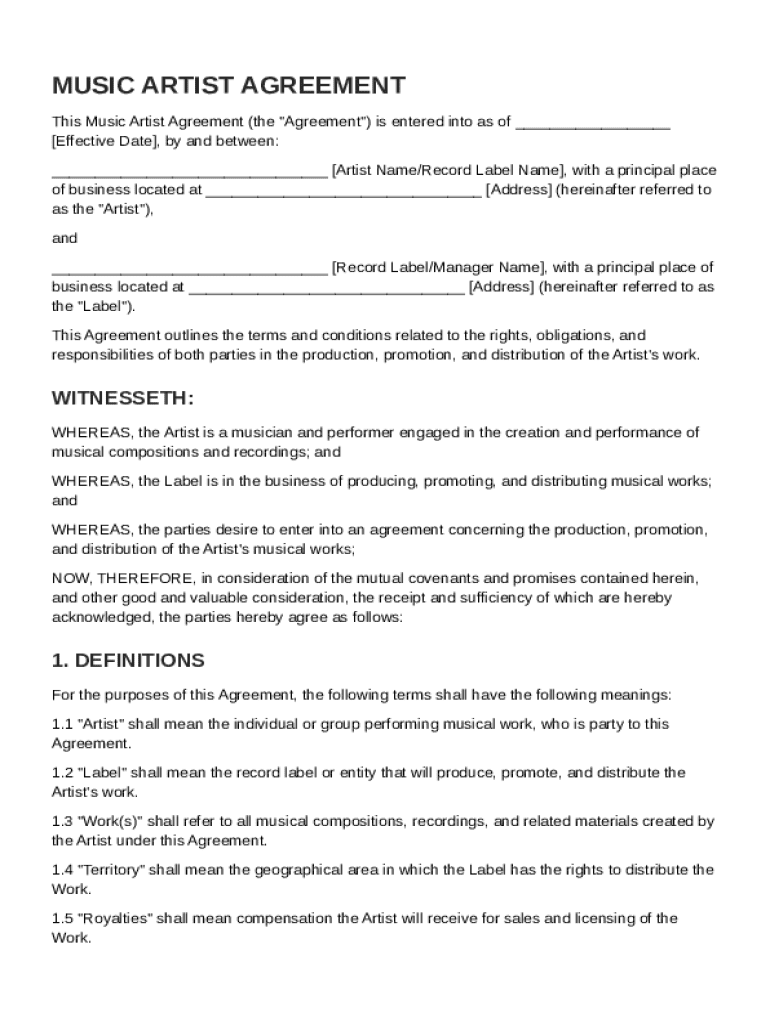







Definition and Meaning
The Music Artist Agreement Template is a legal document that outlines the relationship between a music artist and a record label. It specifies the roles and responsibilities of both parties concerning the production, promotion, and distribution of the artist’s music. By clearly defining the terms, the agreement helps to prevent misunderstandings, protect intellectual property rights, and outline the compensation structure, including royalties and advances.
- Roles and Responsibilities: The agreement establishes the duties of each party, such as the artist’s obligations to produce music and the label’s responsibilities to market and distribute it.
- Intellectual Property: Ownership rights over the artist’s musical works are clearly defined, ensuring that both parties understand their rights to use and distribute the content.
How to Use the Music Artist Agreement Template
Using a Music Artist Agreement Template requires careful attention to detail to ensure that all relevant information is included and accurately reflects the intentions of both parties.
- Customization: Tailor the template to fit specific needs, such as altering sections that pertain to exclusivity or altering financial terms.
- Consultation: Engaging with legal professionals can help identify any omissions in the template and provide guidance on conforming with applicable laws.
- Review: Both parties should review the agreement together to agree on each term and make amendments if necessary.
Key Elements of the Music Artist Agreement Template
Understanding the principal components of a Music Artist Agreement Template is crucial for its effective application.
- Compensation Structure: Details regarding how artists will be paid, including royalty rates and advance payments.
- Rights and Ownership: Defines who owns the rights to the masters and how they may be used or licensed.
- Termination Clauses: Conditions under which the agreement may be ended by either party.
- Confidentiality Clauses: Ensures all proprietary information is kept confidential by both parties.
- Dispute Resolution: Procedures for resolving potential disputes, often including mediation or arbitration options.
Steps to Complete the Music Artist Agreement Template
Creating a complete Music Artist Agreement using the template involves specific steps.
- Identify Parties: Clearly specify the artist and the record label along with their legal names and business addresses.
- Detail Financial Terms: Outline all financial arrangements, including how royalties, advances, and other compensations will be handled.
- Specify Deliverables: Define what the artist is required to deliver, such as album numbers or tour commitments.
- Set Timelines: Include any critical dates for deliverables and promotional activities.
- Legal Review and Signatures: Have the final document reviewed by legal counsel and signed by both parties.
Legal Use of the Music Artist Agreement Template
The template serves legal purposes by providing a binding document that both the artist and the record label must adhere to.
- Compliance with Laws: The agreement should conform to applicable state and federal regulations, which may include labor and contract laws specific to the music industry.
- Enforceability: With the appropriate signatures and adherence to necessary legal formalities, the agreement becomes enforceable in a court of law.
Who Typically Uses the Music Artist Agreement Template
This template is commonly used by a variety of individuals and entities involved in the creation and distribution of musical works.
- Independent Artists: Musicians seeking to formalize agreements with record labels.
- Record Labels: Companies aiming to protect their investments by clearly defining their expectations and responsibilities.
- Managers and Agents: Representatives who negotiate and manage deals on behalf of artists to secure fair terms.

Important Terms Related to Music Artist Agreement Template
Familiarizing oneself with key legal and industry-specific terms can enhance the understanding and negotiation of the agreement.
- Royalty: A payment made to the artist for each copy of the music sold or streamed.
- Advance: A pre-payment of royalties given to an artist that is recouped from future earnings.
- Exclusivity: Terms that prevent the artist from signing similar deals with other labels during the agreement period.
- Synchronization Licensing: Specific rights granted for using the music in films or commercials.
Software Compatibility & Digital vs. Paper Version
In today's digital age, negotiating and signing Music Artist Agreements often involves several software tools.
- Digital Document Platforms: DocHub and similar platforms facilitate editing and signing agreements securely and remotely.
- Compatibility: Ensure the template is compatible with common document formats such as DOC and PDF, making collaboration with legal advisors seamless.
- Electronic Signatures: Platforms like DocHub provide legally binding e-signatures that comply with regulations like the ESIGN Act, reducing the need for paper versions.
State-by-State Differences
Different states may have varying laws affecting music artist agreements, and it is crucial to be aware of these variations.
- Labor Laws: States like California have specific provisions related to artists’ employment contracts.
- Rights of Minors: Some states have unique laws governing contracts with minor artists.
- State Laws: The governing law of the contract should be explicitly stated, and parties must understand how this choice impacts the agreement's enforcement.
Examples of Using the Music Artist Agreement Template
Illustrating real-world applications of the Music Artist Agreement Template can provide valuable insights.
- Emerging Artist: A new artist signs with a local label to produce their debut album with terms that include a specific royalty rate per sale.
- Established Artist: A well-known singer extends their contract with additional rights granted for initial releases and touring arrangements.
- Collaboration Agreement: Multiple artists work collaboratively under one contract, sharing both the creative and financial responsibilities.
These use cases demonstrate the versatility and necessity of a well-drafted Music Artist Agreement in the music industry.